

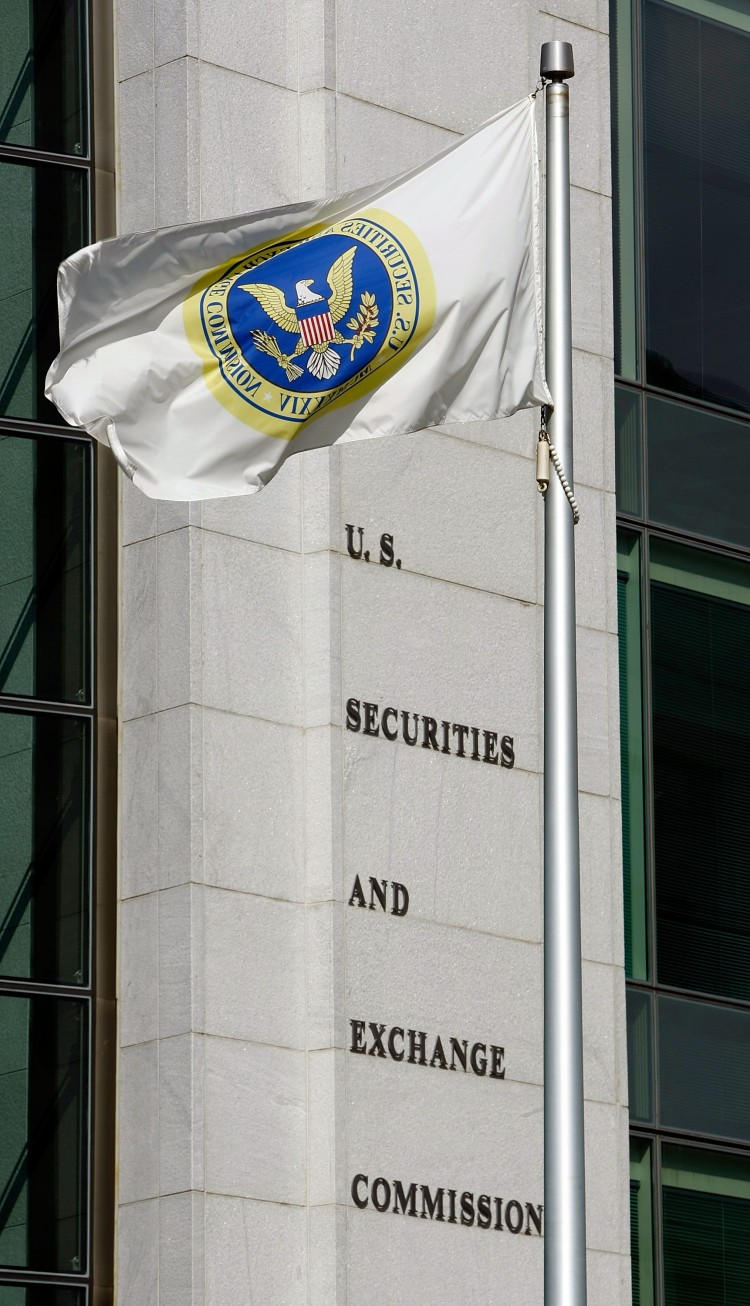
 SEC SUSPENDS TRADING: A flag flies in the wind in front of the U.S. Securities and Exchange Commission building in Washington, DC in this file photo. In 2011, the SEC suspended trading in a number of Chinese Reverse Merger companies for misstatements in public filings. (Chip Somodevilla/Getty Images)
Some Chinese firms have seen the opportunity to take part in stock offerings on international exchanges as a chance to make quick profits through shortcuts and tricks used to fool investors.
The latest trick is that a Chinese operating company merges with an existing U.S. shell company that has been legitimately set up and gone public for access to the investment community. This is called a reverse merger.
“The reverse merger process is a relatively quick way to get listed on a U.S. exchange. A private company is merged into a shell, which is a publicly traded company that is no longer functioning as an operating entity. A share exchange or merger agreement is executed, and within 60–90 days the new company begins trading,” explains a RedChip White Paper.
In layman’s terms, a shell company generally has no real assets or operations and is set up for different legitimate purposes or to commit fraud. On the lawful side, it could just be a well-known company selling its products under a generic name to a discount store, while maintaining the brand name under its known operations. On the more shady side, it could be used as a tax haven, to hide profits, to move illicit profits, for money laundering, and other fraudulent activities.
In investment terms, a Chinese company accesses the U.S. market through the backdoor, under a Chinese Reverse Merger (CRM). This allows the foreign company to be listed on the U.S. stock exchange in a relatively short time and gain access to a large investors’ pool without having to dip into its pockets.
The regular process of entering a stock market is through an initial public offering (IPO), that is, the first sale of stock by a private company, which is a rather time-consuming process.
“A private operating company may pursue a reverse merger in order to facilitate its access to the capital markets, including the liquidity that comes with having its stock quoted on a market or listed on an exchange,” explained the SEC Investor Bulletin on reverse mergers.
Most of the time, during a reverse merger, the two companies swap stocks of both companies, allowing the operating company to become a majority shareholder in the shell company.
SEC Warns Investor Community
“As with any investment, investors should proceed with caution when considering whether to invest in reverse merger companies,” warns the SEC.
Companies that gained access to the U.S. market through reverse mergers may have used a local U.S., international auditing firm, or one of the big four auditing firms (Deloitte Touche Tohmatsu (DTT), PricewaterhouseCoopers, Ernst & Young, or KPMG) to give its financial statements the appearance of legitimacy, transparency, and acceptability to investors.
Some of the smaller auditing firms lack the resources to complete a true accounting audit of a company, as all operations and assets are in a foreign country. Even some of the Big Four, despite having done due diligence, may be hoodwinked because of collusion between banks and the company in the foreign country.
In May 2011, Deloitte Touche Tohmatsu resigned as auditor of Chinese-owned Longtop Financial Technologies Limited, as it discovered after six years of clean audits, that the company’s financial statements were fraudulent. Seeking confirmation of cash balances, DTT for the first time called the Chinese bank’s headquarters, instead of the local bank. There were no cash balances and large amounts of bank borrowing were not reported on the books.
According to its May 22 letter of resignation to Longtop Financial Technologies Limited, filed with the SEC, DTT stated its reasons for resigning as: “1) the recently identified falsity of the Group’s financial records in relation to cash at bank and loan balances (and also now seemingly in the sales revenue); 2) the deliberate interference by the management in our audit process; and 3) the unlawful detention of our audit files.”
China MediaExpress Holdings Inc., a Chinese television advertising operator, announced mid-March that DTT resigned as its auditor on March 11, after having been the company’s auditor since December 2009.
“DTT has lost confidence in the representations of management and also in the commitment of the Board and the Audit Committee to good governance and reliable financial reporting,” according to the SEC.
Next…PCAOB Reverse Merge
 Friends Read Free
Copy
Facebook
Tweet
Friends Read Free
Copy
Facebook
Tweet