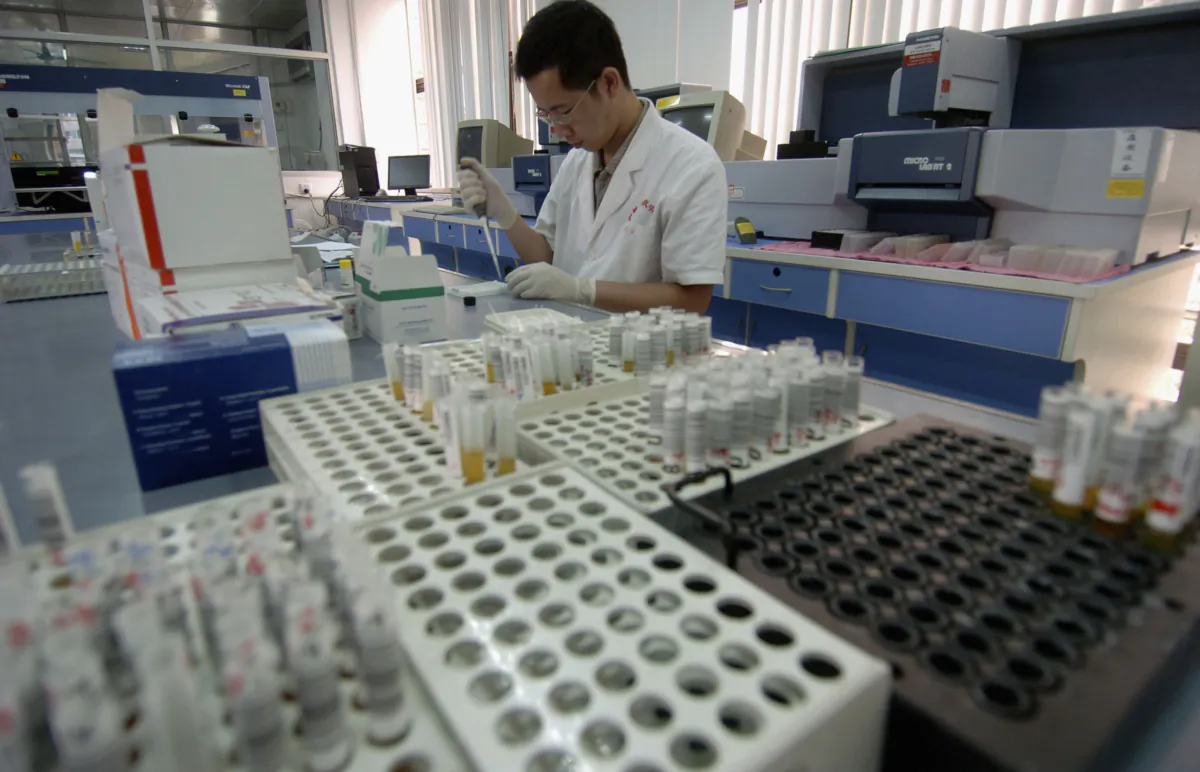
A hospital in southern China is facing criticism after offering interns two days off in exchange for donating blood, while hospital officials sought to identify an intern who publicly questioned the arrangement on social media.
Screenshots circulating on Chinese social media show that interns at Xinyi People’s Hospital in Maoming, Guangdong Province, were asked to register under their real names if they donated blood. Those who donated on the designated day would receive two days of leave. The screenshots were reposted by prominent Chinese-language X account @whyyoutouzhele.
One intern questioned the policy in a social media post.
“Interns have to exchange blood donations for holidays. It’s already bad enough that we get so little time off,” the intern wrote.
After the post began circulating, a person identified as the hospital’s director of its education department appeared to call for the intern to be identified in a work group.
“Which intern posted this? Please come to me voluntarily. Please ask the group leaders from each school to find out who it is. Otherwise, we will directly contact the schools,” the person wrote, according to a screenshot circulating online.
A Vulnerable Position
On March 24, the hospital and the Maoming Central Blood Station held a voluntary blood donation campaign in the hospital’s lobby. The hospital promoted the event as being conducted “under the guidance of Party building.”
The hospital’s public promotion of the campaign did not mention that blood donations would be linked to leave for interns.
Several individuals in China spoke to The Epoch Times regarding the matter on condition of anonymity or only revealing their last name out of fear of reprisal.
A physician surnamed Wang at Nanfang Hospital in Guangzhou, China, told The Epoch Times that interns are subject to both hospital management and evaluations by their schools, putting them in a vulnerable position even when a requirement is not explicitly mandatory.
“Blood donation is a voluntary act. If you make blood donation a condition for exchanging for leave, you are effectively telling students that if they don’t donate blood, they won’t get these two days off,” she said. “Interns generally don’t have much say. They also have to worry about evaluations and comments, and whether they can successfully complete their internships. What is voluntary becomes coercive.”
A former operating-room nurse surnamed Ding, who previously interned at a hospital in Shenzhen, told The Epoch Times that interns typically have little income and few avenues for appealing decisions made by hospitals.
Hospitals can also influence students’ future prospects through internship evaluations, she said.
Ding said the hospital’s threat to contact the schools therefore could place additional pressure on the intern.
“Once an incident became serious, the senior management was not concerned with investigating whether the system was right or wrong. Instead, they would dig to the bottom of it to find the person who reported it,” Ding said about her own internship experience.
“This kind of tactic of punishing one person to warn others makes everyone see the cost of resistance. After that, no matter how much injustice they encounter, they absolutely would not dare say another word.”
A Chinese online commentator told The Epoch Times that the incident illustrates what he described as a broader pattern in China, in which institutions can use evaluations, schools, and an individual’s future prospects as leverage over people in weaker positions.
“When disputes become public, authorities often focus first on identifying those who exposed the problem rather than addressing the underlying issue,” the commentator said.
Xiao Bin contributed to this report.
 Friends Read Free
Copy
Facebook
Tweet
Friends Read Free
Copy
Facebook
Tweet