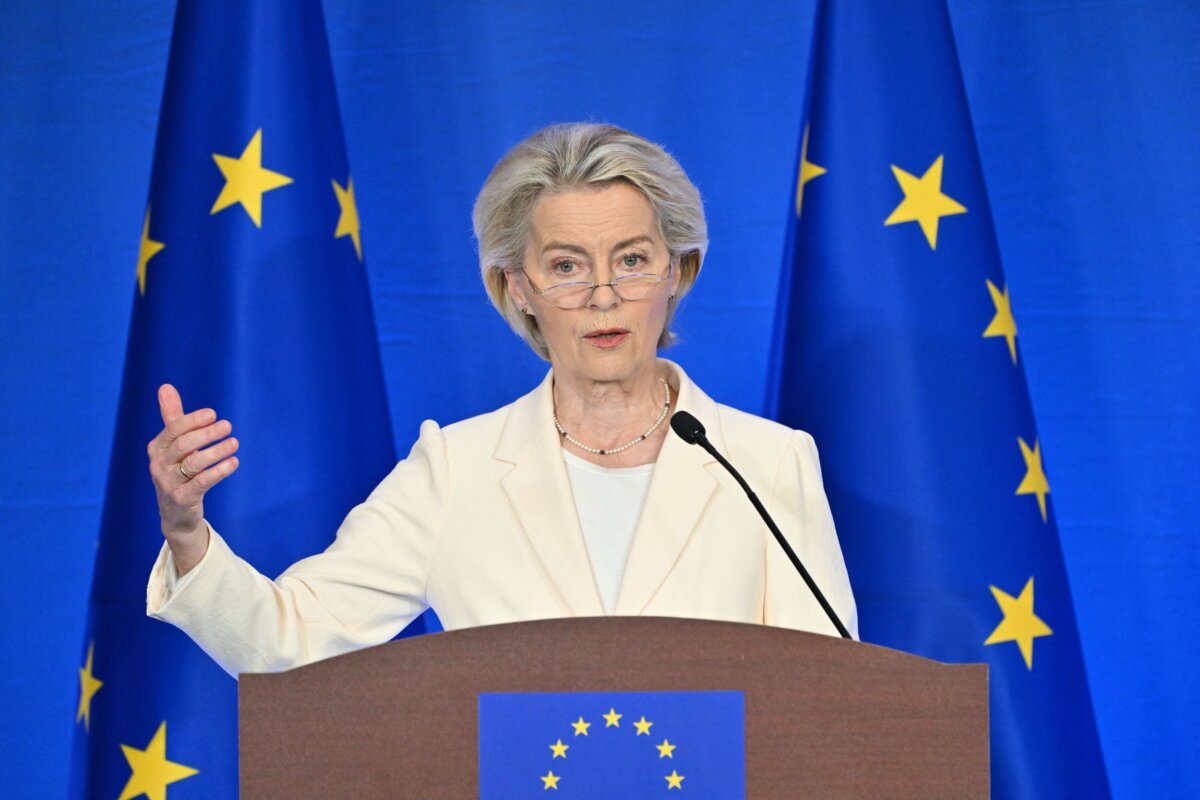

European Commission President Ursula von der Leyen has called on her Chinese counterpart to ensure more balanced trade with Europe as current relations between Brussels and Beijing have reached “an inflection point.”
Von der Leyen, along with European Council President António Costa, was in Beijing on July 24 for the EU–China summit.
In her opening remarks, von der Leyen told Chinese leader Xi Jinping that bilateral cooperation has deepened over the past five decades since the establishment of formal ties.
“But as our cooperation has deepened, so have the imbalances. We have reached an inflection point,” she said.
“Rebalancing our bilateral relations is essential.
“To achieve this, it is vital for China and Europe to acknowledge our respective concerns and come forward with real solutions.”
Speaking to Xi alongside Von der Leyen, Costa called on the Chinese regime to “use its influence on Russia to respect the UN Charter and to bring an end to its war of aggression against Ukraine,” according to his prepared remarks.
Xi, in response, acknowledged that Beijing’s relations with Brussels are now “once again at a critical juncture.”
However, he told European leaders to make a “strategic choice” in the face of what he called “accelerating changes not seen in a century and a turbulent international landscape,” according to a video carried by CCTV, China’s state broadcaster.
Trade tensions between China and the European Union have risen in recent years. A longstanding complaint from Brussels is that Chinese authorities openly subsidize domestic firms across various sectors. EU officials have warned of risks that amid sluggish domestic demand, Chinese companies are flooding EU markets with low-priced electric vehicles, among other products.
Von der Leyen and Costa also stressed the need to balance the trade relationship in a meeting with Chinese Premier Li Qiang on July 24.
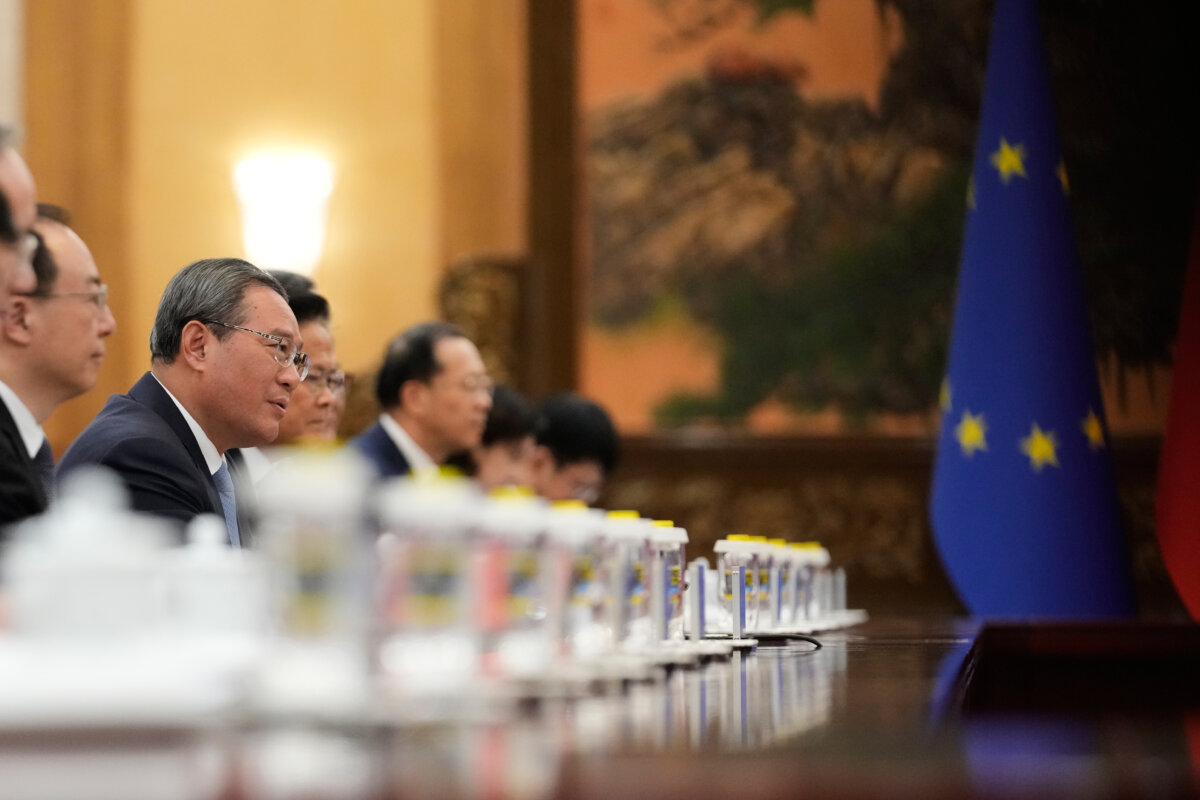
According to the EU’s data, the bloc’s trade deficit with China ballooned to 305 billion euros ($358 billion) in 2024.
In the six months of this year, China exported $267 billion worth of goods to the European Union, while importing $125 billion, Beijing’s customs data showed. The resulting surplus of nearly $143 billion was 21 percent higher than the $118 billion recorded last year.
Further complicating the issues is the Chinese Communist Party (CCP) leader’s relationship with Russia’s Vladimir Putin, which von der Leyen has described as “a determining factor” for EU–China relations moving forward.
During the July 24 summit, EU leaders reiterated their appeal to China to refrain from providing “material support which sustains Russia’s military-industrial base,” according to Brussels’ readout.
The meetings also touched upon the CCP’s human rights violations in the far-western regions of Xinjiang and Tibet, as well as the erosion of fundamental freedoms in Hong Kong.
“Promoting and protecting human rights is a central pillar of the European Union’s engagement with other countries, including with China,” Costa told reporters in Beijing following the summit.
“We reiterated our concerns, and we will continue engaging on this important topic.”
One achievement of the summit, according to von der Leyen, was on the rare earths front, with both sides agreeing to establish “an upgraded export supply mechanism” aimed at addressing issues arising from China’s export restrictions on these critical materials.
“In other words, if there are bottlenecks, this upgraded support supply chain support mechanism can immediately check and solve the problem or the issue that is out there,” she said at the press conference.
 Friends Read Free
Copy
Facebook
Tweet
Friends Read Free
Copy
Facebook
Tweet