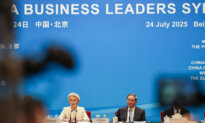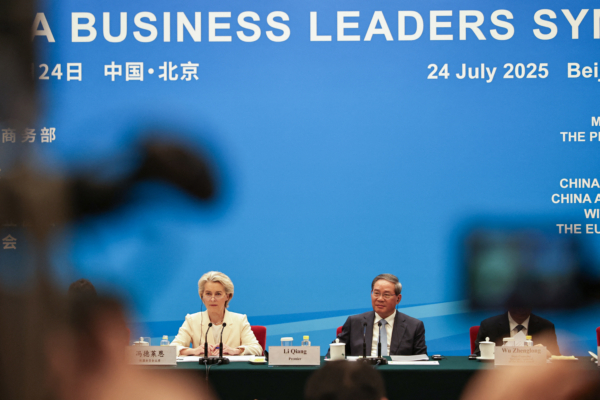
A high-level conference on relations between the European Union and China in Beijing on May 12 descended into unusually sharp exchanges, underscoring mounting tensions over trade imbalances, market access, and industrial policy.
The second Conference on EU–China Relations brought together officials, diplomats, and economists for discussions that quickly turned combative. According to Hong Kong’s pro-China newspaper South China Morning Post, disagreements over Europe’s trade deficit with China and accusations of protectionism dominated the meeting.
The tone escalated during a panel titled “EU–China trade relations, partnership or sinking ship?” when participants openly challenged each other’s interpretations of the economic relationship.
European speakers accused Beijing of ignoring long-standing concerns in Europe over what they described as an increasingly unbalanced trade relationship. Chinese participants, in turn, accused the EU of adopting protectionist policies and attempting to “decouple” from China.
Jens Eskelund, president of the EU Chamber of Commerce in China, sharply criticized Beijing’s position, arguing that it distorts basic economic realities. He said China is flooding European markets with exports while simultaneously accusing the EU of protectionism.
Describing the current trade dynamic, Eskelund said that the relationship is neither a sinking ship nor a partnership, but a “giant container ship loaded with [24,000] containers going to Europe and coming back almost empty,” according to South China Morning Post reporter Finbarr Bermingham.
The remark drew immediate responses from Chinese academics. Jian Junbo, a researcher at Fudan University’s Centre for China-Europe Relations, said Europe’s shift toward decoupling was “unfortunate,” arguing that both sides should “work together to fight protectionism.”
Tensions further escalated after EU Ambassador to China Jorge Toledo criticized Chinese media and government responses to the EU’s Industrial Accelerator Act, calling it the bloc’s first comprehensive industrial strategy. His comments were met with ridicule from a Chinese attendee, who accused him of “a very vivid demonstration of bullying.”
Spanish economist Alicia García-Herrero pushed back, saying that it was inappropriate to accuse an EU ambassador of bullying at an EU-organized conference.
A Structural Shift in EU–China Relations
Two China analysts said the heated exchanges reflect more than diplomatic friction.
U.S.-based China current affairs commentator Wang He told The Epoch Times that the confrontational tone reflects continuity in Beijing’s diplomatic posture rather than a temporary flare-up.
“China’s assertive diplomatic style has not changed,” he said. “It benefits from the system but still takes a hard line against Europe, which the EU is unlikely to accept.”
Davy Jun Huang, a U.S.-based economist and former columnist for Chinese state media outlet CNTV, told The Epoch Times that the confrontation reflects a deeper structural shift in the relationship.
“This is not an isolated diplomatic dispute,” he said. “It is the inevitable result of a long-term structural imbalance in EU–China trade.”
Huang noted that EU policy has shifted from prioritizing economic cooperation to increasingly emphasizing geopolitical risk, industrial security, and technological sovereignty.
According to Huang, the EU is now actively building what he described as “institutional defenses” through legislation such as the Industrial Accelerator Act and tighter scrutiny of Chinese investment in sectors such as electric vehicles, semiconductors, cloud computing, and connected vehicles.
“The EU is increasingly using legal tools, tariffs, and quotas to restrict Chinese firms’ access to sensitive markets,” he said.
The European Commission formally introduced the Industrial Accelerator Act on March 4. The proposal aims to prioritize EU production, strengthen supply chain resilience, and impose new conditions on foreign investment, including higher barriers to acquisitions and to non-EU firms’ participation in public procurement.
Huang said the EU no longer views China purely as a trading partner but increasingly sees it through the lens of industrial security and technological sovereignty.
“The underlying logic of the relationship is being rebuilt,” he said. “It is moving from economic complementarity toward comprehensive defensive positioning.”
He warned that this shift suggests a transition toward a more institutionalized form of economic confrontation.
Wang noted that China’s failure to fully meet commitments made when it joined the World Trade Organization (WTO) has also fueled frustration in Europe, particularly amid weak EU economic growth and rising political pressure.
Trade Imbalances at the Center of Tensions
At the core of the dispute is Europe’s growing trade deficit with China.
Wang argued that the imbalance stems from structural differences between the two economies. Although the WTO framework was designed around free market principles, he said China operates through strong state support for industry, including subsidies and nontariff barriers.
“In practice, every Chinese company has the backing of the Chinese Communist Party,” he said. “That means a European company is effectively competing against a national system.”
He noted that China’s manufacturing expansion—now accounting for more than one-third of global output—has created significant competitive pressure on EU industry.
Shifting global trade dynamics, including U.S. tariffs on Chinese goods, have redirected exports toward Europe, further intensifying friction.
The EU has lodged complaints at the WTO accusing China of engaging in “unfair and illegal” trade practices.
However, Beijing has responded by accusing the EU of protectionism and taking retaliatory measures.
On May 15, China barred cooperation with EU investigations under the bloc’s Foreign Subsidies Regulation, affecting firms such as Nuctech, a Chinese airport-scanning equipment manufacturer.
China has also used its dominance over critical raw materials, including rare-earth exports, as leverage in trade disputes.
Wang said the freezing of the long-stalled EU-China Comprehensive Agreement on Investment reflects a broader strategic miscalculation by Beijing.
“The [Chinese Communist Party] has suffered significant losses from the suspension of the deal,” he said. “But instead of reassessing its approach, it continues to blame the EU.”
Huang warned that EU–China tensions are likely to deepen further.
He said Beijing’s long-standing strategy of maintaining strong ties with Europe to offset U.S. tariff pressures has largely failed.
Huang pointed to three key drivers behind the deterioration.
First, the geopolitical fallout from the Russia–Ukraine war has heightened European security concerns. Second, concerns over Chinese industrial overcapacity are affecting global markets, particularly in electric vehicles, steel, and solar products. Third, the cumulative effect of economic competition and geopolitical rivalry is transforming trade disputes into broader strategic friction.
“The likelihood of a trade war breaking out is now approaching a critical threshold,” Huang said, warning that future confrontation could span multiple sectors simultaneously.
Li Jing and Luo Ya contributed to this report.
 Friends Read Free
Copy
Facebook
Tweet
Friends Read Free
Copy
Facebook
Tweet