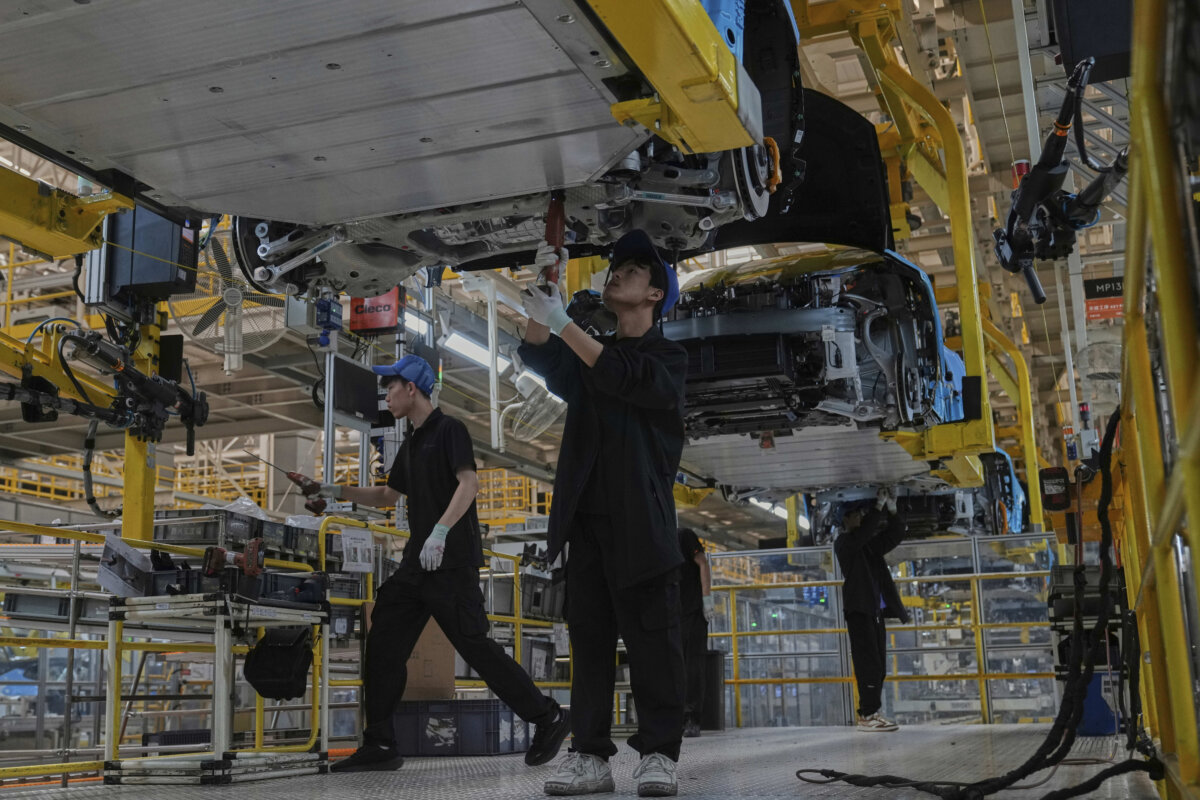
Labor disputes at two manufacturing plants in China a few days ago erupted into walkout protests as workers became increasingly dissatisfied with layoffs, unpaid wages, and compensation disputes amid slowing economic growth and factory restructuring.
In Dalian, Liaoning Province, around 600 workers at an electronics plant formerly operated by Japan’s ROHM Semiconductor took part in a strike and march on May 22, protesting what they described as an unfair compensation plan following the company’s transfer to a Chinese owner.
Separately, in Zhejiang Province, workers at an electric vehicle (EV) manufacturer in Qingtian county staged a collective work stoppage on May 26, alleging wage deductions and excessive working hours.
Freedom House reported in August last year that protests in China appear to be increasing, especially labor protests amid a broader economic downturn under the communist regime.
Workers Protest After Ownership Transfer
Workers at ROHM Electronics Dalian gathered outside the factory to protest uncertainty over how their employment status would be treated after the ownership change.
Video footage circulating online showed workers in yellow uniforms marching along a nearby road in an industrial area.
The dispute centers on whether years of service accumulated under the Japanese-owned company would be recognized after the transfer, or whether workers would have their seniority and benefits reset or partially terminated under the new ownership structure.
Workers demanded that compensation be calculated in accordance with China’s labor laws and existing employment protections.
Japan-based ROHM Semiconductor announced on May 12 that it would transfer its wholly owned Dalian subsidiary—ROHM Electronics Dalian Co. Ltd., which manufactures electronic components—to a Chinese firm under the Dalian Pengcheng Group.
Labor rights advocates say disputes of this kind are common when foreign-owned factories are sold or restructured in China.
A labor rights activist in Shenzhen, identified only by his surname Wang out of fear of reprisal under the communist regime, told The Epoch Times that such disputes often arise when ownership changes trigger uncertainty over worker entitlements.
He noted that while some foreign-invested firms occasionally face labor disputes, they are more frequently reported in Chinese companies.
“When a foreign company is transferred to a Chinese owner and problems emerge, it’s confusing for many people,” Wang said. “Japanese companies rarely have strikes like this in China. Most legal labor disputes in recent years have involved Chinese firms.”
Another labor advocate in Guangdong Province, speaking on condition of anonymity out of fear of reprisal, told The Epoch Times that workers are typically most concerned about three issues during ownership transitions: whether years of service will be “bought out,” whether employment contracts must be re-signed, and whether existing benefits will be preserved.
“If the transaction is treated purely as a corporate transfer or equity deal, the new operator may try not to pay for prior seniority,” he said. “That is where worker dissatisfaction begins.”
The labor advocate added that strikes often occur after other channels of complaint fail.
“My assessment is they likely approached labor authorities first,” he said. “If no action is taken, workers resort to protests. In China, issues often only receive attention once they escalate.”
Wage Disputes at Chinese Factory
In a separate incident days later, workers at EV manufacturer Aima Technology Group Co. Ltd. in Qingtian County, Zhejiang Province, halted production to protest wage deductions.
Online posts alleged that workers were required to work up to 13 hours per day in April, while take-home pay averaged just over 5,000 yuan ($738), with some employees reporting deductions ranging from several hundred to over 1,000 yuan ($148).
Local authorities and the company had not issued public statements confirming or responding to the allegations at the time of reporting.
The recent strikes come amid a wider pattern of restructuring in China’s manufacturing base, including factory relocations, ownership transfers, and cost-cutting measures.
A Chinese academic based in Japan using the pseudonym Liu, out of fear of reprisal from the communist regime, told The Epoch Times that many foreign companies in China are reconsidering their long-term presence in the country as operational risks increase due to geopolitical struggles.
Wang Yibo contributed to this report.
 Friends Read Free
Copy
Facebook
Tweet
Friends Read Free
Copy
Facebook
Tweet