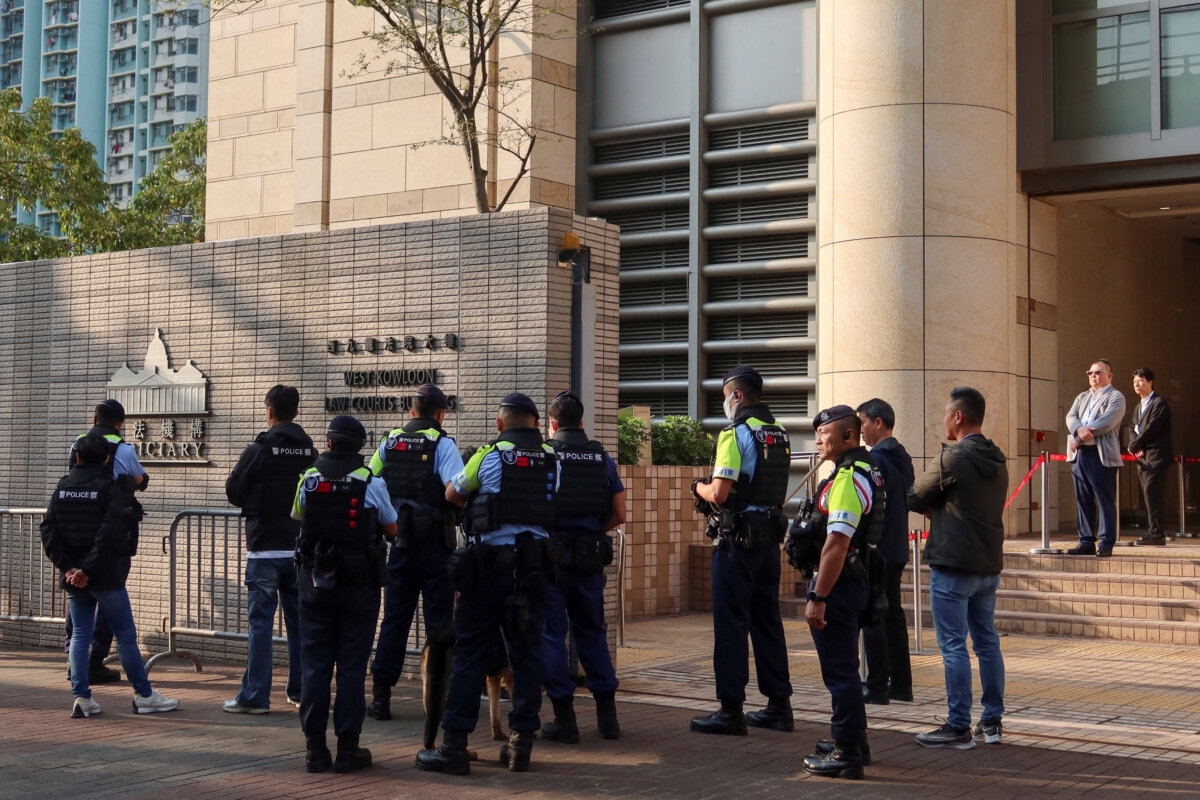

A Hong Kong court on Feb. 23 upheld the prison sentences and convictions of 12 pro-democracy activists, rejecting their appeals in a national security case that has drawn international attention as freedoms in the city continue to erode.
The appeal stems from the high-profile “Hong Kong 47” case, in which 47 opposition figures were arrested in 2021 and charged with conspiracy to commit subversion. After lengthy court proceedings, 45 of those activists were sentenced to between four and 10 years in November 2024, and two others were acquitted. The case drew international criticism from rights groups and from some countries, including the United States, the UK, and Canada.
The subversion charge relates to their participation in and organization of unofficial primary elections in mid-2020 to pick the strongest candidates for a legislative council election. The elections coincided with the anti-Chinese Communist Party (CCP), pro-democracy movement of 2019 and 2020, which started when millions took to the streets of Hong Kong in June 2019.
Eleven democrats lost their appeals against their convictions. They included former lawmakers Helena Wong, Lam Cheuk-ting, Raymond Chan, and “Long Hair” Leung Kwok-hung; former district councilors Clarisse Yeung, Kalvin Ho, and Tat Cheng; and activists Gwyneth Ho, Owen Chow, Winnie Yu, and Gordon Ng.
The democrats—with the exception of Ho, who only appealed her conviction—and one other activist, Prince Wong, also failed in their appeals against their sentences.
Additionally, Hong Kong’s Department of Justice lost its appeal against Lawrence Lau, a former district councilor who was one of the two acquitted in the “Hong Kong 47” case.
Three Court of Appeal judges—Jeremy Poon, Anthea Pang, and Derek Pang—wrote in their Feb. 23 judgment that the defendants were part of a conspiracy “conceived, advocated, and pursued” by legal scholar Benny Tai to engineer a “constitutional mass destruction weapon” with the goal of “toppling the constitutional order” in Hong Kong.
Tai, who was one of the defendants in the case, was sentenced to 10 years in prison in November 2024.
Leung’s wife, Chan Po-ying, an activist who was not connected with the case, said the court’s decision was not grounded in the facts. She argued that the defendants’ actions were consistent with Hong Kong’s mini-constitution, the Basic Law.
“It already presumed these people had intended to subvert the state’s power,” she said.
Amnesty International Hong Kong overseas spokesperson Fernando Cheung said in a Feb. 23 statement that the ruling “underlines the grave state of human rights” in the former British colony.
“None of these 12 defendants committed an internationally recognized crime; they have been serving lengthy sentences simply for exercising their rights to freedom of expression, association, and participation in public affairs,” Cheung said.
“By failing to overturn these wrongful convictions and sentences today, the court has missed a critical opportunity to correct this mass injustice.”
“Peaceful opposition to a government is not a crime,” Cheung added, before urging that all remaining jailed activists in the case should be “released immediately and unconditionally.”
Currently, 18 of the 45 people convicted in the case have been released after completing their prison sentences. Among them were former district councilors Lester Shum and Jimmy Sham.
Australian Foreign Minister Penny Wong said in a statement that she was “deeply concerned” that Ng, an Australian citizen, had lost his appeal. Wong added that the Australian government has “expressed [its] strong objections to Chinese and Hong Kong authorities on the continuing broad application of national security legislation.”
“The Australian Government will continue to advocate at senior levels in support of Mr Ng’s best interests and welfare and has sought consular access to Mr Ng,” Wong said in the statement.
To quell the street protests from 2019 to 2020, the CCP bypassed Hong Kong’s legislature and on June 30, 2020, imposed a national security law on the city, which punishes vaguely defined crimes such as secession and subversion with a maximum penalty of life imprisonment.
In March 2024, the Hong Kong government further tightened control on the city after passing a sweeping new national security law known as Article 23. The law targets political crimes such as treason and insurrection, which may be punished by life imprisonment.
In another national security case, Jimmy Lai, a former Hong Kong media mogul and outspoken critic of China’s communist regime, was sentenced to 20 years in prison in early February.
Lai’s sentence drew international condemnation, including from the United States, the UK, the European Union, Australia, and Taiwan.
The Associated Press and Reuters contributed to this report.
 Friends Read Free
Copy
Facebook
Tweet
Friends Read Free
Copy
Facebook
Tweet