
News Analysis
Five years after the CCP enforced the Hong Kong National Security Law (NSL), Hong Kong’s press freedom has declined, moving toward that of communist mainland China.
In the 2025 World Press Freedom Index released by Reporters Without Borders in May this year, Hong Kong scored 39.86 points, ranking 140th out of 180 countries and territories, the lowest rating it has ever received. China sits at 178.
Foreign media outlets have withdrawn from Hong Kong and local media have faced heavy suppression by the regime. Journalists have been criminally charged and imprisoned, and several online news platforms have shut down. As a result, Hongkongers have lost access to diverse sources of information. Current reporters and columnists are also forced to practice self-censorship under mounting pressure.
The 2024 promulgation of the Safeguarding National Security Ordinance (Article 23) by Hong Kong authorities further expanded the legal threats facing journalists, including potential charges of “espionage,” “theft of state secrets,” and “external interference.”
In last year’s report, Reporters Without Borders said at least 900 journalism jobs being lost, many of which were moved overseas, since the NSL was enacted on June 30, 2020.
Several Media Outlets Closed, Executives Jailed
Shrouded in the oppressive atmosphere of the NSL, several news media outlets shut down in the city between 2020 and 2022.
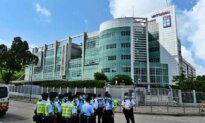
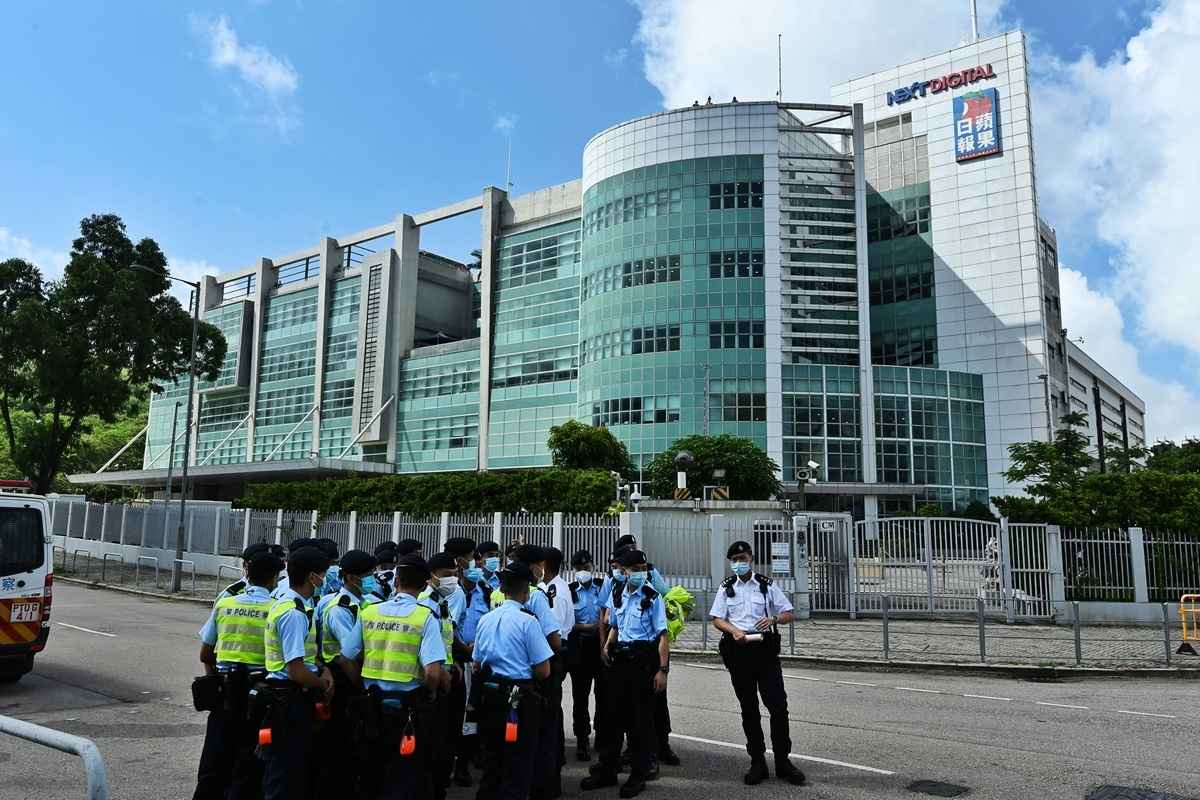
Authorities arrested Lai Chee-ying, founder of One Media, together with other executives of the group on Aug. 10, 2020. The One Media building, where Apple Daily and its weekly journal had their offices, was raided by more than 200 police officers sent to search the premises for violations of the new law.
On June 17, 2021, the police again deployed more than 500 personnel to search Apple Daily and took into custody Cheung Kim-hung, then-CEO of One Media, One Media Group’s chief operating officer Chow Tat-kuen, Apple Daily’s deputy chief editor Chan Pui-man, editor-in-chief Ryan Law Wai-kwong, and Apple News platform director Cheung Chi-wai.
On June 24, 2021, the last issue of Apple Daily was published, with the front page titled “Hong Kongers Farewell in the Rain, We Support Apple,” with a print run of 1 million copies.
Lai Chee-ying, Cheung Kim-hung, Chan Pui-man, Law Wai-kwong, former executive editor-in-chief Lam Man-chung, former English-language executive editor-in-chief Fung Wai-kwong, and former chief writer Yeung Ching-kei were later charged with “conspiring to collude with foreign or overseas forces to endanger national security,” and “conspiracy to publish, promote, sell, offer to sell, distribute, display or reproduce seditious contents.”
Of the seven, only Lai Chee-ying pleaded not guilty, and the case was postponed to Dec. 18, 2023. After a 146-day trial, closing arguments are scheduled for Aug. 14.
Even with the unfavorable precedent of Apple Daily, several media outlets persisted.
But in December 2021, Stand News former editor-in-chief Chung Pui-kuen and then acting editor-in-chief Patrick Lam Shiu-tung by the National Security Department of the Hong Kong Police on suspicion of “conspiring to publish a seditious content.” Stand News actively reported and conducted many live broadcasts during the anti-extradition movement.
The Hong Kong government used long-forgotten laws to accuse media organizations of incitement for the first time since the transfer of sovereignty in 1997.
Chung was sentenced to 21 months in prison, while Lam’s sentencing starting point was 14 months. However, due to health issues, the judge allowed Lam to be released immediately. Lam later appealed his conviction. National security-designated judge Kwok Wai-kin rejected the argument that the defendants were simply carrying out their journalistic duties, claiming instead that they were “participating in what was then called the protest movement.”
Chung was released on July 10 this year after completing 21 months in prison without a third of his prison terms reduced, as is usually granted to inmates with good behavior.
Another well-known online media outlet, Citizen News, stopped operations after the Stand News manhunt, saying, “We are in the eye of the storm. Our small boat is in a serious situation amid high winds and waves. In a crisis, we must first ensure that everyone on board is safe and sound.”
Foreign Media Pull Out
As the authorities have cracked down on so-called dissent under the NSL and Article 23 of the Basic Law, foreign media outlets have gradually withdrawn from Hong Kong.
After the implementation of the NSL, The New York Times reported in July 2020 that some staff had encountered obstacles when applying for work permits in Hong Kong. Citing concerns over the chilling effect of the law on media organizations, the paper announced it would gradually relocate its “digital news team” of reporters and editors from Hong Kong to Seoul, South Korea, over the following year.
In March 2024, Hong Kong promulgated the Regulation on Maintaining National Security under Article 23 legislation. On March 29, Radio Free Asia (RFA) announced that it had decided to release all its full-time employees in Hong Kong and closed its physical offices in response to the legislation and enforcement of Article 23. Then-Secretary for Security Chris Tang Ping-keung criticized RFA’s reports by name, as well as its funding from the U.S. government and that it used “inaccurate news” to incite public distrust of the local government. Tang alleged that RFA’s office closure in Hong Kong was due to “criminal intent.”
By May 2024, the Wall Street Journal informed its employees through internal memos that it was moving its Asian headquarters. Its editor-in-chief Emma Tucker said in an internal circular at the time, “We are shifting our center of gravity in the region from Hong Kong to Singapore, as many of the companies we cover have done.”
Self-Censorship of Remaining Media
Since the introduction of the NSL, there have been significantly more government departments and officials criticizing the media than before the law came into effect.
Since 2022, Zunzi Comics, which have been published in Ming Pao for 40 years, has been named six times by different government departments for “damaging Hong Kong’s image,” “misleading,” and “defaming” the principles of the government’s appointed Area Committees and the District Fight Crime and Fire Safety Committees. By May 2023, the editorial board of Ming Pao announced the discontinuation of its Zunzi Comics strip.
In July last year, the Correctional Services Department issued a statement condemning the “falseness” of an opinion article written by former HKU Law School dean Chan Man-min in Ming Pao. Tang followed up by singling out a columnist for frequently publishing what he said were biased articles.
In August last year, Ming Pao’s editor-in-chief, Dominic Lau Chung-yeung, sent an email to the paper’s columnists, urging them to “lend us a hand” by exercising greater caution in their writing. He stressed that commentary must be based on accurate facts, comply with the law, and observe proper boundaries.
“Otherwise,” he warned, “there’s no guarantee that a crisis won’t suddenly arise one day.”
65 Percent of Journalists Self-Censoring
The Foreign Correspondents’ Club, Hong Kong, published a survey in April this year saying that of the 69 journalists they surveyed, 62 percent or 43 of them said their working environment as journalists in Hong Kong had become worse since the last survey in July 2023. The NSL, along with related prosecutions and the withdrawal of international news organizations, is widely seen as the driving force behind this shift.
Sixty-five percent of respondents, or 45 individuals, said they had engaged in self-censorship over the past 18 months, with 12 journalists reporting they had done so “considerably.”
The survey also found that 16 percent of respondents said they encountered minor interference while reporting, with one saying they encountered significant interference.
On March 27 this year, the UK government released its six-monthly report on Hong Kong, covering the period from July to December 2024. The report highlighted the continued deterioration of freedoms and human rights in Hong Kong, including the worsening media environment.
Examples cited included senior staff at Apple Daily being charged under the National Security Law with “conspiracy to collude with foreign forces,” the conviction of Stand News editors on sedition charges, and the temporary suspension of The Epoch Times’ printing operations.
Newsstands Selling The Epoch Times Harassed
On Sept. 17, 2024, the Hong Kong Epoch Times stopped distributing physical newspapers because its printing venue could not renew its lease and only resumed printing the weekend edition earlier this year. In February this year, several newspaper stalls selling The Epoch Times received anonymous letters threatening to report them for allegedly “endangering national security.”
The Hong Kong Journalists Association held a press conference in September 2024, saying that dozens of journalists and their families were harassed in different ways from June to August last year. At least members of 15 families, the organizations they belong to, or their employers and partner organizations have received complaint emails and letters from self-identified “patriots.”
The complaint emails and letters included complaints alleging that journalists and their family members posed a “risk to national security,” as well as requests for their employers to terminate them. At least 36 other journalists were “named” online, with some accused of inciting through their writing—several even received violent or death threats.
 Friends Read Free
Copy
Facebook
Tweet
Friends Read Free
Copy
Facebook
Tweet