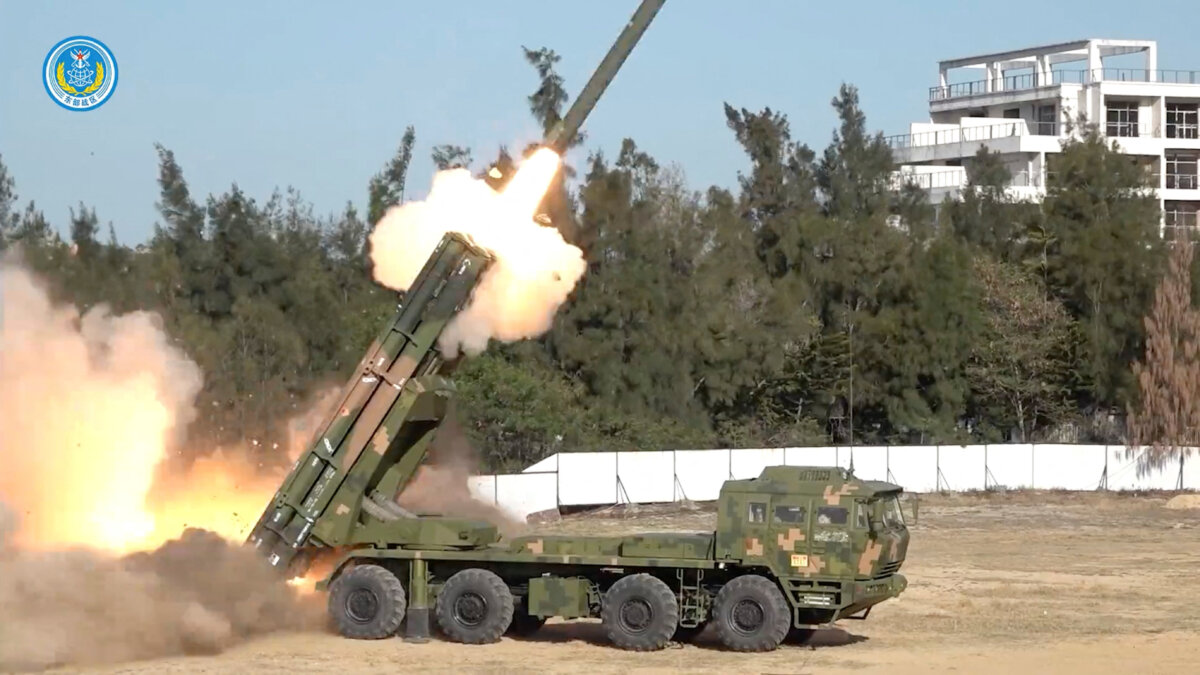

China staged massive live-fire military drills all around Taiwan on Monday and Tuesday, drawing criticism from multiple countries and prompting an official response from Japan, which said the drills have heightened tensions in the Taiwan Strait.
In a statement released Jan. 1, the Japanese government said it had conveyed its concerns to Beijing, warning that the exercises increase tensions in the region.
Toshihiro Kitamura, a press secretary for Japan’s Ministry of Foreign Affairs, outlined Tokyo’s position in a three-point statement published on the ministry’s website.
“The recent military exercises conducted by the Chinese military around Taiwan constitute actions that increase tensions across the Taiwan Strait, and the Government of Japan has conveyed its concerns to the Chinese side,” Kitamura said.
He added that Japan’s longstanding position is to seek a peaceful resolution of the Taiwan issue through dialogue, stressing that peace and stability in the Taiwan Strait are “important for the international community as a whole.” Japan, he said, will continue to closely monitor developments with strong interest.
Military Drills and Broader Fallout
The drills, conducted by the Chinese military earlier this week, involved large numbers of fighter aircraft and naval vessels and included live-fire exercises. The maneuvers simulated a blockade of Taiwan’s major ports and attacks on maritime targets.
Japan’s response to the military drills came amid already strained ties between Tokyo and Beijing. Relations have deteriorated in recent weeks following remarks by Japanese Prime Minister Sanae Takaichi, who said, during a parliamentary session on Nov. 7, that a military conflict in the Taiwan Strait could be considered a “survival-threatening situation” for Japan.
Her comments were widely viewed as a legal interpretation for Japan to exercise its right to collective self-defense and potentially deploy forces if a Taiwan conflict were to occur.
However, China responded with a series of retaliatory measures, including issuing warnings to Chinese citizens against traveling to Japan, suspending efforts to resume imports of Japanese seafood, and halting approvals for new Japanese films. Beijing also demanded that Takaichi retract her remarks, a request she rejected.
Takaichi said the Japanese government would make a comprehensive assessment based on all available information and the specific circumstances of any situation that threatens Japan’s survival.
Yasuhide Nakayama, a ruling party lawmaker and former assistant defense minister, defended Takaichi’s comments in a post on X, saying that speaking candidly about security realities is not provocation but a right of sovereign nations.
The diplomatic fallout has begun to affect economic exchanges. On Wednesday, a roughly 200-member delegation representing Japan’s three major business organizations announced it had postponed a planned January visit to China, according to Kyodo News.
The groups—the Japanese Business Federation, the Japan-China Economic Association, and the Japan Chamber of Commerce and Industry—informed members that the trip was unlikely to yield “substantive results” under current conditions. No new date for the visit was announced.
Zhang Ting contributed to this report.
 Friends Read Free
Copy
Facebook
Tweet
Friends Read Free
Copy
Facebook
Tweet