
Leaked messages and notices related to China’s high-profile “520” marriage registration events have been circulating in Chinese journalist chat groups in recent days, according to internal information obtained by The Epoch Times. Chinese state-run media outlets have avoided covering the allegations.
The materials, reposted online by Chinese netizens, appeared to show recruitment notices seeking young men and women to “pretend to be couples” at marriage registration events organized by local civil affairs bureaus.
The allegations surfaced around May 20—known in China as “520” because the numbers sound similar to “I love you” in Mandarin. The date has become one of the country’s busiest annual occasions for marriage registrations, often accompanied by government-sponsored ceremonies and publicity campaigns.
However, online discussions this year surrounding several “520” events focused less on romance than on whether some of the crowds themselves had been staged.
One widely circulated set of images showed a heavily promoted marriage registration event held in Zhengzhou, China.
Photos of the event showed rows of young men and women standing in line or posing for cameras, with some social media users questioning the mood of those captured in the images.
One screenshot, shared online, showed what appeared to be a message from an internal community work group advertising what it called a “pure welfare project.” The notice requested 30 men and 60 women for a May 20 civil affairs bureau event.
Their assignment, according to the message, was to “pretend to be couples waiting in line.”
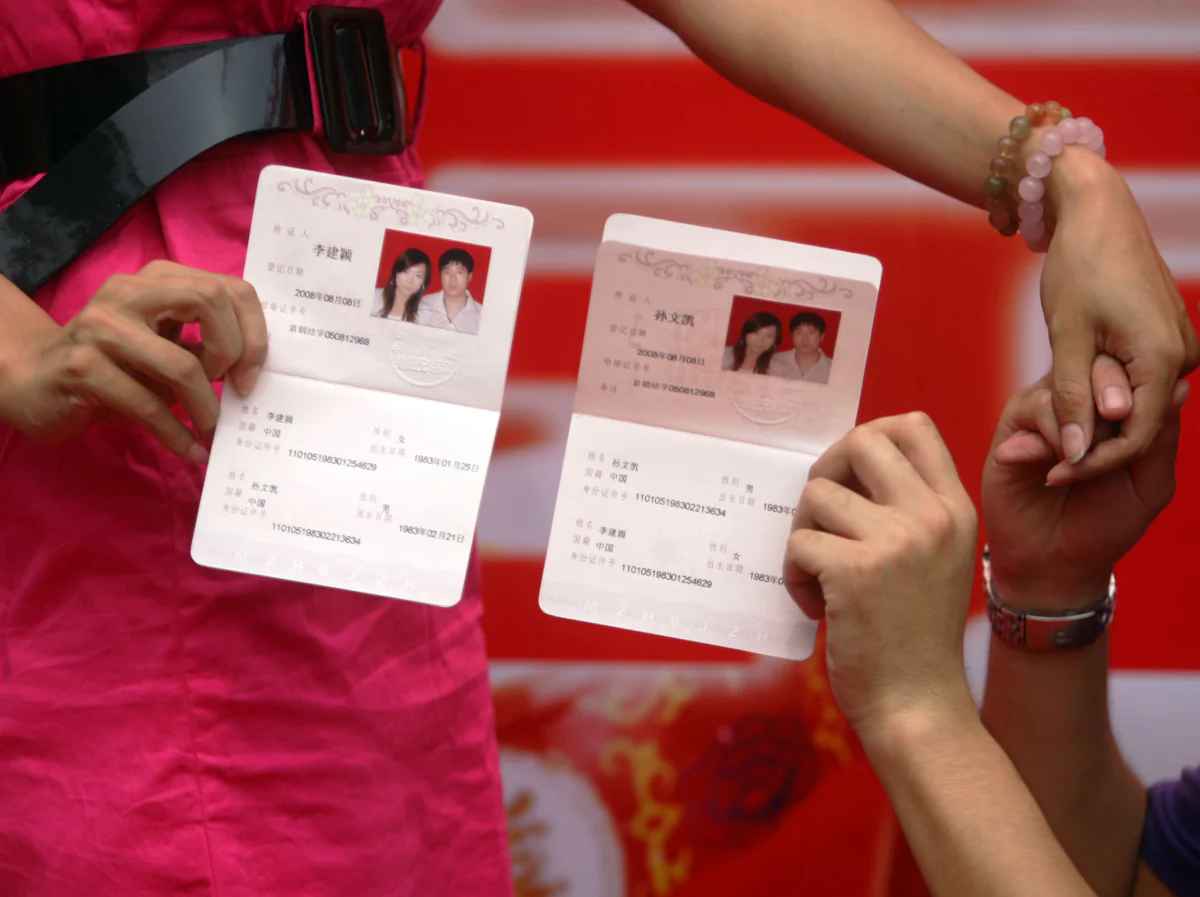
The notice also stated that participants would be provided with fake marriage certificates “for display only,” and instructed them to speak positively about the civil affairs bureau if interviewed by television reporters. Participants who cooperated well, the message said, would receive cash gifts.
The post added that “TV stations and senior leaders” would be present and included appearance requirements for recruits, telling them not to dye their hair or wear certain hairstyles.
The authenticity of the screenshots could not be independently verified.
China’s marriage numbers have been falling for most of the past 13 years, according to data compiled by the National Bureau of Statistics of China. Registrations peaked at 13.47 million couples in 2013, then declined almost without interruption, reaching 6.83 million in 2022. They bounced back to 7.68 million in 2023 before dropping sharply to 6.106 million in 2024—a 20.5 percent decline in a single year. Full-year 2025 reported a modest uptick to 6.76 million.
Allegations of Staged Crowds
A couple of residents in China spoke to The Epoch Times on condition of anonymity out of fear of reprisal.
A resident of Zhengzhou said to the publication, “Young people can’t afford to get married anymore. Many are still relying on their parents financially. Civil affairs officials are anxious too.”
She added that in some places “there may be more government employees than people registering for marriage.”
Not all regions, however, appear to be struggling to attract applicants on major wedding registration days. According to a report published earlier this month by Guangzhou Daily via Chinese news portal Sohu, all available appointment slots for May 20 at 15 marriage registration offices across Guangzhou had already been booked by May 8.
Still, some civil affairs workers acknowledged that local offices have become increasingly sensitive about declining registration numbers.
An employee at a civil affairs bureau in Shenyang told The Epoch Times that staff members sometimes encourage couples to postpone registrations until symbolic dates such as May 20 or May 21 to improve official statistics and create busier-looking events.
“Normally, there really aren’t that many people registering,” the employee said. “Our superiors give us targets, but we can’t force people to get married.”
Another social media post, written by a participant from Inner Mongolia province, described being recruited to help “fill out the numbers” at a civil affairs bureau event.
The participant said organizers initially described the appearance as a brief favor lasting only 20 minutes. But after arriving, she said, television crews filmed close-up shots of her without warning.
“Friends and family saw the footage and thought I had actually gotten married,” she wrote online.
When she later asked organizers to remove the images, she said intermediaries told her the footage could not be deleted because doing so might lead to accusations that the event had been staged.
China’s marriage rate has been falling for years, contributing to broader concerns over declining birth rates and long-term demographic decline. In response, local governments across the country have introduced marriage and childbirth subsidies, organized collective weddings, and experimented with destination-style marriage registration programs at tourist attractions.
According to statistics released May 9 by China’s Ministry of Civil Affairs, nearly 1.7 million couples registered for marriage nationwide during the first quarter of 2026, while 622,000 couples filed for divorce, according to a Chinese internet news portal.
Chinese media calculations based on the official data showed that marriage registrations fell by roughly 113,000 couples compared with the same period in 2025—a decline of more than 6 percent.
Arthur Zhang and Wang Xin contributed to this report.
 Friends Read Free
Copy
Facebook
Tweet
Friends Read Free
Copy
Facebook
Tweet