
The Taiwanese military has established a new battery equipped with a new U.S.-supplied rocket system, boosting the island’s self-defense capability in the face of China’s military threat.
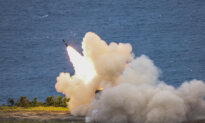
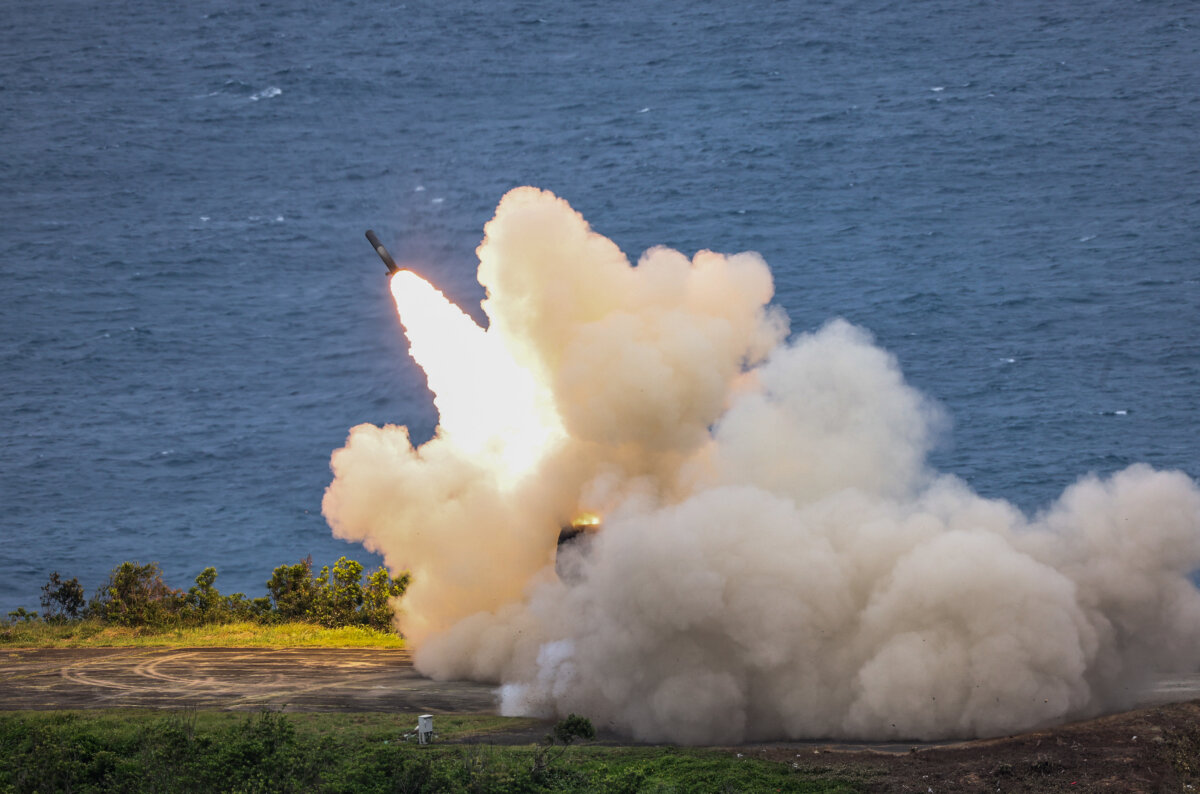
Wellington Koo, Taiwan’s defense minister, presided over the battery’s formation ceremony in central Taiwan’s Taichung city on July 4. The battery, equipped with Lockheed Martin’s High Mobility Artillery Rocket System (HIMARS), is part of the Army’s 58th Artillery Command. It’s Taiwan’s first HIMARS battery.
The United States is Taiwan’s biggest arms supplier. Taiwan has purchased 29 HIMARS launchers and received the first 11 units in 2024. In May, the 58th Artillery Command conducted the first live firing of the HIMARS system.
At the ceremony, Woo said the new battery will enhance Taiwan’s military strike capability and overall defense combat effectiveness, thereby achieving the objective of deterrence and safeguarding national security, according to Taiwan’s Ministry News Agency, which is run by the island’s Ministry of National Defense.
Woo added that the HIMARS system represents an important breakthrough in the long-range precision strike capability of Taiwan’s military.
HIMARS has a range of about 186 miles, meaning that Taiwan could hit coastal targets in southern China’s Fujian Province in the event of conflict. China and Taiwan are separated by the Taiwan Strait, a body of water 80 miles wide at its narrowest.
Woo revealed that HIMARS will be part of the weaponry used during future annual Taiwan military drills called Han Kuang.
This year’s Hang Kuang exercises will last 10 days beginning on July 9, twice as long as previous drills, with a particular focus on simulating the Chinese military’s use of gray zone tactics leading up to an invasion of the island.
The Chinese Communist Party sees Taiwan as a part of its territory and is aiming to seize the self-governing island in the name of “national rejuvenation.” Contrary to Beijing’s territorial claim, Taiwan is a de facto independent country with its own democratically elected government, constitution, and currency.
Taiwanese President Lai Ching-te visited the Army’s 58th Artillery Command in June, accompanied by Woo, Commander of Army Headquarters General Lu Kun-hsiu, National Security Council chief Joseph Wu, and other military officials.
In May, at the Shangri-La Dialogue in Singapore, U.S. Defense Secretary Pete Hegseth spoke about the importance of maintaining peace across the Taiwan Strait.
“Every day you see it. China’s military harasses Taiwan. These activities have been paired with China’s rapid military modernization and buildup–including huge investments in nuclear weapons, hypersonics, and amphibious assault capabilities,” Hegseth said at the time.
“It’s public that [Chinese leader Xi Jinping] has ordered his military to be capable of invading Taiwan by 2027,” Hegseth added. “Any attempt by Communist China to conquer Taiwan by force would result in devastating consequences for the Indo-Pacific and the world.”
In 2022, about 48 percent of the world’s 5,400 container ships passed through the Taiwan Strait, according to the Council on Foreign Relations.
In recent years, China has routinely dispatched military planes and vessels to areas near Taiwan.
In the 24 hours ending at 6 a.m. local time on July 5, Taiwan’s defense ministry reported that it had detected 18 Chinese military planes and 11 vessels in the island’s vicinity.
Reuters contributed to this report.
 Friends Read Free
Copy
Facebook
Tweet
Friends Read Free
Copy
Facebook
Tweet