
TAIPEI, Taiwan—Taiwan’s opposition leader arrived in China on April 7 for a six-day visit, a trip that has sparked debates amid the Chinese regime’s escalating political and military coercion against the island.
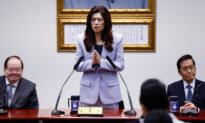
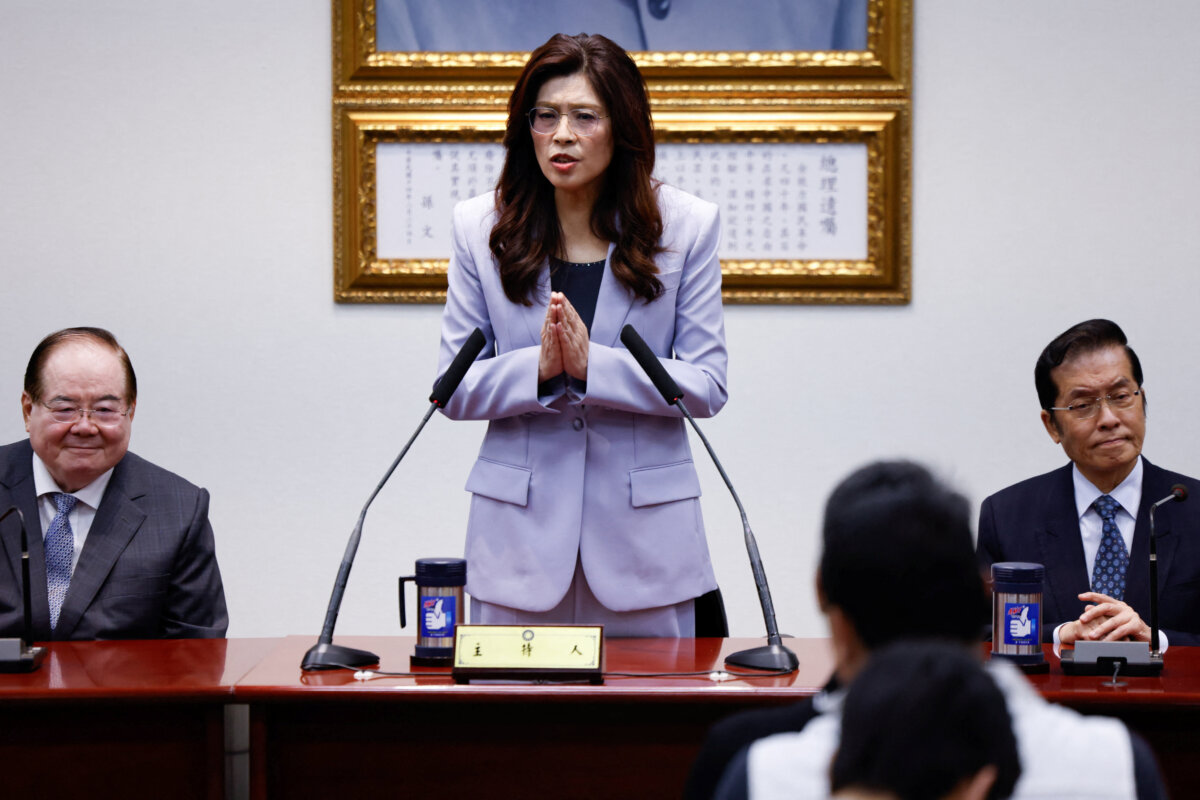
Cheng Li-wun, chairwoman of Taiwan’s largest opposition party, the Kuomintang (KMT), led a delegation arriving at the Hongqiao Airport in Shanghai on Tuesday afternoon (local time), welcomed by a group of Chinese Communist Party (CCP) officials that included Song Tao, director of the China’s Taiwan Affairs Office, according to the KMT’s Facebook page.
Soon after arrival, Cheng and her delegation, accompanied by Song, boarded a local train bound for Nanjing, the capital of coastal Jiangsu Province.
Cheng made the trip to China at the invitation of Chinese leader Xi Jinping. However, there has been no official announcement of a meeting between the two.
Before leaving Taiwan on Tuesday, Cheng held a press conference, saying that she was embarking on a “historic journey for peace.” It marks the first trip by a KMT leader to China since 2016.
“If you truly love Taiwan, you will seize even the slightest opportunity, every possibility, to ensure Taiwan is not ravaged by war,” Cheng said, according to a translation.
Cheng suggested that the “success” of her trip could transform Taiwan from “the most dangerous place in the world into the safest in the world.”
The CCP views Taiwan as a part of its territory and is rapidly modernizing its military in an effort to take the island by force or compel it to submit to its rule.
The timing of the Cheng’s trip has drawn intense scrutiny, as it comes amid a rare political crisis in Taiwan involving the ruling Democratic Progressive Party (DPP) and the opposition. The opposition—which consists of the KMT and its much smaller ally, the Taiwan People’s Party (TPP)—has used its majority in parliament to block or stymie key government proposals, including the budget.
The KMT is widely seen as more Beijing-friendly than the DPP. The Chinese regime has labeled DPP members who openly support Taiwan’s sovereignty, such as President Lai Ching-te, as “separatists.”
In a Facebook post marking the celebration of Freedom of Speech Day in Taiwan on Tuesday, Lai said that Taiwan “cannot rely on the benevolence of dictators to obtain peace,” according to a translation.
“Peace is not merely the absence of war. It must also guarantee sovereignty and uphold the democratic system that the [Taiwanese] people have pursued and built over the years. That is true peace,” Lai added.
Lai’s proposed $40 billion special defense budget, which has the support of U.S. lawmakers, has stalled in parliament, with KMT and TPP lawmakers countering with smaller spending proposals.
Ahead of Cheng’s arrival in China, Taiwan’s top official in charge of China policy, Mainland Affairs Council (MAC) Minister Chiu Chui-cheng, told parliament on April 7 that the KMT chairwoman should demand that Beijing end its “compounded pressure” against Taiwan, including its dispatch of military aircraft and vessels to areas near the island, according to Taiwan’s Central News Agency.
MAC spokesperson Liang Wen-chieh said at a regular briefing on April 2 that Beijing’s invitation to Cheng is intended to frame cross-strait issues as China’s “internal affairs” and assert that other countries must not “intervene.”
Beijing seeks to “internalize the cross-strait issue, treating it as a domestic matter for the Chinese people, and to block Taiwan’s military procurement from the United States as well as its cooperation with other countries,” Liang said, according to a translation.
At a daily briefing in Beijing on Tuesday, Mao Ning, spokesperson for China’s foreign ministry, did not answer questions about whether Zheng and Xi would meet or whether Xi and U.S. President Donald Trump would discuss U.S. arms sales to Taiwan.
Instead, Mao replied that the issue regarding Taiwan is “China’s internal affair.”
Trump is scheduled to meet with Xi during a two-day trip to China in May, marking the second bilateral meeting between the two leaders in Trump’s second term.
Zheng’s trip to China comes as a U.S. congressional delegation, led by Rep. Zach Nunn (R-Iowa), visits Taiwan. Nunn, who serves on the House Select Committee on the CCP, is accompanied by Reps. Scott Fitzgerald (R-Wis.), Julie Fedorchak (R-N.D.), and Jefferson Shreve (R-Ind.). According to Taiwan’s foreign ministry, the four lawmakers will stay in Taiwan until April 11.
On Tuesday, the four lawmakers met with Lai. According to a press release from the presidential office, Nunn said the purpose of the visit is to affirm U.S. support for Taiwan and to gain a firsthand understanding of the various challenges Taiwan is currently facing.
 Friends Read Free
Copy
Facebook
Tweet
Friends Read Free
Copy
Facebook
Tweet