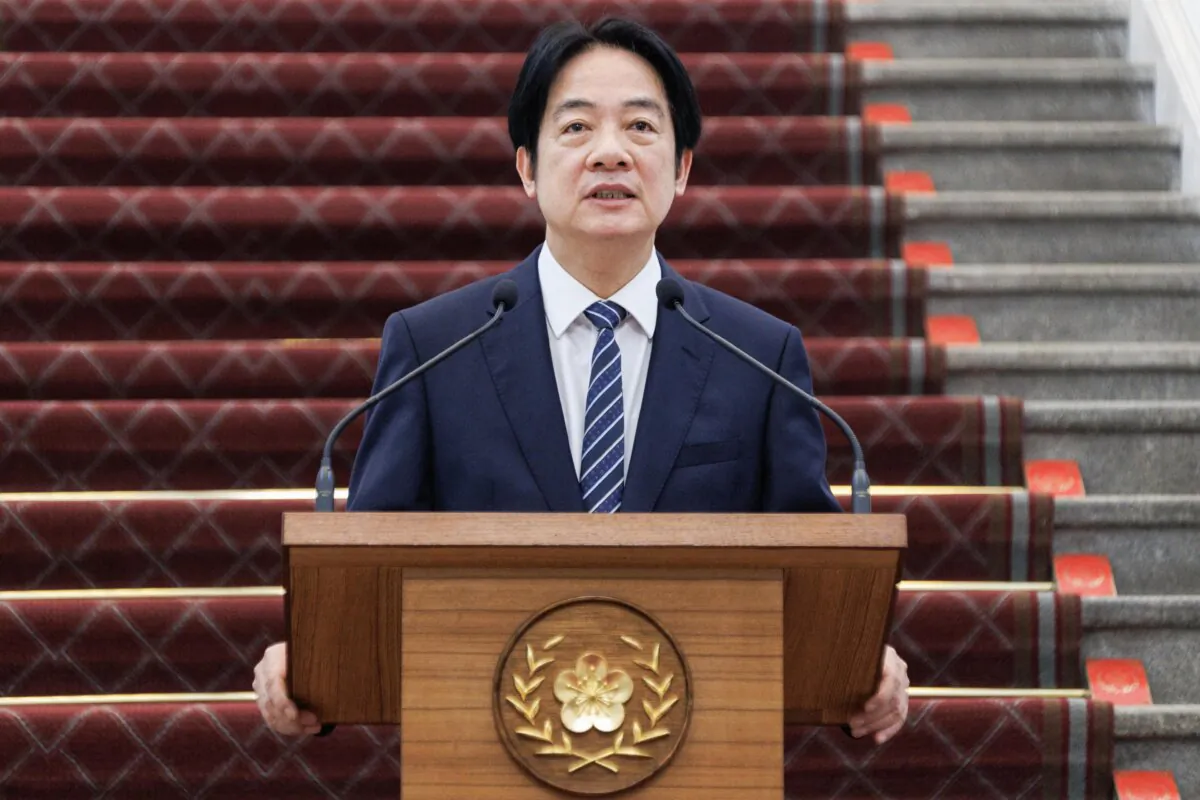

Taiwan’s president urged European lawmakers on July 22 to safeguard shared democratic values in the face of foreign infiltration within their borders.
In a bid to draw support against the Chinese regime’s aggression, Taiwanese President Lai Ching-te courted EU lawmakers at the presidential office in Taipei by highlighting common causes across political and economic interests, establishing the need to “deepen cooperation.”
Speaking with members of the European Parliament’s Special Committee on the European Democracy Shield, Lai said that “the efforts that democracies make are not for opposing anyone else; they are for safeguarding the way of life that we cherish.”
“However, in recent years, we have both been subjected to information manipulation and infiltration by foreign forces that seek to interfere in democratic elections, foment division in our societies, and shake people’s faith in democracy,” Lai added.
Beijing challenged similar claims of influence campaigns in March and reiterated the “one China” principle, dismissing Taiwanese democracy as a threat to reunification. The Chinese communist regime has never ruled Taiwan.
Nathalie Loiseau, chair of the European Parliament’s Special Committee on the European Democracy Shield, reiterated Lai’s emphasis on close ties between Taiwan and the EU, championing the importance of confronting “very similar challenges and threats.”
Loiseau said Russia employs similar tactics toward European member states, adopting hostile measures such as cyberattacks, sabotage, and gray-zone movements—namely military provocations that fall just short of an act of war.
The European Union has condemned Russia’s “persistent malicious activities” as part of “coordinated and longstanding hybrid campaigns” targeting the EU, its member states, and partners.
According to a July 18 statement, Russian efforts aim to undermine democratic institutions, public trust, and critical infrastructure. Recent cyberattacks linked to Moscow include those targeting elections and media in France, Romania, Germany, and the Czech Republic.
In response, the EU has imposed sanctions on multiple units of the GRU—Russia’s military intelligence agency—reaffirming its intent to “prevent, deter, and respond effectively” to hybrid threats.
Referring to Taiwan’s recent Han Kuang military drills, Loiseau expressed the desire to learn from the island’s military preparation, in particular its societal integration methods.
Taiwan’s response, according to its president, includes a “whole of society approach,” combining public-private cooperation and cybersecurity readiness. The Han Kuang exercises are 10 days of drills simulating a Chinese invasion and testing joint defense capabilities.
Loiseau added that efforts by democratic nations do not provoke neighboring countries, but simply strive to “defend ourselves, not to attack others.”
“We are not being threatened about what we do, but about what we are,” she said.
 Friends Read Free
Copy
Facebook
Tweet
Friends Read Free
Copy
Facebook
Tweet