
As ceasefire negotiations with the United States reached an impasse, the Iranian regime’s foreign minister and deputy defense minister have visited Russia to seek help.
Analysts told The Epoch Times that the Chinese communist regime is at the core of the “axis of evil” of China, Iran, Russia, and North Korea and operating behind the scenes, even as the Iran war has exposed Beijing’s weak hard-power projection.
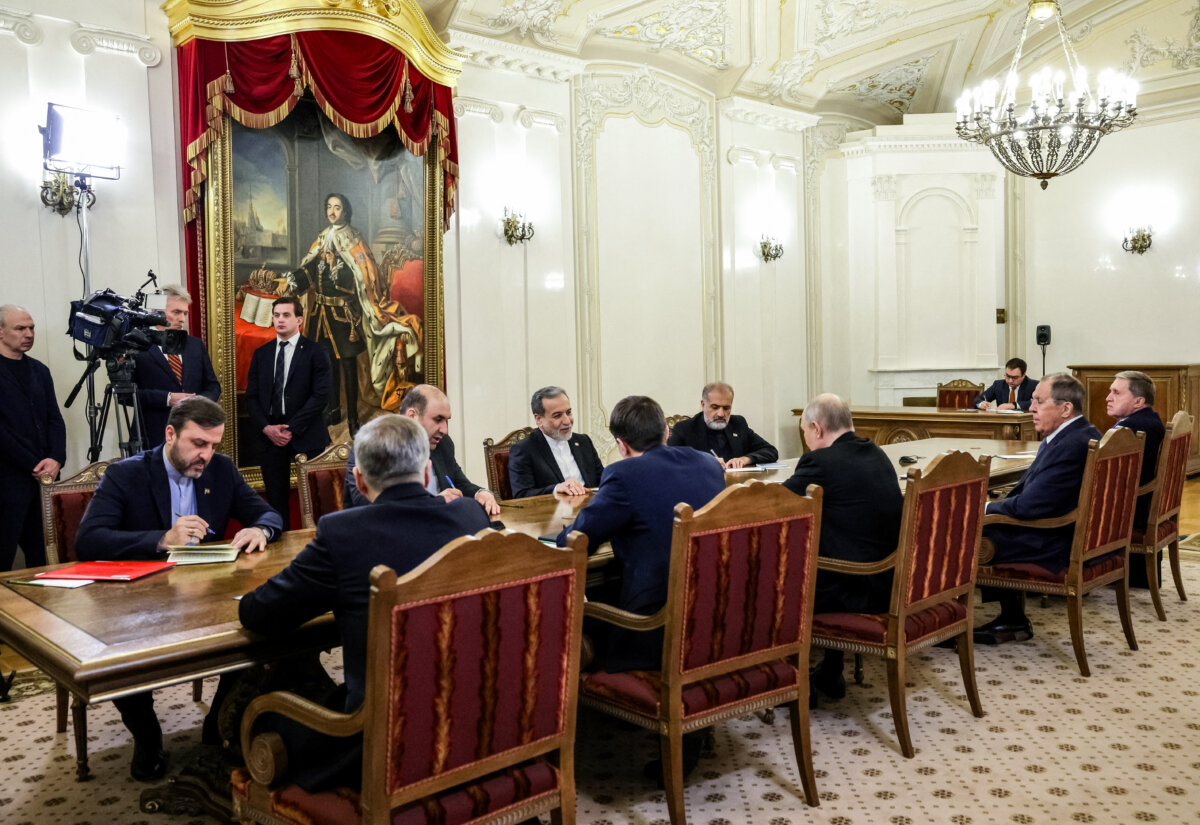
During a meeting in Moscow on April 27, Russian President Vladimir Putin praised the Iranian people for battling to stay independent in the war with U.S.–Israeli forces, and told Iranian foreign minister Abbas Araghchi, “We will do everything that serves your interests and the interests of all the peoples of the region to ensure that peace is achieved as quickly as possible.”
Russia and Iran signed a 20-year strategic partnership pact last year.
Meanwhile, the Iranian regime’s deputy minister of defense, Reza Talaei-Nik, held talks on April 27 in Kyrgyzstan with Russian Defense Minister Andrey Belousov.
Belousov reiterated Russia’s position that the Iran war should be resolved exclusively through diplomatic means and said that Moscow and Tehran would continue to support each other.
Talaei-Nik also visited Belarus, a close ally of Russia, and discussed the Middle East situation with Belarusian Defense Minister Viktor Khrenin. Belarus’s state BelTA news agency said both officials agreed that the only way to resolve the conflict was “a return to the sphere of a political-diplomatic settlement and the intensification of the process of negotiations.”
“[The meeting] confirmed the mutual interest of Minsk and Tehran for a further deepening of their joint interaction,” according to a statement by the Belarusian Defense Ministry.
The Iranian regime’s move indicates that it’s under immense pressure from the United States and needs greater bargaining leverage, as well as a broader array of diplomatic resources across various fronts, Hsieh Pei-Shiue, associate research fellow at the Institute for National Defense and Security Research in Taiwan, told The Epoch Times, “which is precisely why they have found it necessary to visit Russia and Belarus at this point.”
Another reason for the visit is that although the Chinese regime has been providing Iran with economic, material, and diplomatic support, “in order to avoid a direct conflict with the United States … it’s unwilling to provide overt, substantive military security guarantees to Iran,” Hsieh said.
China is the largest buyer of sanctioned Iranian oil and is heavily reliant on energy shipments passing through the Strait of Hormuz.
The Chinese regime’s strategy is to take a behind-the-scenes role rather than a position on the front lines, Hsieh said.
CCP Behind the Scenes
The fundamental geopolitical landscape at present is characterized by a contemporary bloc of rogue states—centered on the tyrannical regime of the Chinese Communist Party (CCP) and encompassing Russia, North Korea, Iran, and even Pakistan—that has forged an extremely tight-knit and tacitly coordinated alliance, Yuan Hongbing, a Chinese legal scholar and well-known political writer living in exile in Australia who has informants in the CCP’s upper echelons, told The Epoch Times.
Within this bloc, various nations play distinct roles, Yuan said.
“The CCP primarily adopts the persona of a ‘two-faced actor’: Outwardly, it poses as a champion of peace, while supplanting the United States to remake international law and global order,” he said.
According to his two separate high-level sources within the CCP system, Yuan said: “The negotiation strategies currently being employed by Iran with the United States were, to a significant extent, devised and provided by the CCP.
“Consequently—whether one looks at the Iranian foreign minister’s recent visit to Moscow or his talks with Putin—what is actually taking place is a confrontation between the United States and the ‘evil axis’ bloc centered on the CCP.”
Yuan also revealed that according to information revealed by conscientious individuals within the CCP system, “Chinese Foreign Minister Wang Yi has urged North Korea—specifically Kim Jong-un—to intensify its missile launches during the Iran war.”
“The objective is to divert U.S. attention and exert deterrence against the U.S.–South Korea alliance,” he said.
Furthermore, Iranian officials’ recent visit to Russia is no different from a direct visit to China, Yuan said.
“The CCP is currently shipping vast quantities of both civilian and military supplies—in a continuous, steady stream—into Iran via the China–Iran railway and highway networks, as well as through maritime routes transiting Russia,” he said.
Pakistan, which has acted as a liaison in recent U.S.–Iran negotiations, “is in reality being fully supported from behind the scenes by the CCP,” according to Yuan.
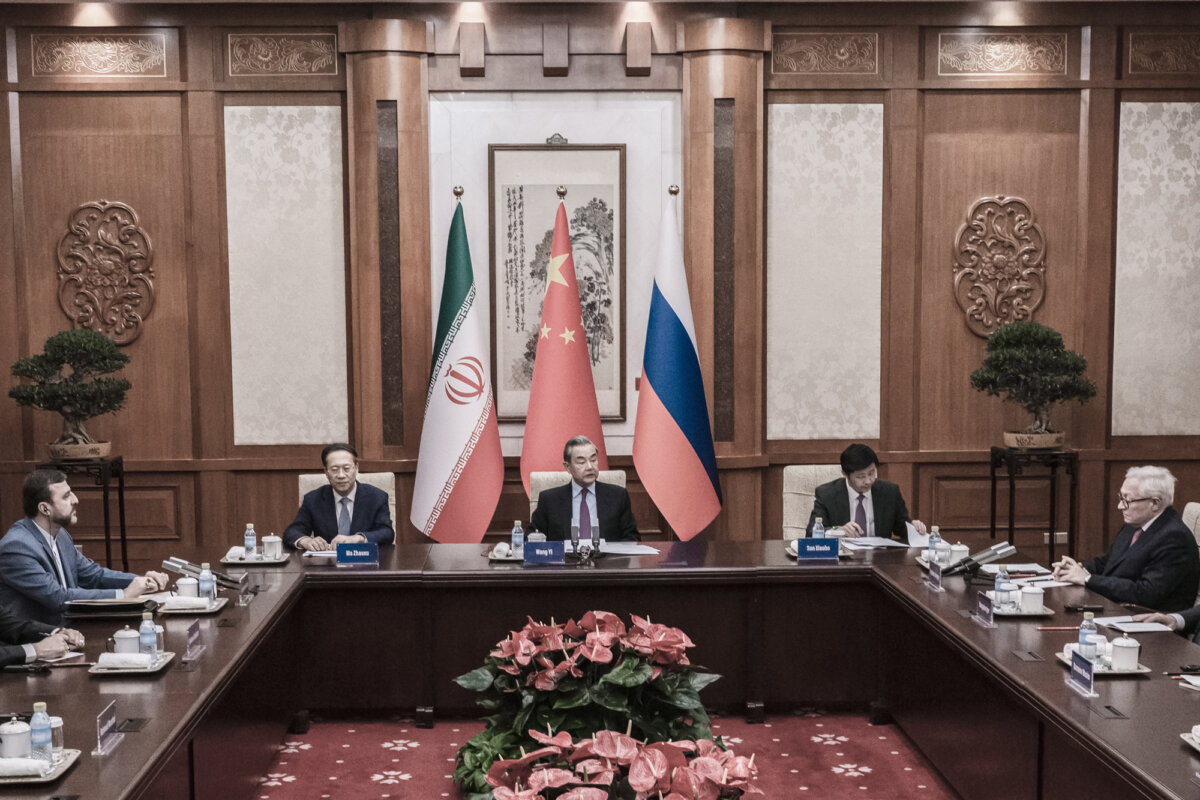
Although the Chinese regime and Russia share a common objective of undermining U.S. global leadership, their interests in the Middle East are not necessarily aligned, Hsieh pointed out.
“This is because the CCP actually requires a stable Middle East to maintain the security of its energy supply chains; however, Russia is relatively well-positioned to benefit from the turmoil in the Middle East and the rise in oil prices,” he said. “At the same time, Russia is happy to see the United States shifting its strategic support away from Eastern Europe—specifically Ukraine—and toward the Middle East.”
During the Iran war, Russia has provided the Iranian regime with some intelligence support regarding U.S. military deployments.
With U.S. President Donald Trump having canceled the U.S. envoy’s trip to Pakistan for peace negotiations, the Iranian regime is left with no cards to play and no bargaining chips, according to Hsieh.
The Iranian foreign minister’s visit to Moscow is in hopes that Putin can convey to Trump Iran’s willingness to continue negotiations and “perhaps even to seek Russia’s role as a guarantor for any future talks,” he said.
On the other hand, the CCP’s model of power projection in the Middle East and Eastern Europe has inherent limitations that have been thoroughly exposed by the Iran war, Hsieh said.
“While its economic influence appears to be substantial, its influence regarding security guarantees is comparatively weak,” he said. “The CCP is neither willing nor able to supplant the United States in the Middle East—specifically in the role of security guarantor.”
Boots on the Ground?
Although the Iranian deputy defense minister met with Russian and Belarusian defense ministers on this trip, the likelihood of openly deploying their troops to help Iran in the war is extremely low, according to the analysts.
What Iran is seeking is not tangible military aid—such as the overt deployment of combat forces or the stationing of foreign troops on its soil, Hsieh said.
“Rather, it is seeking diplomatic or operational assistance. Both Russia and Belarus are fully aware that they cannot, at this juncture, fall into the trap of directly deploying troops—a move that would constitute a blatant military intervention and inextricably entangle them in this conflict,” he said.
Yuan also said that there is absolutely no possibility of deploying troops to assist the Iranian military under the current circumstances.
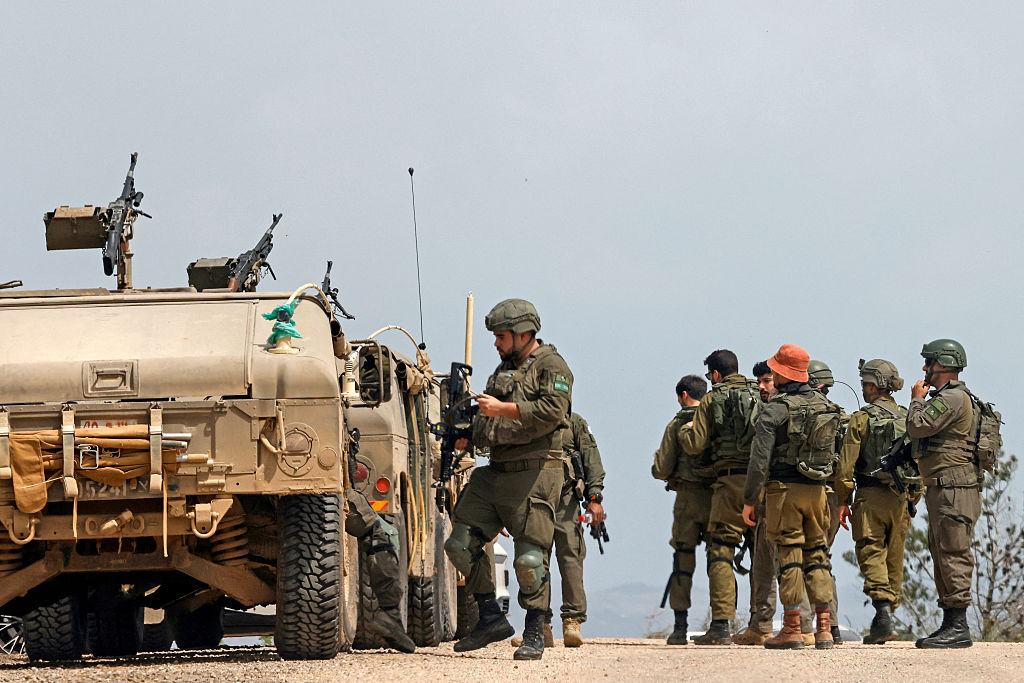
“At this juncture, both the United States and the CCP share the view that the strategic moment for a decisive showdown between them has not yet arrived,” he said. “Given that both the United States and China believe that the strategic threshold for the outbreak of a direct military conflict or a full-scale confrontation has not yet been reached, neither Russia nor the CCP will directly deploy troops into Iran to engage in combat.”
However, Yuan said the CCP military personnel had long been sent to Iran, operating under the guise of civilians.
“Currently, a significant portion of the military instructors within the Iranian armed forces are drawn from the CCP’s military,” he said.
“The design of Iran’s entire network of underground tunnels was executed by the military engineering division of the CCP’s military; furthermore, the critical high-tech components for Iran’s missiles and drones were all supplied by the CCP.
“Even the satellite positioning systems and capabilities for Iran’s missiles and drones were provided by the CCP.”
Meanwhile, Indian and Iranian forces are participating in joint military exercises by Russia and Belarus, according to mainland Chinese media.
Fundamentally, this is a joint military operation involving the “axis of evil” powers, specifically aimed at brokering negotiations between the United States and Iran, Yuan said.
“Given that U.S. President Trump has repeatedly praised the ‘peace making role’ played by Pakistan, India perceives this as a threat; after all, it is common knowledge that a longstanding adversarial relationship exists between Pakistan and India,” he said. “Consequently, India’s participation in these military exercises is a signal directed at the United States—expressing the hope that the United States will not allow its relationship with Pakistan to become too close.”
Prospect of the Iran War
The United States is at war with Iran to dismantle its nuclear program, destroy its military capabilities, and force regime change, Yuan said.
Simply relying on a comprehensive naval and economic blockade to achieve the military objective of dismantling Iran’s theocratic regime or forcing its complete surrender is essentially impossible, he said.
“The reason lies in what’s behind Iran. Iran isn’t fighting the U.S. alone; it’s backed by an evil axis of power centered on the CCP,” he said. “Various military and civilian supplies from the CCP are continuously being shipped to Iran.”
For the United States to achieve its objectives, only two possibilities exist, according to Yuan.
“The first involves launching another powerful military strike against Iran—not with the aim of eradicating Iranian civilization, but rather of dismantling its theocratic regime,” he said.
“The second possibility entails utilizing a combination of military strikes and economic sanctions to galvanize internal resistance forces opposed to theocracy, thereby triggering a nationwide uprising and popular revolt to overthrow the Iranian regime.
“Only through one of these two approaches can the United States conceivably attain the aforementioned objectives it seeks to achieve through military action against Iran.”
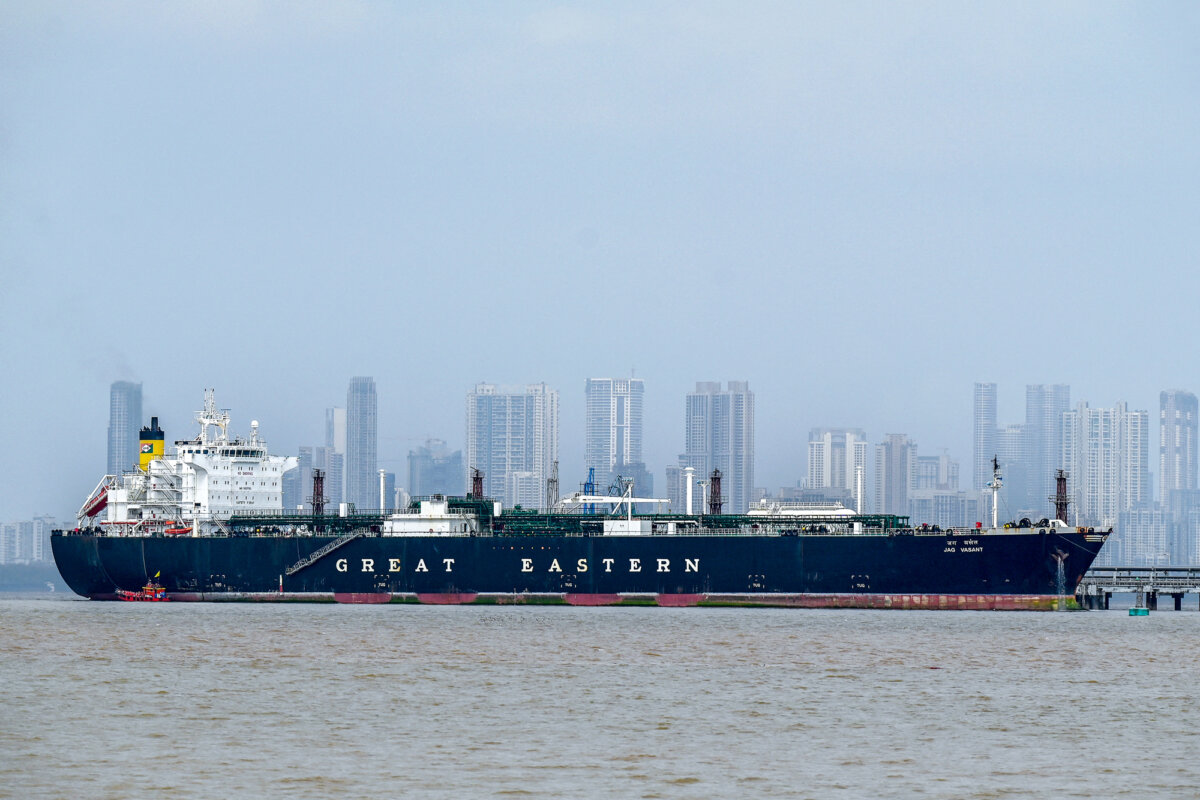
As to the impact on oil supplies, Hsieh said, “If the root causes of the conflict remain unresolved, global energy supply chains will inevitably come under pressure, potentially even triggering brief, acute crises.”
However, the current situation differs significantly from the oil crises of the past, he said.
“This is because, largely due to initiatives spearheaded by the Trump administration, the United States has achieved a considerable degree of energy independence,” Hsieh said. “Furthermore, taking control of Venezuela’s oil export and the UAE’s withdrawal from OPEC have further reduced U.S. reliance on Middle East’s energy exports.”
Luo Ya and Reuters contributed to this report.
 Friends Read Free
Copy
Facebook
Tweet
Friends Read Free
Copy
Facebook
Tweet