
News Analysis
Washington is closing a loophole that let a handful of foreign-owned chipmakers ship most U.S.-origin tools, software, and technology into their China fabrication plants without licenses, a fast-track privilege no U.S.-owned fab ever had.
Analysts say the move could slow advancement in Chinese fabs and further inflame the U.S.–China tech rivalry. As Beijing applies “case-by-case” screening over rare earth exports, they say, Washington will now apply the same logic to chip tools bound for China.
The Commerce Department’s Bureau of Industry and Security (BIS) announced on Aug. 29 that it will terminate the Validated End-User (VEU) program after a 120-day transition. The termination will go into full effect on Dec. 31. The decision puts every future shipment under a license, tightening U.S. control over what tools and technologies reach Chinese production lines.
Under the change, former VEU participants must obtain licenses for every shipment of U.S.-origin equipment and technology to their China fabs. According to BIS, it will prioritize approvals needed to keep existing lines running but is unlikely to approve applications tied to capacity expansion or technology upgrades in China.
The rules cover the Taiwan Semiconductor Manufacturing Co. (TSMC) plant in Nanjing, China, as well as Samsung Electronics and SK Hynix facilities in China.
“The Trump administration is committed to closing export control loopholes—particularly those that put U.S. companies at a competitive disadvantage,” Commerce Department official Jeffrey Kessler said in a statement on Aug. 29.
Taiwanese economist and TV commentator Edward Huang called it a reset of the rules.
“[Foreign fabs operating in China] are being forced off a highway and onto a narrow dirt path,” he told The Epoch Times on Sept. 4.
He said Washington’s target remains cutting China off from sub-14-nanometer (nm) manufacturing—“not the absolute cutting edge, but strategically important.”
In chips, smaller process nodes mean higher performance and lower power use, critical for advanced computing and artificial intelligence. China can reliably produce mature-node chips about 14 nm and larger; cutting-edge chips seven nm and smaller remain out of reach.
Huang said the new licensing regime aims to preserve that gap by restricting the tools and know-how required to move beyond mature nodes.
Routing around the rules will be difficult, he said, because “core suppliers of semiconductor components are highly concentrated in the U.S.”
“Many products that look like they come from other countries still incorporate U.S. technology,” he said.
He also framed the move as counter-leverage against Beijing’s weaponization of rare earth exports.
Hsueh Tsung-chih, a veteran procurement chief who worked at Tsinghua Unigroup subsidiaries and TSMC, previously told The Epoch Times that advanced semiconductors remain a major advantage the United States has over China.
Advanced chipmaking, he said, depends not only on equipment, but also on a culture of rigorous research, steady innovation, and disciplined execution.
China’s industry has long leaned on reverse engineering and adoption rather than fundamental breakthroughs, an approach that limits the homegrown innovation needed at the leading edge, he said.
Impact on TSMC, Samsung, and SK Hynix
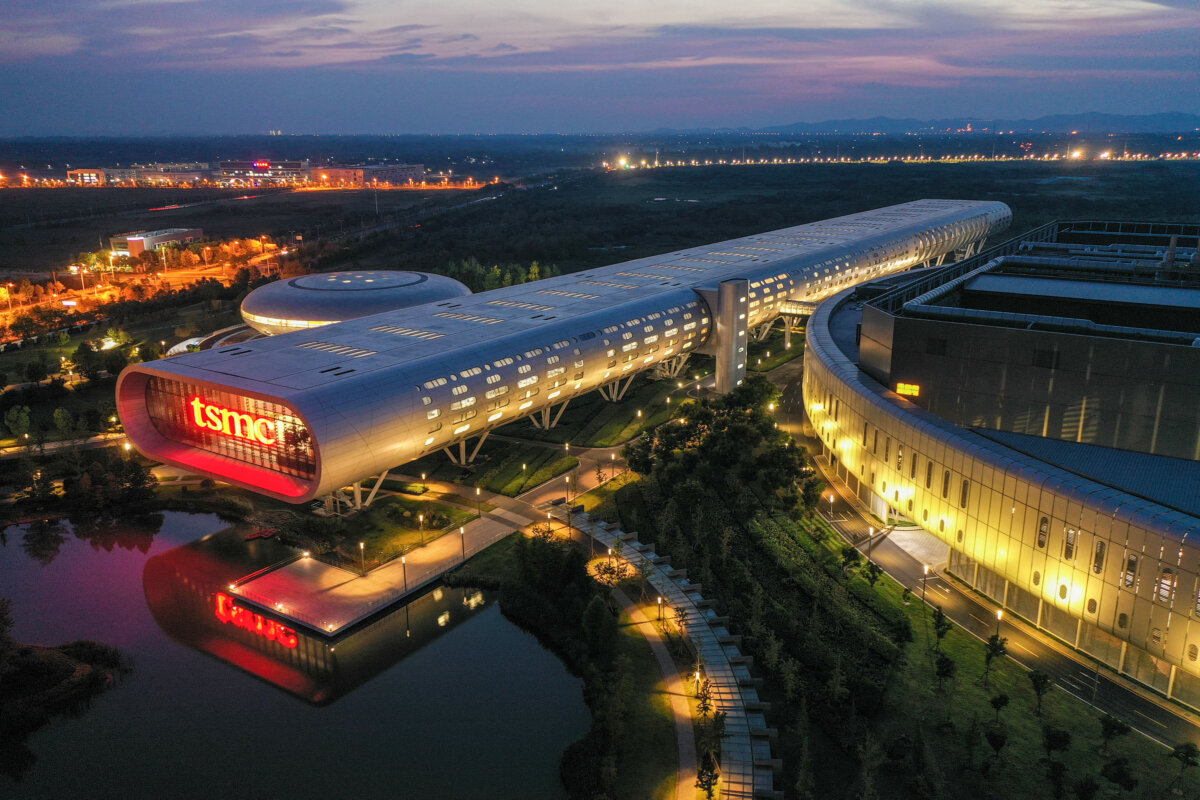
For TSMC’s fab in China, the hit is real but contained, according to Sun Kuo-hsiang, professor of international affairs and business at Taiwan’s Nanhua University.
“After the VEU revocation, every U.S.-controlled tool, part, and chemical at TSMC’s Nanjing plant will require separate export approval,” he told The Epoch Times. “This could slow equipment maintenance, upgrades, and expansion significantly, while raising overall supply chain costs.”
The Nanjing fab mainly produces at 16/12 nm and 28/22 nm nodes—“not the most advanced, but essential for auto chips, telecom components, and consumer system-on-chips, with solid commercial demand,” Sun said.
Losing VEU will squeeze expansion timing, upgrade speed, and operational predictability, he said.
TSMC said it has received notice of the rules, is assessing the impact, and will work closely with the U.S. government to keep operations stable.
For now, the Nanjing site is the only TSMC facility in China subject to BIS controls and accounts for about 3 percent of TSMC’s global capacity, making the direct impact relatively limited, the Taiwanese Ministry of Economic Affairs said on Sept. 3.
The ministry said TSMC’s exposure is small compared with that of Samsung—whose China capacity is about 20 percent of its global total—and SK Hynix, at nearly 40 percent. It added blanket revocation across the three global giants, showing that this is not a targeted strike on any one firm but a broader tightening of U.S. controls.
In an earlier statement, SK Hynix told The Epoch Times that it would “maintain close communication with both the South Korean and U.S. governments and take necessary measures to minimize the impact” on its business.
Samsung did not respond to a request for comment.
Possible Next Moves
Huang linked the VEU decision to the upcoming Section 232 investigation into semiconductors.
Section 232 of the Trade Expansion Act of 1962 authorizes the U.S. president to investigate whether specific imports threaten national security. The semiconductor probe launched in April 2025, with a report due within 270 days.
“It’s a preemptive move,” Huang said. “A 232 probe could lead to tariffs, with differentiated rates by country and product.”
He suggested that the Trump administration may reprise its Nvidia approach and “impose a 15 to 20 percent ‘security fee’ on chips going to China, then use it as a bargaining chip in broader U.S.–China negotiations.”
The Trump administration on Aug. 11 said it would allow Nvidia to sell its N20 chip and AMD to sell the MI308 chip into China but would levy a significant “security fee” of about 15 percent to 20 percent on revenue from those sales.
From the factory floor, the risk is more immediate, Sun said.
If case-by-case licensing slides into routine denials, he said, companies may struggle to obtain spare parts for critical maintenance, undermining yields and delivery reliability.
“When compliance costs outweigh the benefits of staying, rational withdrawal will become the only choice,” Sun said.
He noted that such exits may not be what Washington wants: The U.S. aim appears to be freezing China’s leading-edge progress while keeping some commercial engagement that maintains Chinese reliance on foreign chipmakers.
Li Jing and Luo Ya contributed to this report.
 Friends Read Free
Copy
Facebook
Tweet
Friends Read Free
Copy
Facebook
Tweet