
Sponsored Content by Greenstead Naturals. This article includes affiliate links, which may earn us a commission, to support truthful and independent journalism (at no extra cost to you).
Most consumers assume that skincare products—like the lotion they use or the balm they rub on their child—have been tested for safety. But a recent government report tells a different story.
Since the 1950s, the cosmetics industry has successfully blocked Congressional efforts to modernize safety laws—leaving most skincare products virtually unregulated for over 70 years. Even today, despite mounting scientific evidence, industry lobbying continues to delay reform.
In one of the most eye-opening reviews to date, the Environmental Working Group (EWG) conducted a large-scale scientific analysis identifying 88 toxic chemicals across more than 73,000 personal care products. These included:
- Phthalates, linked to reproductive harm
- PFAS, the so-called “forever chemicals” that build up in the body
- Formaldehyde-releasing preservatives, which remain legal in S. skincare
- Heavy metals such as lead and arsenic, absorbed through daily use
Research confirms that these substances don’t just sit on the skin—they’re inhaled, ingested, and absorbed into the bloodstream. Chronic, low-dose exposure has been linked to hormonal disruption, skin inflammation, breast cancer, mesothelioma, and even developmental toxicity in children.
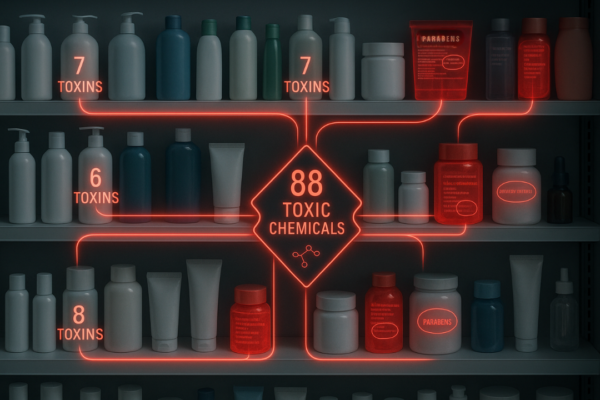 (Source: Greenstead Naturals)
To make matters worse, a recent report by the U.S. Government Accountability Office (GAO) was commissioned to assess cosmetic safety under newly revised laws. The GAO was asked to review FDA oversight, and its official conclusion stated: “Certain substances found in cosmetics are potentially harmful to human health. The effects can be difficult to confirm, in part because they may take years to develop.”
The GAO named several examples still found in everyday products: parabens, which mimic estrogen and disrupt hormone balance; asbestos, a known carcinogen; and vague ingredients listed as “fragrance,” which often conceal dozens of hidden chemicals. These aren’t rare outliers—they’re still commonly used in lotions, shampoos, baby products, and deodorants. Some are added intentionally, others appear as byproducts—but many are absorbed through daily use without warning.
The GAO acknowledged that many of these health effects take years to manifest—precisely why they’re often ignored. Yet in other parts of the world, the European Union, for example, has banned over 1,300 cosmetic ingredients, compared to just 30 in the U.S.
Legally, the term “cosmetic” covers everything from lotions and creams to balms, serums, and deodorants. Most of these products are not required to undergo any pre-market safety testing in the U.S.—unless they make a drug-like claim, such as treating eczema or acne. But even products in the “drug” category aren’t necessarily safer. Many still include the same harmful ingredients identified by the GAO and EWG—just repackaged in clinical language.
So what’s the answer?
If we want real change—and it isn’t coming through regulation—then it has to start with conscious choice. That means simplifying our personal care routines and choosing products grounded in science and nature. One ingredient, in particular, is quietly rising above the noise: beef tallow.
For centuries, humans used beef tallow to moisturize, soothe, and nourish the skin. When rendered from grass-fed cattle, tallow closely resembles our skin’s natural oils. It contains bioavailable, fat-soluble vitamins A, D, E, and K, along with conjugated linoleic acid, a potent anti-inflammatory, and saturated fats that help restore the skin’s lipid barrier and seal in moisture.
Ancestral fats like tallow are finally being recognized by health professionals—especially when sourced cleanly from grass-fed animals.
PubMed—a leading database for peer-reviewed medical research—now features a 2024 scoping review affirming tallow’s effectiveness in repairing the skin barrier, improving hydration, and easing conditions like eczema, psoriasis, and dermatitis.
Major outlets like National Geographic, Healthline, and Medical News Today have reported on the tallow skincare revival and the growing science behind it. But in a market crowded with trendy brands making unverified claims, it’s hard to know what’s truly clean, transparent, or even made in the USA.
Greenstead Naturals didn’t just follow the trend—they raised the standard.
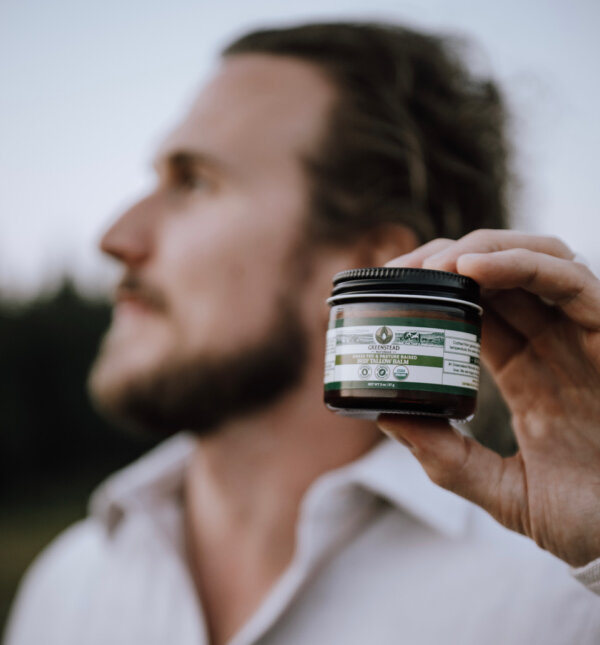
Unlike most conventional products, those with certifications like USDA Organic are third-party verified. To earn this seal, brands must disclose every ingredient and its source—down to the farm. That means no synthetic preservatives, petroleum derivatives, or hidden toxins make it into the jar.
At Greenstead Naturals, we believe trust should be traceable. That’s why we created the USDA Certified Organic beef tallow balm—with full transparency from pasture to packaging.
Epoch Times readers receive 15% off with promo code EPOCHREADER at checkout.
 Friends Read Free
Copy
Facebook
Tweet
Friends Read Free
Copy
Facebook
Tweet