

Sponsored Content by Ora Organics. This article includes affiliate links, which may earn us a commission, to support truthful and independent journalism (at no extra cost to you).
If you’ve spent any time on social media or reading health news lately, you’ve likely heard of GLP-1 medications like Ozempic, Wegovy, or Mounjaro. Originally developed for type 2 diabetes, these drugs have surged in popularity for one major reason: they’re remarkably effective at supporting weight loss.
But while the results can be dramatic, the experience isn’t always smooth – and the risks aren’t minor.
Why Everyone’s Talking About GLP-1 Drugs
The rise of GLP-1 medications isn’t just a passing wellness trend – it’s happening against the backdrop of a growing public health crisis:
- Over 42% of U.S. adults are obese, and an additional 30% are overweight.⁽¹⁾
- 1 in 10 Americans now have type 2 diabetes, and nearly 1 in 3 has prediabetes.⁽²⁾
- GLP-1 prescriptions, including semaglutide and liraglutide, grew by nearly 300% from 2020 to 2023.⁽³⁾
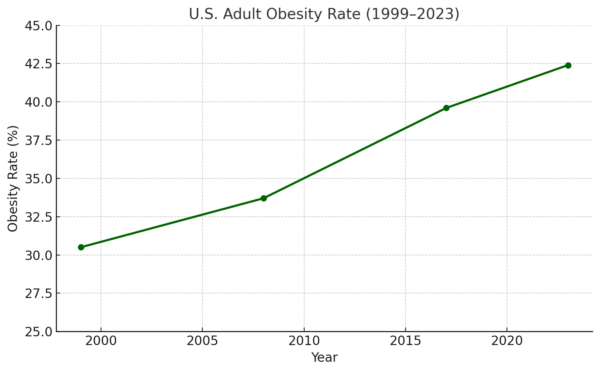 (Source: Ora Organic)
While GLP-1 receptor agonists are undeniably effective, they weren’t designed for the average person simply looking to manage appetite or improve metabolism. They’re prescription medications for chronic diseases, and they come with a list of potential side effects ranging from nausea to more serious concerns like pancreatitis and thyroid tumors.
What About Potential Side Effects?
According to the FDA and peer-reviewed studies, GLP-1 receptor agonists like semaglutide and liraglutide can be associated with a range of side effects:
- Nausea, vomiting, diarrhea, and constipation – among the most common gastrointestinal effects.⁽¹³⁾
- Pancreatitis – noted as a risk in several case reports and clinical reviews.⁽¹⁴⁾
- Gallbladder disease – increased risk observed in observational studies.⁽¹⁵⁾
- Kidney problems – especially in patients experiencing severe dehydration from vomiting or diarrhea.⁽¹⁶⁾
- Thyroid C-cell tumors – observed in rodent studies; relevance to humans is unknown, but warnings exist.⁽¹³⁾
- Suicidal thoughts or behaviors – reports prompted an ongoing FDA investigation, though no causal link has been established.⁽¹⁷⁾
- Bone density loss – some emerging research suggests potential effects on bone turnover markers, though more data is needed.⁽¹⁸⁾
Additionally, a now widely discussed aesthetic side effect is “Ozempic face” – a term coined by dermatologists to describe facial volume loss caused by rapid weight loss.⁽¹²⁾ While not medically dangerous, it has raised concern about the broader physiological effects of sudden fat loss.
The Power of GLP-1, Naturally Activated
GLP-1, short for glucagon-like peptide-1, is a hormone your body naturally releases after eating. It helps regulate appetite, stimulate insulin, reduce blood sugar spikes, and slow down digestion.
So what if there were a way to support GLP-1 naturally, without synthetic drugs or harsh side effects?
Ora, the creator of premium natural supplements, just launched their newest plant-based formula, GLP-1 Up – designed to support your body’s natural production of GLP-1† without pharmaceutical intervention. It uses 4 impressive patented plant compounds studied in human clinical trials, and is without the harrowing side effects aforementioned.
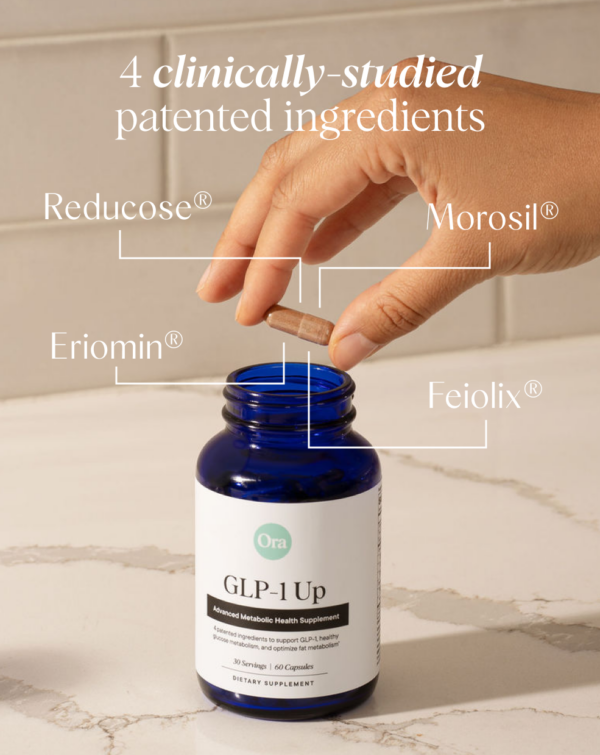 (Source: Ora Organic)
Backed by Plants, Not Prescriptions
1. Encourages Your Body to Make More GLP-1†
Eriomin®, a citrus flavonoid complex from lemon, has been shown in clinical studies to naturally increase GLP-1 levels by up to 17.5%†⁽⁴⁵⁶⁾ and improve glucose control, insulin sensitivity, and inflammation markers.†⁽⁴⁵⁶⁾
2. Helps Manage Healthy Blood Sugar Spikes After Meals†
Reducose® (white mulberry leaf extract) slows down carbohydrate digestion and absorption, leading to up to a 40% reduction in post-meal glucose and insulin spikes in human studies.†⁽⁷⁸⁾
3. Supports Fat Metabolism and Insulin Health†
Morosil® (Moro blood orange extract) and Feiolix® (whole feijoa fruit) have shown human clinical benefits for metabolic health:†
- Morosil: reduced body weight, BMI, and waist circumference over 12 weeks†⁽⁹⁾
- Feiolix: improved fasting glucose, triglycerides, LDL, and gut function in adults with type 2 diabetes and prediabetes†⁽¹⁰¹¹⁾
A Safe Option for Metabolic Health
Ora’s natural GLP-1 support formula is available without a prescription, starting at $59.99/month ($74.99 one-time) – and 20% off with your exclusive Epoch Health discount.
If you want to support metabolism, curb cravings, and feel more energized naturally,† this may be the safe, gentle alternative you’ve been looking for.
👉 Shop GLP-1 Support – 20% off with Epoch Health Offer
References
- CDC National Center for Health Statistics, 2023
- CDC National Diabetes Statistics Report, 2022
- IQVIA Institute for Human Data Science, U.S. Medication Trends 2023
- Ribeiro CB, Ramos FM, Manthey JA, Cesar TB. Effectiveness of Eriomin® in managing hyperglycemia and reversal of prediabetes condition. Phytother Res. 2019;33(7):1921-1933. https://pubmed.ncbi.nlm.nih.gov/30919998
- Cesar TB, Ramos FMM, Ribeiro CB. Eriomin® reduces hyperglycemia by increasing GLP-1 and downregulating systemic inflammation. J Med Food. 2022;25(11):1050-1058. https://pubmed.ncbi.nlm.nih.gov/36384444
- Ramos FM, Ribeiro CB, Cesar TB, et al. Eriomin® attenuates prediabetes intestinal dysbiosis. Food Sci Nutr. 2023. https://pubmed.ncbi.nlm.nih.gov/37415644
- Wang Y, Liu S, Yang Z, et al. Mulberry leaf extract reduces postprandial glycemia in healthy adults. J Diet Suppl. 2017;14(6):650-661. https://pubmed.ncbi.nlm.nih.gov/28914546
- Zhang Y, et al. Mulberry leaf extract for glucose metabolism in prediabetic adults. J Med Food. 2021;24(1):35-41. https://pubmed.ncbi.nlm.nih.gov/32811282
- Cardile V, et al. Moro orange extract and weight management: a randomized clinical evaluation. Nat Prod Res. 2015;29(6):518-522. https://pubmed.ncbi.nlm.nih.gov/25280038
- Taghavi M, et al. Feijoa sellowiana supplementation in type 2 diabetics: effect on glycemic control and lipids. Int J Endocrinol Metab. 2012;10(2):497–503. https://ijem.sbmu.ac.ir/article_1223.html
- Derosa G, et al. Abscisic acid treatment in prediabetics: effects on glyco-metabolic markers. Nutrients. 2020;12(10):2931. https://pubmed.ncbi.nlm.nih.gov/32987917
- American Society for Dermatologic Surgery. “Ozempic Face” and Aesthetic Concerns with Rapid Weight Loss. 2023. https://www.asds.net/Blog/Post/ozempic-face-and-weight-loss
- FDA Prescribing Information for Ozempic and Wegovy
- Lee CJ, et al. Pancreatitis associated with GLP-1 receptor agonists. Diabetes Metab Syndr Obes. 2019. https://pubmed.ncbi.nlm.nih.gov/31410036
- Faillie JL, et al. Gallbladder-related events associated with GLP-1 agonists. JAMA Intern Med. 2016. https://pubmed.ncbi.nlm.nih.gov/27842167
- Egan AG, et al. FDA perspective on GLP-1 kidney risks. N Engl J Med. 2011. https://pubmed.ncbi.nlm.nih.gov/21776413
- FDA. Update on Suicidal Thoughts and GLP-1 Drugs. July 2023. https://www.fda.gov/drugs/drug-safety-and-availability/update-fdas-ongoing-evaluation-reports-suicidal-thoughts-or-actions-patients-taking-certain-type
- Zhang Y, et al. GLP-1 and bone metabolism: a review. Front Endocrinol. 2022. https://pubmed.ncbi.nlm.nih.gov/35401626
Disclaimers:
† These statements have not been evaluated by the Food and Drug Administration. This product is not intended to diagnose, treat, cure, or prevent any disease.
GLP-1 Up does not contain GLP-1 or synthetic GLP-1 and is not a GLP-1 agonist drug. GLP-1 Up is not a weight loss supplement. The product is formulated to support healthy weight management.†
 Friends Read Free
Copy
Facebook
Tweet
Friends Read Free
Copy
Facebook
Tweet