Live chat
July 9, 2024
American Thought Leaders
Live chat
 Expand
Expand
 Expand
[FULL TRANSCRIPT BELOW] “I think the Socratic method is something, like many things that are highly effective, within us. And if you kind of have the right intention, the right goal, it often just happens. I don’t think Socrates invented the Socratic method. I think he discovered something that was already there.”
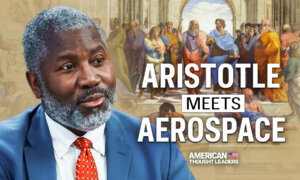
In January, high school teacher Warren Smith posted a video of an exchange he had with a student—an exercise in Socratic dialogue and critical thinking. Within a short time, the video went viral. Six months later, his life has dramatically changed.
“When I look at that video, I never in a thousand years would have guessed that would have gone viral. And to me, that’s indicative of a larger problem. The fact that there’s that much hunger for logic and critical thinking and seeing such a transformation occur—there’s so many presuppositions and unfair accusations and such lazy thinking out there that that is what went viral. Really?” Mr. Smith says.
We dissect the viral video Mr. Smith recorded, and discuss his project to expand the Secret Scholars Academy. We also discuss his faith in God, views on higher education, and lessons he has learned from the Harry Potter series.
“Whatever picture that paints is the picture that’s painted. Who cares what they want to call it? It’s just boats floating on the surface,” says Mr. Smith.
Views expressed in this video are opinions of the host and the guest, and do not necessarily reflect the views of The Epoch Times.
FULL TRANSCRIPT
Jan Jekielek:
Warren Smith, such a pleasure to have you on American Thought Leaders.
Warren Smith:
Thank you for having me.
Mr. Jekielek:
Perhaps many people have seen your viral video about helping someone change their mind from a position they once held quite strongly. I remember your demeanor more than the content, because you were truly open to this person. Please tell us about this video.
Mr. Smith:
I wasn’t really thinking about what I was doing in that video, but I have since thought about it. Why did it have the effect that it had? As far as the demeanor thing, that is just my personality. Growing up, I never knew anyone that really thought differently about politics. I wouldn’t consider myself political, but that shifted after 2016.
After 2016, when trying to have conversations with your family or close friends, you learn to navigate delicately when everyone seems to disagree with you on certain topics. That’s where that comes from. Also, as a teacher, that demeanor is useful in the classroom.
Mr. Jekielek:
There is something more there. You are actually employing a way of thinking and applying the Socratic method. But this isn’t what you teach. You actually teach filmmaking, correct? Please tell us what you are doing here.
Mr. Smith:
I teach multimedia, video editing, podcasting, and photo editing at the high school level. Yes, it is the Socratic method, I can’t argue with that. But I wasn’t consciously using it. The Socratic method, like many things that are highly effective, is within us. If you have the right intention and the right goal it often just happens.
I don’t think Socrates invented the Socratic method. He discovered something that was already there. Imagine the ocean and imagine that we have boats floating on the ocean. The boats are up on the surface and beneath the surface is the subtext. That’s the relation between words and subtext. But also beneath the surface are all the elusive and intangible things that we’re trying to articulate with our words. The boats are just tools, and the words are just tools. They’re not the end-all and be-all.
People put so much stock in terminology, but we’re bumbling our way through, like me speaking to you right now. There is something deeper and more subconscious that I’m trying to communicate through these tools as they pop in my mind, so those patterns are what interest me.
That’s what the Socratic method is all about. It is identifying what is beneath the surface and what is underneath the assumptions. That is called critical thinking and it’s beyond the Socratic method. It is looking at what is actually happening and why it is happening, so I can then understand how to navigate it and inevitably learn from it.
Mr. Jekielek:
Were you genuinely trying to figure out where this student was coming from?
Mr. Smith:
Yes, I was genuinely intrigued. He brought it up, because the accusations toward J.K. Rowling had been a story in the news. Those certain conversations that are built upon presuppositions often stick to a pattern. That’s why they’re presuppositions. Again, those elusive, intangible patterns are beneath the surface, and you can see them coming. Yes, that’s what I was thinking.
Mr. Jekielek:
You said that it’s not your favorite thing to have everyone always talking to you about this video, but it resonated with people. People find themselves in situations like this all the time. Someone confronts them and they know their core assumption is wrong. But they don’t know how to respond, because challenging it might cause confrontation.
Mr. Smith:
Yes, it goes back to the analogy with the boats and not putting all the stock on the boats floating on the surface, which are the words. It is being able to realize that those are just tools. It is being able to parse the waters and move the boats aside and just focus on what the person is really saying. If you block everything else, then the next thing is revealed.
That’s the layer by layer, peeling back of the onion, Socratic method. But the words are just tools, and a lot of them aren’t even necessary.
You need to be able to recognize which ones are actually necessary to understand what the person is saying and what is actually meaningful.
Mr. Jekielek:
Part of it is the person realizing that you care about them.
Mr. Smith:
Again, that is subtext. The idea is that most communication is nonverbal. If you care about them, then the person will sense that. I want to wrap up this idea of the boats. We are teaching the meaning of words to potential directors and screenwriters, because they’re going to be working with actors. What does an actor care about? Nonverbal communication. They don’t really care about the words in the scene. They care about how to be in the scene.
That’s what is going to dictate their behavior as an actor. It’s not the acting, it’s everything else. When I’m interacting with that student, there is this non-verbal communication between us all the time. If you don’t like a coworker, you would not say, “Hey, I don’t like you.” It might become more apparent through your interactions in other ways that are non-verbal. That’s another indication of critical thinking, to be able to pick up on those patterns.
Mr. Jekielek:
How did your video end up online?
Mr. Smith:
I uploaded it to my online teaching portfolio on YouTube where I had been uploading lectures that I had recorded in the past several years, as well as some narrative filmmaking. I didn’t have that many people following the channel. I had created my X platform when I taught my first year teaching at a public high school, but I hadn’t used it in four years.
Someone found the video and posted it on X. Once I found out it had gotten big, I tried to log onto X, but I couldn’t remember my password. My brother said, “Elon Musk just tweeted this video of you. You should recover your password, so you can get on there and try to make something of this.”
Mr. Jekielek:
This moment of fame happened, and now you’re some months into the aftermath. Since then, you have founded the Secret Scholar Society.
Mr. Smith:
Yes, we started that maybe a few months ago when a team reached out to me. They had created this app that was mostly being used for homeschooling and they were interested in partnering. I spent some time developing the Secret Scholars Academy, which would allow me to offer critical thinking classes, or just spaces where we could explore these concepts like we’re doing right now. There is both a social media and a community aspect to it. We’ve been trying to find our direction with it.
Ever since I lost my job, I have been doubling down on that, because it allows me to monetize in a way that I can’t on YouTube. We don’t make much on YouTube. But the platform has potential. There is an educational summit occurring today that the team is at right now as we speak. I hope that we see some growth.
I have seen charter schools trying to offer an alternative to students in impoverished communities. The parents get so excited because there are so few spaces available. They have these raffles with the balls bouncing and then the number comes out like bingo. They call out the number and the parents just explode with joy. But what was more powerful to me was the look on the faces of the people that didn’t get in.
It just seems wrong that it’s whether or not you get your number called. Their kid’s education is important to them. They are that crestfallen and it’s like this is their only shot. I don’t think it’s just about getting into college. Yes, at that charter school, the college acceptance rate is super high. But this is their only shot as teenagers to gain knowledge. Maybe we can use this platform to help with that.
Mr. Jekielek:
There is a crisis in the educational system, and perhaps this is one of the reasons why there’s such an interest in these charter schools, which perform very well. Any help in resolving that is very noble.
Mr. Smith:
This is an idea that hit me just last night. I texted the team and I posted that video on our forums. Can we help with this crisis in any way? Not that we can fix it, but maybe we can help. It was a bit rash of me, but I said, “My classes for the summer are going to be free for any high school students.”
Mr. Jekielek:
You mentioned that you recently lost your job. Do you think that’s connected with recent events?
Mr. Smith:
I can only speculate. I don’t think they technically did anything that they weren’t allowed to do. I don’t think they did anything illegal, and did not check all the boxes. I don’t know if it was a new box that had been introduced. I was supposed to check with this one supervisor, and I didn’t check with them. Immediately following that, they told me they had decided to part ways, because they couldn’t trust me to not upload something online. I didn’t check one certain box, and I take responsibility for that. As far as anything else, it would just be speculation.
Mr. Jekielek:
I understand that you’re continuing to teach classes at another college.
Mr. Smith:
Yes, I’ve been teaching at Emerson College since grad school. I still teach two classes a semester.
Mr. Jekielek:
What are you hoping to accomplish as an educator?
Mr. Smith:
I would like to grow the academy, but we need to find the right direction for it. It hit me last night that it feels right. I would really love for that to work, to build it out, and to have a thriving community there. I want to continue growing my YouTube channel. We will see what else happens. Maybe I will work on a book. I have ideas that I’m kicking around.
But the big thing is the academy and growing the platform and trying to get to a point where I can make a living doing this. When people interview me, I often get the question, “Are you worried that one political group is going to bring you in and label you?” I just think that’s all noise. Again, it’s the boats on the surface of the water.
If you care about what’s beneath the surface more, things are going to go better. What is the alternative? I’m going to follow the logic point by point, wherever it takes me. This would be my two cents for you all. Don’t worry about things, because actually, what’s the alternative? Don’t worry how the chips will fall. Most people will take the path of least resistance.
It’s almost like a law of nature. It’s easier to be foolish than wise, therefore most people you’re going to meet are not going to be wise. They’re going to be foolish, almost by choice. This occurs in workplace politics and in your family relationships. With what I’ve been going through in these last few weeks, I’m hoping I can come out of the other side and that in the long run will be better, hopefully. People keep saying that, but when you’re in it, it doesn’t feel like it, because it’s hard and it’s awful. But sometimes, that is required.
Whatever picture that paints is the picture that’s painted. Who cares what they want to call it? It’s just a boat exploding on the surface. It’s almost like being in a courtroom. That’s why they go to such great lengths to agree on the evidence that is presented. What is the fair conclusion based on the evidence that has been presented in the courtroom? It is not what anyone is saying outside of the courtroom or on social media. It’s just what has been presented.
That’s all I did. I wasn’t making a point at all. That’s what happens when you follow the logic, though, and I believe that logic is evidence. That’s how we can anticipate what hasn’t happened yet. There was that Don Lemon interview with Elon Musk. Lemon was saying, “How do you know that? Do you have any examples of DEI lowering standards?” Logically, it’s a certainty that’s how it would have to happen. If you were going to do that, that’s how it would have to happen, based on logic. Therefore, logic is the evidence.
Mr. Jekielek:
What is the state of education around logic today? Is it taught properly?
Mr. Smith:
I can only speak for myself. I don’t know what other people are teaching. We have two levels; high school, those students trying to get into college, and then college level. Then we have the teachers’ unions, lack of school choice, the questions around school choice, charter schools, and private schools. Then we have the whole debacle of higher education, and I know that’s a larger conversation.
Mr. Jekielek:
What is the debacle?
Mr. Smith:
The quality of the product is decreasing and the cost is increasing. It’s a loan that you don’t have to qualify for. You can’t declare bankruptcy. You’re straddled with it for life. How much does it cost for four years of college? At the school where I work, it’s over $60,000. Often, it’s more than that. It can be $80,000, so you’re up to almost $400,000 by graduation.
What are you getting in exchange for that? The value of these degrees are not logical. What’s being taught is not logical. Tenure is not logical in some sense, because what that does is it leads often to complacency.
I’ve had teachers that were just coasting and didn’t get in, similar to teachers’ unions. I understand that the entire reason for tenure was to allow professors to push the bounds of knowledge and explore new territory without fear. But you can’t do that in higher ed without potential pushback.
Mr. Jekielek:
You were a volunteer firefighter.
Mr. Smith:
Yes, I still am.
Mr. Jekielek:
Do you get to do it very often?
Mr. Smith:
I go on call whenever I’m available. But we don’t get that many fires where I live.
Mr. Jekielek:
What’s it like to be a volunteer firefighter?
Mr. Smith:
It’s cool to be on a team of guys and a few girls, to be part of something, and to feel like you’re being of use to your community. It fulfills a part of me. There’s something masculine about it that’s criticized as toxic masculinity, but I think it is essential and it’s real.
Mr. Jekielek:
Why did you choose to do this?
Mr. Smith:
When I moved to this town, the realtor said, “They love joiners here.” I said, “What’s a joiner? What do you mean?” They said, “Join a committee.” I asked, “What committee am I going to join?” They replied, “You should join the fire department. Frank up on the corner is in the volunteer fire department. They’re the cool guys in town and they have the shirts and everything.”
Three weeks later there was a storm and a bunch of branches came down. I was driving back from school and I saw them jumping in the truck and loading up to go out. When there are storms, there are usually some
car crashes and stuff. I thought, “This would be really cool.” I went and talked to him and started the process. It took a long time, about several months.
Mr. Jekielek:
This is you voluntarily entering the unknown.
Mr. Smith:
Yes, but I didn’t think about that. The voluntary aspect is key. That is an idea Jordan Peterson has talked about. I had a short interview with Piers Morgan a few days after that viral video. He said, “What’s the best lesson from Harry Potter? I summed it up as voluntarily entering the unknown. Harry, Ron, and Hermione, in almost every book, if not every book,
will voluntarily go beneath the surface and face the beast, or enter the Chamber of Secrets through the toilet, or Harry will voluntarily walk into the Forbidden Forest to his death at the hands of Voldemort so that he can be reborn.
Yes, they are reluctant heroes, but there’s still a voluntary aspect. You can’t force someone to go on the hero’s journey. That goes for teaching as well. You’ve got to get kids to do it voluntarily, whether it’s their homework or their assignment. If you’re doing stupid things as a teacher that are illogical, they’re not going to listen to you, because they can smell it and they can feel it. That’s how I know that everything beneath the surface is more important. It’s not the boats on the surface.
There are a lot of teachers that think the boats are all that matters. People like that will never innovate. They shun their noses at YouTube and the teachers that do things differently. Perhaps that’s one of the reasons we are in the state that we’re in. We are always going to be tribal, though. We’ve been tribal since the dawn of man. That’s how we survive, so you’re not going to get rid of that aspect of human nature. But political labeling is just ideology.
Mr. Jekielek:
Did the J.K. Rowling’s books, the Harry Potter series, have a significant impact on your life?
Mr. Smith:
Yes, they are my favorite books. They have had the greatest impact of any books I’ve ever read. I was 11-years-old, the same age as Harry Potter, when the first book came out.
Mr. Jekielek:
Why are they your favorite books?
Mr. Smith:
It is a masterfully created world built upon archetypes. They incorporate things like voluntarily accepting the unknown, recognition there’s pieces of evil in you, the slaying of the dragon, that masculinity is not a bad thing,
and that you can save Ginny from the beast. They also recognize categories as well, with Slytherin, Ravenclaw, and Hufflepuff.
They also show that you’ve got to understand when to break the rules with the Marauder’s Map. You might not put your name in the Goblet of Fire, but the Goblet might shoot it out anyways. Then you have to decide if you are going to play the game to the best of your ability and try and get that golden egg from the dragon when you don’t even know how you’re going to do it.
Harry didn’t know what he was going to do until the last minute. Somebody gave him a tip to just think differently. Just a little innovation was all he needed. He was allowed a wand which allowed him to get his broom. He was able to use that one little bit of ingenuity to stand up to the dragon.
He loses his friends in the process, though. Ron turns his back on him and gets jealous and says, “You put your name in that goblet.” It’s coming from a place of jealousy. Harry says, “I didn’t put my name in that goblet.” All his friends turn on him, but he keeps going and keeps playing the game
to win, even though he didn’t sign up for it. In the end, Ron says, “I was wrong. You would have been barking mad to put your name in that goblet.” Harry says, “You’ve finally caught on, haven’t you?”
Mr. Jekielek:
Is it by coincidence that you were talking about J.K. Rowling in this video?
Mr. Smith:
I wasn’t talking about her, the student brought it up. Coincidence is a remarkable thing. I’m not sure coincidence is even the right word. I’ve toyed with the notion of God, and it makes for interesting conversations.
Mr. Jekielek:
Here’s another thing that you picked up from Jordan Peterson. You said that you are going to live as if God exists.
Mr. Smith:
He said, “When I live as though God exists, I’ve seen remarkable differences.” People ask, “Do you believe in God?” Then I ask, “What do you mean by the word believe? What do you mean by the word God?” There are things I encounter in those conversations that I don’t have words for. Therefore, there are things that cannot be expressed logically. I can’t logically justify the idea of God, but when I live as though He exists, I can see results and I can feel results. I can’t articulate them.
Mr. Jekielek:
You say that is the definition of faith.
Mr. Smith:
Yes, I would have to play with that, but I do think it’s something like that. I’ve had interesting conversations around faith. If we suddenly had evidence that God exists tomorrow, what would happen? Everyone in the streets of New York City would start living as though God existed, if they had any logic. Now, we’re just living up to a standard.
People ask, “Why would God make it impossible for there to be any potential proof or logical evidence?” My response is that if I were going to create a system where faith is possible, I would make it impossible for there ever to be proof. Otherwise, faith would cease to exist. Everyone would just be living up to a new standard.
Mr. Jekielek:
When you have faith, suddenly things are transformed in a very positive way that you can’t explain. That’s what I heard you say.
Mr. Smith:
It’s something like that. Faith exists because of the elusive intangible, and I can’t formulate words.
Mr. Jekielek:
What’s next for you? You’re working on the Secret Scholars Academy, creating education.
Mr. Smith:
I am trying to reach financial stability and grow the channel. There’s so much criticism of that online. They say, “He’s a grifter, he’s a shill, he’s trying to profit off this.” Yes, I’m trying to profit off this. When I look at that video, I never in a thousand years would have guessed that that would have gone viral.
To me, that’s indicative of a larger problem, that there is that much hunger for logic and critical thinking and for a transformation to occur. There’s so many presuppositions and unfair accusations. There’s such lazy thinking out there, that this is what went viral.
Mr. Jekielek:
It was the compassion and the heart and the caring. That’s what made that video and facilitated the transformation ultimately.
Mr. Smith:
That means a lot, thank you. That’s a genuinely interesting read.
Mr. Jekielek:
You’re saying that people have accused you of grifting.
Mr. Smith:
It’s understandable. They say, “He’s a teacher. Now, he’s offering classes for $15 an hour. He’s going on podcasts and talking.” There are people that try to make this political and pigeonhole me politically, if they disagree about J.K. Rowling or any number of other issues. Anyone who is publicly discussing intellectual ideas or trying to break new ground is going to face backlash.
Mr. Jekielek:
You’re getting me to find significance in this Harry Potter story. This is really the goblet situation. I say that you put your name in the goblet. You say that you would never put your name in the goblet.
Mr. Smith:
When I was making that video, somebody made a joke and said,
“Elon put your name in the Goblet of Fire.” I said, “Technically, that’s not true. It was the guy who brought the video over from YouTube,” who I know as a nice guy and very supportive. I said, “Elon Musk didn’t put my name in the Goblet of Fire, he is the Goblet of Fire.”
Mr. Jekielek:
That’s funny.
Mr. Smith:
Someone just put my name in, but who spit the name out? I don’t think Elon Musk knows who I am or anything, but that’s a more accurate analogy.
Mr. Jekielek:
Any final thoughts as we finish up, Warren?
Mr. Smith:
This has been lovely. Thank you so much for taking the time and allowing me to stop by. It’s always surreal that anyone wants to talk to me.
Mr. Jekielek:
Warren Smith, it’s such a pleasure to have you on the show.
Mr. Smith:
Thank you so much for having me.
Mr. Jekielek:
Thank you all for joining Warren Smith and me on this episode of American Thought Leaders. I’m your host, Jan Jekielek.
This interview was edited for clarity and brevity.