Live chat
December 10, 2024
American Thought Leaders
Live chat
 Expand
Expand
 Expand
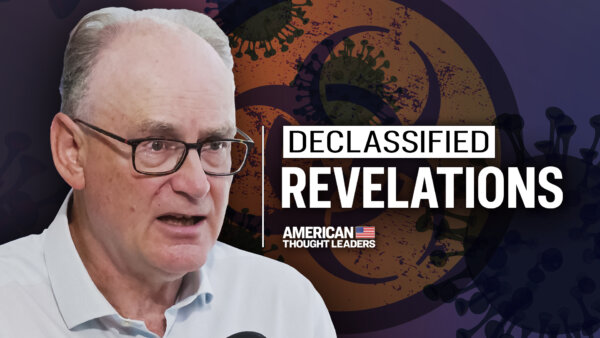
[FULL TRANSCRIPT BELOW] Dr. David Bell is a former World Health Organization medical officer and a senior scholar at the Brownstone Institute. Garrett Brown is a professor of global health policy at the University of Leeds.
“Their argument is that there is an exponential increase going on in risk. But again, if you look at the data in their reports that we’ve looked at in the reports from the World Bank, etc, it’s not showing this at all,” says Bell.
“The good study that we found on this suggested that a COVID-like event will take place every 129 years to 344 years,” says Brown.
Since 2023, they have been publishing a series of reports as part of a research project reevaluating the global pandemic preparedness and response agenda, which estimates an annual budget of $31.1 billion dollars. They say that this will have massive opportunity costs and will have a negative impact on low and middle-income countries.
“They use COVID [as] an example of the cost, although most of the costs of COVID were not directly from a virus that killed people on average at [the] age of about 80 to 83. They were the costs of closing down economies, obviously,” says Bell.
Views expressed in this video are opinions of the host and the guest, and do not necessarily reflect the views of The Epoch Times.
*Big thanks to our sponsor for this episode Patriot Gold Group. Check them out here: https://ept.ms/3sr5LhH
FULL TRANSCRIPT
Jan Jekielek:
Dr. Garrett Brown, Dr. David Bell, such a pleasure to have you back on American Thought Leaders.
Dr. Garrett Brown:
Thanks.
Dr. David Bell:
Thank you.
Mr. Jekielek:
You have been doing some remarkable work with the REPPARE group at
the University of Leeds that is looking at this pandemic preparedness infrastructure that’s being built. What’s really happening these days?
Dr. Brown:
After COVID, various governments and international organizations have decided that what we need is to be more prepared for the next pandemic and to have response mechanisms in place prior to the next outbreak. So what we’re doing is looking at how that architecture is coming together, what sort of policies are emerging from that architecture and just analyzing what is being proposed, what evidence is being used to underwrite those proposals, and sort of the robustness of that evidence base.
Dr. Bell:
Yes. In fact, most of the investment proposed is in trying to prevent pandemics in the first place and mitigate them. If a small outbreak occurs, stop it becoming a pandemic. So we’re talking about $31.1 billion a year is what the World Bank and WHO allot to this. So we’ve been looking really at the evidence that they’re using on pandemic risk, which they say is greatly increasing. And people have heard that in the media, that it’s an existential threat of pandemics, as we’re being told, and this is increasing year by year and therefore we have to invest this and in return we’ll get a huge return on investment up to 300 times in mitigating the costs.
So we’re looking at this in a dispassionate way, I think, but we have found very major flaws in the argument which we’re at a stage now, we’ve produced two reports on this and we’re very interested in getting this across, this understanding across, particularly to governments who are receiving these reports from the WHO, World Bank and other international agencies and acting on them. And I think it’s fair to say a fairly broad misrepresentation of the actual risk and the probable return on the investment they’re being asked for.
Mr. Jekielek:
So $31 billion in the last four years, we’ve been talking about some huge amounts of money being spent on all sorts of things. How does that match up with what has been spent in the past? That would be the first question.
Dr. Brown:
If you look at it relatively, $31.1 billion is the annual estimate to do what they would like to do in terms of pandemic preparedness. If you look at the WHO in 2022, their overall budget is $3.8 billion. So that’s a massive difference between what we’re spending on sort of all health programs or the WHO to handle all these health programs and putting that amount of money just into pandemic preparedness.
So the worry is that if the risks are inflated and the costs are inflated, then this is a massive opportunity cost because that $31.1 billion or another amount could be spent somewhere else on other disease burdens or other disease priorities that we know exist vs. a pandemic which we don’t know, right? It’s uncertain. There will be these events, but we don’t know when, and we don’t know how severe, and we don’t know how frequent.
And so these are the types of questions we’re trying to answer through their evidence. How are they justifying these costs? How are they justifying the threat? Does it make sense from a cost benefit? Then we unpack that to see how robust the evidence supporting those claims.
Mr. Jekielek:
That $3.8 billion with the WHO includes all the spending on tuberculosis, and malaria.
Dr. Bell:
It includes what the WHO spends on that. There are other agencies out there. There’s the Global Fund, which is a similar overall budget per year for malaria, TB, HIV. then you have private partnerships like Gavi on
vaccines. So if you take it as a disease the whole world spends about three and a half billion in total on malaria. This is a disease that kills 600 over 600
thousand people, mostly children, every year. People hear about mpox at the moment in the Democratic Republic of Congo [DRC], which the media is telling us is a big outbreak.
Of the confirmed deaths in the DRC this year there are 25 from mpox. There are perhaps a thousand unconfirmed, but suspected mpox deaths. In that time up to this time so far this year, about 50,000-55,000 children have died in their country from malaria. So there’s this huge disproportion in what is being proposed and what is actually being spent for these outbreaks, which have, and we can come back to COVID later, but otherwise a very small mortality since the time of the Spanish flu in the pre-antibiotic era versus diseases like tuberculosis, that is 1.3 million deaths every year, malaria, 600,000, HIV, over a million.
The concern is not that the WHO wants to deal with pandemics or outbreaks. The concern is that there is a massively disproportionate amount of money and concentration on it, which when you do that, you will take resources away from much greater disease burdens.Inevitably, if you look at the numbers that we’re looking at, you would expect a negative public health impact from what is happening now.
Mr. Jekielek:
Please break that down for us. How does that work?
Why is it negative? What evidence do you look at?
Dr. Bell:
The reason we live longer in wealthy countries is mainly because of better nutrition, better sanitation, and better living conditions. Nutrition spending internationally has gone down since the start of COVID due to this diversion of funding. If you take money away from malaria, we know mortality will go up because we have very good technologies, insecticide, impregnated bed nets, good treatment, good diagnostics for malaria is something that we can treat. So you take money away from these diseases, which are by and large diseases of poverty that we can readily address, then the mortality will inevitably go up.
We saw this during COVID when clinics were shut down. You move it to outbreak diseases, which even if you look at the G20 and the WHO publications on this, the diseases they list, they’re reducing in mortality over the last 50 years or so. And the mortality, say, in the last 20 years in the G20 high-level panel report is about 187,000 in 20 years. Most of that is influenza from the swine flu outbreak. That’s what they list as the major outbreaks. And this is all including COVID? This is before COVID, so these are natural outbreaks.
Then COVID is an interesting one. The WHO lists just over seven million deaths recorded from COVID over the last four years, or since the start of 2020, almost five years now. Even if you do that per year, that’s not more than TB. It’s very close to TB. Most of these deaths are in much older people. If we say COVID is a natural outbreak, with the pandemic in the late 50s, and the one in the late 60s, there were about a million deaths each. Over the last century, the mortality rate is relatively tiny. Now, their argument is that there is an exponential increase going on in risk.
But again, if you look at the data in their reports that we’ve looked at in the reports from the World Bank, et cetera, it’s not showing this at all.s showing a huge increase in our ability to detect outbreaks. So we’ve invented point of care tests for serology, for antigen tests, as people became familiar with during COVID, where you get a colour change in 15 minutes, etc. These are all new. The PCR tests were only invented in 1983, and they only became widespread in the last 30 years. These are all new technologies.
So we would have had the same diseases in the 1960s but we didn’t have the ability to detect them from all the background diseases. We’re seeing an increase in the number of outbreaks we can distinguish because we’re getting much better at detecting them. But actually from about the year 2010 to about the year 2020 when COVID started we were actually seeing a decrease in outbreaks and a decrease in mortality on top of that.
Mr. Jekielek:
That goes against everything we are being taught at the moment. They’re planning for one outbreak every 10 to 50 years. How does that square with the historical data?
Dr. Brown:
The history doesn’t back that and it doesn’t also back the numbers of deaths they’re assigning to these outbreaks on a yearly basis. So one of the later reports that have come out suggests something like 2.5 million people a year die based on these emerging diseases and outbreaks. But they include things like the plague and the Spanish flu in order to drive up those numbers.
Dr. Bell:
With the plague from medieval times, we go back hundreds of years.
Dr. Brown:
And they average those out. And that’s how they can say that. But, you know, the historical record doesn’t back that. We’re not seeing 2 million. If we were seeing 2.5 million deaths a year, then we would know about it. And that would be a public health threat that you would want to address. So it’s just the way these things are being modeled and the way that the evidence is being presented makes the existential threat seem immediate, increasing, and more severe. And yet the data and the evidence that they cite say something opposite, which looks like a misrepresentation or an underrepresentation of what the true condition is that we’re trying to address.
Of course, there’s a risk if zoonosis spillover takes place. We have historical examples of it. But that risk is still under debate. It’s either underdeveloped or it’s not developed to the point where it looks robust enough to make the kind of decisions that are being made in terms of policy and financial obligations. And that’s what we’re kind of looking at.
We’re trying to figure out what are these costs, what are the justifications of these costs, what is the evidence being used to support the justification for those costs, how robust is that evidence, who are they citing, who are those citations citing and what is the robustness of those studies as well. So we’re going into secondary material. This is the evidence that they’re presenting or these are the arguments that they’re presenting and we’re just unpacking those.
Dr. Bell:
We talk about the World Bank, we talk about a high-level panel of the G20, the World Health Organization. So governments assume that these are reliable entities and they’re busy. You get a report and it says there’s an existential increase and it quotes a couple of papers and there’s a list of references at the back. They haven’t got time to go through all those and find that those references, if you actually read them objectively, actually say quite the opposite of what is being quoted in the text.
So we’re finding that a lot. But what the governments are hearing from what they assume are reliable agencies, is that we have this rapid increase that if they don’t act now, then their populations will be in great danger. Well, whereas the background data is actually showing quite a different story.
Mr. Jekielek:
Basically, your argument on the risk side is that the risk is being over exaggerated or based on the data that is being presented by these reports themselves.
Dr. Brown:
I’m not quite sure we understand the risks fully and they’re being presented very matter-of-factly. And then when you look at the evidence supporting those risks, it shows something different. In fact, maybe even a reduction of risk. And so that makes you ask, well, we’re making these really big decisions based on an existential threat, and that’s their wording, not our wording. And what we have been proposing is, hey, let’s just stop, slow down a little bit.
The good study that we found on this suggested that a COVID-like event will take place every 129 years to 344 years. So that’s a rather good study. It has its problems, but at least it was very systematic and they worked through the model and the model is presented so you can understand how they generated those numbers. If that’s true, then we have time to think about this, to get the response to be proportional, to think about other disease burdens, to make sure that we’re relatively doing what we need to do to make people healthier and safer. So why don’t we rethink this, maybe even get a better evidence base? Let’s do these studies properly. Some of the studies that they did should take three years to do properly.
Mr. Jekielek:
You’re arguing that there’s no reason they don’t do them that way.
Dr. Brown:
There has been a tremendous amount of pressure post-COVID for people to look like they’re acting. There have been a lot of questions about why we weren’t more prepared. I think governments think they need to be more prepared. The financial costs of COVID are massive. And so you obviously want to avoid something like that again, but I’m not sure what they’re proposing is going to do that. In fact, it might even be more costly because the measures that are being put in place are disproportionate to the risk. And it’s not even clear to us that the measures that they’re thinking about doing would have the kind of effect they think they’re going to have. And the return on investment is what they propose is fairly unrealistic.
Mr. Jekielek:
The focus goes too much in this direction, and these things can get neglected to the known detriment of the populations. Is that what you are saying?
Dr. Brown:
Yes, we call it opportunity costs. What’s the opportunity you lose by investing in this? David was saying that nutrition went down by 10.2% during COVID, our spending on nutrition. But we know that will then underwrite immune deficiencies, so you’re escalating risk. This is what’s happening with mpox. It’s harming these young children because they just don’t have the capacity to fend it off, so these things have knock-on effects.
Not only are there immediate opportunity costs, but then there are knock-on effects by not putting the type of resources we know work into known disease burdens instead of things we don’t know work into unknown disease burdens. Part of our project is trying to estimate or trying to figure out how people estimate pandemic disease burden. We looked and did a systematic review. It was like 2,700 different studies to try to figure out how they are trying to figure it out, different methods using excess mortality or using DALYs or other kinds of forms of disease burden measure. There’s nothing out there.
There’s a lot of different studies, but there’s nothing trying to figure out systematically what those different mechanisms are and what they say and what are the problems of using one kind of measurement against another kind of measure. And then comparing those against other known communicable and non-communicable diseases. What are those disease burdens and how do these things measure up against each other?
Mr. Jekielek:
There has been increased discussion of lab leaks being possible origins for some of these diseases or COVID and then even in the past. Is that factored in here at all into these studies?
Dr. Bell:
No, it’s not. So all these studies are about, or all of them really, we’ve seen quite a bit about natural outbreaks and the risk of natural outbreaks. So it’s an important issue because they use COVID, a lot of these, as both an example of the cost, although most of the costs of COVID were not directly from a virus that killed people on average at the age of about 80 to 83. They were the costs of closing down economies, obviously, and closing supply lines and pushing people out of the cost of the mitigation measures.
There was a choice. It wasn’t the virus. It was a choice of a public health response that we had not done before. And in past outbreaks, like in the 50s and 60s, when we had those flu pandemics, we didn’t do that. And after a year or so, it went away. We didn’t have mass vaccination as we do now. They use COVID as an example of the cost, but all their work, all their mitigation is about natural outbreaks.
And I think that the reason for that, and it’s perhaps a reason why the lab leak hypothesis is still quite unpopular in the mainstream. If you assume that the main risk is from lab leaks, from dealing with modifying or just keeping and studying and transporting potential viral threats, then you would mitigate it, not by spending $31.1 billion, creating a huge industry with a huge pharmaceutical sector, potential gain, et cetera, from mass vaccination and so on. You would just stop doing that, or you would improve lab security, and it would be very cheap.
You could stop gain-of-function research, you could decide what we’re getting out of this is actually not that useful because most gain-of-function research in these viruses is part of this pandemic agenda. It’s saying these viruses could change into a more virulent form, they could pass from animal to human and cause a pandemic. But we could say well we haven’t seen that from a natural outbreak at any big scale since the Spanish flu which was before we had antibiotics and although as a virus most people died of bacterial infection, so even now the Spanish flu would be much less harmful.
In a century since then we haven’t seen such big outbreaks. So probably the real risk is from viral manipulation or it’s a reasonable argument and not from natural outbreaks. If you pivot in that direction, you admit that for COVID, then the whole argument and the whole investment argument goes away.
Mr. Jekielek:
This manipulation also includes going to faraway places like bat grottos and finding viruses that might have pathogen potential and bringing them out into the public sphere. I’ve read a number of grants about that type of activity.
Dr. Brown:
You’re going to find them if you’re looking for them. The point is that the pandemic preparedness sort of architecture landscape is not factoring that element of it. So if it was a lab escape, those types of measures aren’t in this 31.1 billion response that we’re talking about. Probably far cheaper to control that. And you should just hedge your bets. There is going to be natural zoonosis. You’re going to get spillover events, but you also potentially can get laboratory escape.
We saw that with anthrax before in the CDC many years ago. These things can happen, but it’s not being factored in. And that’s the kind of the question that we have is it’s very expensive to do the kind of mitigation work that they want to do with the surveillance, the diagnostics, the countermeasures. The key example that they use as the pandemic risk, the pandemic threat may have another explanation, but that doesn’t go factored into any of the decision making or any of the policies that I’ve seen come out.
Mr. Jekielek:
Please tell us about your backgrounds. Let’s start with you Dr. Brown
Dr. Brown:
My background is health economics. I did a lot of stuff on health systems financing, usually in African contexts where I would do some evaluation of their programs. I’ve spent most of my life looking at results-based financing and whether it is successful or not.
Mr. Jekielek:
You’re looking at whether certain types of health-related measures actually work. Is that correct?
Dr. Brown:
And how they work and to what degree they work and what modalities you use. Some work better than others, and it’s usually quite critical. I never worked on pandemics prior to COVID, but I was working in the securitization of health in critical ways, thinking that we’re over-medicalizing it, or we’re spending a lot of money on health security, when actually, good public health and good lifestyle is also a form of health security. I was writing about that topic already.
That came to light with COVID because of the comorbidities. I was thinking that on any given weekend, the NHS in England was about to crash. It operates on a really thin adaptivity model. There’s no elasticity. And so on weekends, they’re always talking about the NHS being stressed. And that’s largely because of the way the NHS works in terms of efficiency modeling. There’s just no elasticity. People can’t move, things can’t adapt. If you get a surge of anything, and so I’ve always been arguing that, well, look, that’s not very good for health security.
Health security would be strengthened by resilient systems that have some adaptivity built into it and healthier people who have to spend less time in the hospital. And though, you know, that’s when COVID kind of dovetailed on that, because we were talking about, you know, underlying poor health being a driver of the mortality that we were seeing. And that got me interested in it.
Since then, it’s taken over my research agenda, because it became a topic in global health. Climate change and health are the two hot topics, and I mean hot topics. That means all the funding is going into it, all the interest is going into it, all the pressure is into it, and all the institutions are facing toward it. You get into that game when that kind of momentum is happening. You start wondering, well, how justified is this momentum? That’s my background and how I got into this particular project.
Mr. Jekielek:
Dr Bell, what is your background?
Dr. Bell:
I’m a public health physician and worked in international health for about 25 years. I was in the World Health Organization for eight years working on infectious diseases, mainly malaria. I worked on the first SARS outbreak in 2003 and in a number of other outbreaks and among other jobs since then I was director of health technologies at a Gates lab in Seattle or just out of
Seattle.
Now, I consult in the global health biotech field. I’ve been involved in how to get healthcare technologies into low middle-income countries and how to understand how those health systems work and you know what makes a difference and what doesn’t. It was very clear when COVID came along that there was something grossly wrong. I was aware of the push towards pandemics and how it didn’t make sense vs. the other disease burdens that we had. But with COVID it was very clear early on that the response was going to be inappropriate, especially for low-middle-income countries.
Mr. Jekielek:
Disproportionate, you mean?
Dr. Bell:
Grossly disproportionate, particularly as we knew very early on about it was killing old people in China, not young people. 50% of sub-Saharan African people are less than 20 years of age and 1% are over age 75. So clearly, COVID was not going to be a problem in Africa, yet we saw this messaging of a catastrophe in Africa. A lot of this was pushed by corporate interests and pharmaceutical investors. I’ve been aware of this for 20 years, but it became very obvious how these other forces that were invested in and directing the global health field and how they were diverging greatly from what we knew in global health.
Public health makes a difference, which is making these basic determinants of disease. We had this completely vertical approach which was the opposite of what WHO was supposed to stand for. So it was clear that there was something wrong and that this wasn’t really a legitimate public health response. There were other forces that were involved that were twisting it.
Dr. Brown:
I should also mention that because I was working in health financing I was asked to work on one of the reports in which we’re critiquing and I had a teamwork on it and I was one of many that were working on it. It was the World Bank, WHO and I was a bit disillusioned with how that report came out and I couldn’t see how what we provided in terms of the data was actually being reflected in the results of the report. And I couldn’t see how the final analysis was done. That made me start to question the rigor and the robustness of the report.
And I’m critiquing my own work here. I was part of that. I don’t like how it turned out. Wouldn’t it be great to look at this more thoroughly, more systematically? That triggered an agreement. Let’s pull a team of the right people together, academics, almost exclusively, and just look into it.
If we’re wrong, then great, then we can support these reports and say, you know, this is the appropriate amount that we need to spend on this. And, you know, there will be costs, but this is still an appropriate amount. And if we’re right, if our hunch that there is something potentially not very robust about it, then that, we would hope, would spur a conversation that would lead to more accurate estimates or at least a much more proportionate and reasonable response. That was the driver behind this.
It’s about information and knowing, being informed about the decisions you’re making. It is about evidence-based policy. And when you rush things like that, there’s going to be errors. Part of the scientific process is questioning this stuff. And then we get questioned and then we’ll go back. That’s what you want. You want that dialogue. It’s tough to do that in three months.
Dr. Bell:
We’re not about advocacy. We’re about evidence-based medicine, basically. And the only thing we’re advocating for here is to go back and look at the data in a more appropriate way, look at it in context, and come up with evidence-based policy rather than a sort of knee-jerk reaction,
which is clearly contrary to data that we’re seeing at the moment.
Dr. Brown:
You can look at the titles of these reports: Time for Action Now, Managing Epidemics, and Pandemic-Free Future. They are proposing that it’s really immediate, and it’s very sharp, and that something needs to be done very quickly.
Dr. Bell:
Earlier, Garrett mentioned a paper that we looked at that says once every 129 to 200 something years, we would expect another COVID event on average. That paper was quoted in one of these reports as saying we can expect in the next few decades a three times increase in risk of COVID or another large pandemic. So, you know, we only knew what the paper actually said because we went through the references in this report
to check that they were being quoted properly. And what the paper actually shows was a complete antithesis of what the claim was in the report.
Dr. Brown:
That’s what happens when you move quickly. It’s either deliberate or it’s accidental, but both aren’t good, right? You’re either misquoting something or you just need to get a citation to prove a point and you scan a paper very quickly and you cite it. That happens more and more in academia. But it’s also happening more and more with these types of reports.
You get some you know young civil servants who need to justify something quickly. They do a Google Scholar search and find a couple papers. Maybe they read the abstract really quickly and then they cite it. But if you won’t go through the report line by line, which we’re doing and trying to be very systematic, and it says something different, then that exposes a problem. It’s either a misrepresentation or it’s sloppiness, but either one is not good.
Dr. Bell:
Often that won’t matter. In this particular case, we talk about tens of billions of dollars of funding for health, and a lot annually, and a lot of lives, millions and millions of lives that hang on that being spent well. In this case, this has huge implications for the way that taxpayers’ money is used and for the survival of people in low and middle-income countries in particular.
Dr. Brown:
The sloppiness goes into the way they’re actually justifying the costs. They’ve produced a series of return on investments. And those return on investments make some pretty unsophisticated, let’s just say, assumptions. And one of the assumptions that’s very problematic is that if we invest this $10.5 billion a year in ODA over the next five years, then we’ll see a return on investment that looks like this.
But when you unpack the numbers, that 100% economic impact can be mitigated by doing this investment. Now, any outbreak is going to have some costs. So you automatically have to question that. How could that possibly be the case, that you would be able to mitigate in advance 100% of the economic impacts?
The other mistake that they make, and David referred to this earlier, is they don’t disaggregate indirect costs from direct costs. So the direct cost of the virus is what? Hospitalization, lost wages due to illness, therapeutics, right?
So these are things that you need because people show up sick. The indirect costs are stimulus packages, travel bans, lockdowns and economic decline. Those are indirect costs.They fuse those together.
When they say that if you invest this amount, you’re going to get a 40,000% return on investment of the likes of $50 trillion in 100 years, that looks like a pretty good investment. And I think that that’s why you would need to look at that and unpack these return on investment calculations. And most of the time they don’t even give them, they don’t even tell you the methods they use to do that. We had to reverse engineer them, figure out what they say the end was, and then figure out how they could possibly get there using some other numbers and other parts of their reports. We were able to do that, but it showed that they were incredibly unsophisticated and problematic in their assumptions.
This is problematic, but then you hear from someone who’s worked on the report, and I worked on the report, so I know people who worked on the report that, well, this particular return on investment was done by a 26-year-old in a large consulting firm who was tasked with this. Now, is that intentional that you put someone so junior on it? Is that just the best you have in your consulting firm? Maybe it wasn’t double-checked. Maybe you’re moving so quickly to get this out in three months, that’s just the best you can do.
Whatever the excuse is for that, when you see that the assumptions are wrong, then you have to say, well, if you’re basing policy on that, then that’s going to be wrong too. It’s going to have a knock-on effect and it just has to be more robust than that. Why are we going to spend that kind of money to alleviate a problem, when we have all these other problems in global health to deal with, ones that are really immediate, endemic, year on year? You just want better justification and more robustness.
Mr. Jekielek:
Describe to me a few very surprising things that you found, that we may not have discussed already.
Dr. Brown:
Just how shallow the evidence was that was being used and it could be a really weak graphic with no explanation of source for the data or even no use of data, just a name of a disease and a year. And say, well, look year there you know every so often there’s these diseases so you know this is an increase but they don’t give you anything else I just think the level of evidence was fairly shocking I knew it was bad but I didn’t know how bad it was and
Dr. Bell:
I’ve worked in WHO and 20 years ago this sort of thing wouldn’t have happened. There were two publications from WHO backing this agenda; Futures of Violence, and Managing Epidemics. They both include a graphic, which I’ll describe because it’s an interesting one. It goes from the year 2000 to the year 2022. At the start, there’s no outbreaks, and then it has lines of outbreaks as they start. When you get to 2020, there’s seven or eight outbreaks ongoing, and there’s a few that get resolved. This is published for member states.
You look at it and you think, wow, we’re having this huge increase in outbreaks. Those outbreaks are things like cholera, plague, yellow fever, et cetera, which used to be huge problems in the past and are now very minor problems overall. There are some outbreaks like SARS and MERS which we can detect now, but coronaviruses would have already always had outbreaks. What the graphic should show is that a hundred years ago, a large burden of these diseases came down.
What it should be showing is that we’ve been very successful against these diseases but they’ve redone the graphic to make it look as if these are new emerging diseases and we have an exponential increase in them. We talk about the World Health Organization and we’re talking about official publications for member states to use to develop policy. There was a time, I like to believe, in the past when that would not have been possible to get that out of the organization. That is what has shocked me, the shallowness of evidence and the willingness to misrepresent data and truth in order to push a particular agenda for whatever reasons they want to push that.
Dr. Brown:
There’s now a new fund called the Pandemic Fund. It’s operated out of the World Bank. In order to own the space very quickly, before they had even their sort of procedure manual drawn up, they released the first transfer funds. They did a first grant call, and that was in July last year. And that was for them to be able to say, look, we’re already operating in this space. You can trust us. We’re the pandemic fund. And we have a results-based model. We haven’t designed it yet, but we’re going to. So you can trust that you’re going to get results from this. And that was so quick. And it was so poorly designed. It’s had to have so many tinkers since.
I was just shocked and thought, why didn’t you learn the lesson from the last pandemic fund you had that collapsed? The pandemic emergency fund that was started in 2015, basically was a massive failure. Why don’t you learn from that a little bit, slow down and design something properly instead of just knee-jerking into it? And then you start questioning, well, what would be the motivations for not doing that? It’s the competing interests of various groups at the global level.
The World Bank wants to own this fund. They want the money channeled through the World Bank. Of course they do. They want to grow and they want to keep their staff employed and they want their epistemic authority. And, you know, the WHO was vying for it too, but no donor trusts the WHO. So they’ll trust the World Bank because they feel like they have more control of it. And all of them are trying to move in this space so quickly to capture what they can get. And I was surprised by that because that’s political. That’s not necessarily public health.
Mr. Jekielek:
That’s very interesting because you’re describing vying even within the UN, among the agencies at the UN.
Dr. Brown:
Yes, they’re vying for control.
Dr. Bell:
These are people and there are thousands of people now on this agenda and they all have salaries, they all have benefits that they want to protect, they like to travel, they’re trying to build their own team, they need more money for that. So, there are incentives right through this to grow your organisation, to grow your team. And if the money is out there for the pandemic agenda, and you’ve shown that that works, this sort of fear-based approach, even to countries, then that is what you do, because you’re working in one of these organisations, and your primary objective is to grow your team and to secure your salary.
You can put the building blocks in place and you can argue about how that was done. But once you put these objectives in place, then it runs itself. People compete against each other. If the money is there, they’ll compete for the money. They’ll come up with a more urgent story in order
to get more of the money, and it feeds on itself. I think that’s what we’re seeing.
Dr. Brown:
Let’s take Germany as an example. So Germany has invested a lot of money in a biohub called the International Pathogen Surveillance Network running out of Berlin. This is supposed to get all these samples that are going to be shipped to it through increased surveillance and diagnostics. They’re going to try to identify where the most high-risk next virus is, or pathogen of your choice. Then they’re going to farm that out for countermeasures.
Now, why would it be in Germany’s best interest to have the biohub in Berlin, Germany? It is because they have a pharmaceutical industry that will benefit from that. I’m sure some of the three billion investment that Germany put into it if we looked at the numbers I haven’t so I don’t know for sure. It probably comes from pharmaceutical investments as well as some kind of public-private partnership. These kinds of incentives are built into it, so you get policy swaying towards these types of incentives. It’s certainly in Germany’s interest to have a strong pharmaceutical industry and that helps their GDP. It helps other people in the WHO to be running that biohub. So it’s co-produced with the WHO. It’s just kind of how global health is going.
But what was surprising is how quickly those aligned interests met. And if you look at what’s being proposed so far, or at least what’s been designed so far, it’s all based on surveillance, diagnostics, and human resources for those two activities. That’s all the pandemic funds at the moment. No health system strengthening, no adaptivity of your health systems, no nutrition, nothing about better health for your citizens, which means you’re more resilient, and this international pathogen network. So you can see the logic, right? Find, distribute, countermeasures, put it into implementation. And that’s sort of what’s all been taking place so far.
Now, they might expand on that. They talk about strengthening health systems and making more resilient, healthier people. That’s all part of the agenda and the narrative, but where the money is going and what has been established is very much on the line of, you know, we are going to make countermeasures to counter this threat. So it’s kind of a one trick pony and it looks like more of the same.
Dr. Bell:
Remember that during COVID, locking people down and countermeasures generated the largest concentration of wealth in human history. The people who are very interested in this agenda benefited hugely through this COVID model. There are incentives at that level. With pharmaceutical companies, their job is to make a profit. They’re private companies.
The CEO of a pharmaceutical company, his job is to maximize return on investment of his shareholders. His job is not to be altruistic and to improve sanitation, because that is the best way to make people more resilient so that they will be resistant to viral infections. His job is to move things in a way that he will have more vaccine sales or more antiviral sales. He will do that because that’s his job. If he can do that through the global health industry, then he will do it through the global health industry.
In a way, this is inevitable. If you take off the checks and balances and you do away with concerns of conflict of interest, then you don’t need someone orchestrating all this. This is something which will almost inevitably happen. It is due to this huge confluence of incentives from the people who are in these organisations who want to keep their salary, to people in industry who see huge potential income from this model of dealing with outbreaks.
Dr. Brown:
Epistemic authority, like it matters to be important. The WHO went through a bit of an existential crisis after the Ebola outbreak, where they were blamed for not acting fast enough. And, you know, is this, you know, and they’re under attack all the time. People want to defund the WHO and, you know, Trump threatened to do so before. And so this happens. And I think, you know, you’re in this organization. This organization wants to have that epistemic authority and be relevant and important, and that can cloud judgment sometimes. Maybe not.
I work for the WHO. I do a lot of co-projects with them. There’s some very good people there and their intentions are all very good. But as a structure, as a bureaucracy, you’re going to get all types. And some of those types just want to make sure the doors stay open. So some of it’s just opportunistic, right? Look, everyone is absolutely scared of the next pandemic. We don’t ever want to go through what we went through with COVID again.
Most people think that the natural result of the virus was all the lockdowns. That’s just what we had to do to get through it. So people are operating on that perception. That’s a nice opportunity, right? That opens up a huge door for your institution if you’re in public health to pivot towards that agenda and to try to seize that agenda to continue your existential worth. It makes sense to me. It’s not conspiratorial. It’s the way humans are.
It’s very human, actually. But that also means that as human beings, because we are reflective creatures, we should also stop and recognize that when we see it or stop and recognize it when we’re worried about it and then test it out a little bit because we know we’re fallible and then that’s part of the deliberative process of how you get things done.
Mr. Jekielek:
At this point, you provide some recommendations in your reports, because this project is ongoing, as I understand.
Dr. Brown:
We’re moving into other phases. We’re not trying to find solutions yet. We’re only a year into it. We are trying to find the extent of the challenges we’re facing, and the evidence base of the challenges we’re facing. We’re setting it up and exposing those problems and asking reflective questions about them.
At the end of the project, we are planning to make some recommendations. Our recommendations so far have only been, let’s slow down and reevaluate the evidence base. Is this proportional to the risk? Is this a cost-benefit? The first step of reform is to recognise the problems that you have.
Dr. Bell:
It’s very basic. If you are investing in pandemics, then look at where that money is coming from and look at the opportunity costs. So don’t just put the money there and then worry about that later. This is pretty obvious to anyone. You can look at the history of outbreaks and see that in the last century we’ve had very few and therefore you know they’re not the big things that kill us so we do have time to sit down and do this properly.
People need to disconnect themselves from this fear narrative which is going on and just be a bit 2019-ish, and just think this through from a logical viewpoint. When I say people I mean countries as in the people who are getting this information from the WHO and the World Bank and that they need to understand also that you know in these organizations of people with their own self-interest so the World Bank is not a purely altruistic entity there for the world that sort of happened from I don’t know, God or something.
It’s something that was put together by humans and is run by humans. It’s been there for a long time. A lot of people have been in it for a long time, gaining good salaries from it. And so we have to treat all these international organizations in that way, as these are organizations run by flawed humans. We should listen to what they say, but take it with a grain of salt and check it.
Mr. Jekielek:
You mentioned the pandemic treaty, which didn’t go through earlier this year. What is the status of the treaty?
Dr. Brown:
The vote was in late May, actually very early June, to adopt the pandemic treaty. It’s now called the pandemic agreement. But they couldn’t agree on all the articles. And there’s a couple of key, very key articles that aren’t agreed upon. So they’ve suspended it for up to another year, up to this coming May, to try to work that out. And what they’ve decided to do is to focus only on the sticking points. So when you look at the treaty during the negotiations, there’ll be green lines, red lines, there’s different color lines, most of them are green, there’s just a few red lines.
They’re just focusing on those to try to get it approved or passed at the World Health Assembly in May. The dynamics that seem to be taking place are that primarily sort of the global South, African countries, some Latin American countries are resistant to the way the treaty is set up because they think they’re getting a raw deal. I think they’re probably right about that. There are sticking points on intellectual property, on what they call beneficiary sharing. Who benefits from these countermeasures? How much access will you have to those? If you contribute to the system, how much do you get out of it? It can’t just be a public good that is turned into a private good. They’re resisting that.
Then there’s a little bit of resistance on the amount of surveillance and the cost of the surveillance. They want integrated surveillance, and that’s very costly. So a lot of these low-income countries are saying, well, without you, you either pay for it, which it doesn’t look like you’re going to fully, or you don’t have to do this because we have trouble making sure our rural clinics have power 24 hours a day. How are we going to afford to do this very costly integrated surveillance?
Mr. Jekielek:
That means testing for these diseases, basically.
Dr. Brown:
Yes, but it’s testing animals, soil, water, and integrating across sectors. So you would need your environmental agency to be aligned with your public health institutions.
Mr. Jekielek:
Hence, this giant budget that we’ve been discussing all along.
Dr. Brown:
I don’t know if that will cover that, and that’s the sticking point. Because of this 31.1 billion a year, 26.4 billion of that is in low and middle income countries. So they’re going to have to pony that up. The donors, rich Western countries, have to pony up $10.5 billion. So you’re asking these very, very poor countries that already struggle to keep the doors open of some of their clinics, to keep their doctors paid. We’re talking about places like Mozambique, Zimbabwe, Lesotho, now diverting large amounts of resources to an integrated surveillance program that’s very, very costly.
During one of these negotiations, an African delegate stood up and said, we can’t even do coordinated surveillance within the health sector, let alone integrated surveillance across sectors. In theory, it’s a great idea. In theory, One Health is a great idea. But these African countries are saying that without significant help, they won’t be able to do that.
These sticking points are pretty embedded, and it would be difficult to overcome them. Maybe that’s a good thing. There’s parts of the pandemic treaty that might not be good for public health. I’m glad they paused it and that gave another year for these deliberations to take place. But ultimately, I’m not sure all the right questions are being asked. But we’ll see how it unfolds. It doesn’t look promising for the pandemic treaty at the moment.
Mr. Jekielek:
Dr. Bell, a final thought?
Dr. Bell:
Just as we said, people should slow down and we need to get back to evidence-based medicine and to the basics of public health, which is weighing cost and benefit, looking at context. The other issue is we need to get back to countries making their own decisions. And this is very much a centralised sort of, I would say, colonialist agenda that we’re seeing.It’s very much run by the West and pushed on these countries as you were saying. And that is not what public health was supposed to be.
This whole area needs to sit back and rethink what are the basic ethics around public health? What should an organisation like WHO really be doing as a servant of countries? We’ve got to a point where I think it’s going to be very hard to fix. But there’s a huge need to fix it, and it’s not in the direction they’re saying. It’s quite the opposite, I think.
You stop infectious diseases by being resilient against infection, having a good immune system, having good nutrition, and having good economies in the country. We need to shift back to that rather than this knee-jerk reaction to individual pathogens, which we knew from the 70s and 80s was a really bad way to go.
Mr. Jekielek:
Dr. David Bell, Dr. Garrett Brown, it’s such a pleasure to have you on the show.
Dr. Bell:
Thank you.
Dr. Brown:
Thanks.