Live chat
August 26, 2025
American Thought Leaders
Live chat
 Expand
Expand
 Expand
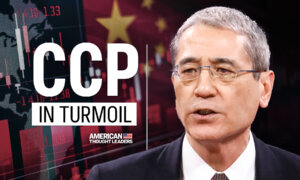
[RUSH TRANSCRIPT BELOW] Political economist Chenggang Xu grew up amid the upheaval of China’s Cultural Revolution and in the 1970s was beaten, imprisoned, and subjected to years of forced labor by the Chinese Communist Party (CCP).
Today, he is a senior research scholar at the Stanford Center on China’s Economy and Institutions, a visiting fellow at the Hoover Institution at Stanford University, and author of the new book, “Institutional Genes: Origins of China’s Institutions and Totalitarianism.”
For decades, Beijing has repeatedly deceived the world about its true intentions, Xu says. So why do we keep falling for it?
In this episode, we dive into the origins of the Chinese Communist Party and why Xu believes its model of totalitarianism is distinct from any other regime today.
Views expressed in this video are opinions of the host and the guest, and do not necessarily reflect the views of The Epoch Times.
RUSH TRANSCRIPT
Jan Jekielek:
Professor Chenggang Xu, such a pleasure to have you on American Thought Leaders.
Professor Chenggang Xu:
Thank you for having me.
Mr. Jekielek:
Something that is very, very difficult to understand, but of critical importance in the relationship between communist China and the free world, is the nature of the Chinese Communist Party and how it’s fundamentally different from what we think of as conventional institutions. You’ve come up with a way of explaining it.
Mr. Xu:
If we want to explain that in a very simple way, then the simplest way of telling this story is that the Chinese Communist Party is actually part of the Soviet Union Communist Party. So it’s a historical fact that it was created by the Soviet Union. And from the very beginning of establishing the Chinese Communist Party, it followed all the basic principles, the basic rules of the Soviet Communist Party. So any other interpretations of the nature of the Chinese Communist Party are just wrong.
And the wrong interpretations actually started fairly early, since the late 1930s, since the Second World War. So since that time, many American intellectuals were fooled by the Chinese Communists. From then on, they regarded the Chinese Communist Party as something else, only with a name called communists. And that actually was a story told by Mao Zedong. So that was a story purposely portrayed to create a different picture of the Chinese Communist Party that not only fooled the Americans, more importantly, it fooled Chinese intellectuals.
Mr. Jekielek:
Let’s get to what the Communist Party actually is. Because I mean, your answer here is basically that the Chinese Communist Party is masquerading as not a Communist Party. And that’s, of course, of critical importance. But I don’t think people understand what a Communist Party is in the first place.
Mr. Xu:
The so-called communist party is not a political party in the common sense. So if we try to understand what a political party is, then the easiest way is to go back to a definition given by Max Weber in the early 20th century. So by his definition, a political party is a party within political competition. So you have multiple political parties competing to gain the votes for power. And parties attract people voluntarily into the organization.
But here, a communist party is going to violate all of these definitions. So first of all, a communist party does not allow other organizations to exist. So it controls all organizations. It’s not within; it’s above. All the organizations have to be controlled by the communist party, and also it’s not voluntary. So entering and exiting the party are not voluntary. A communist party is a secretive political organization from the very beginning to today.
Mr. Jekielek:
In your book, Institutional Genes, you describe these secret organizations that are part of the institutional genes of the original communist structure, both in China and the Soviet Union, as being a secretive terrorist organization. Please explain that for us.
Mr. Xu:
To understand the nature of the Communist Party, we have to understand the Leninist principle. The so-called Communist Party is a creation of Lenin, but actually, Lenin didn’t really create such an important institution from scratch. Instead, Lenin inherited these principles from those terrorist organizations. The term terrorist is not created by scholars. It is given by those organizations themselves.
A leading example is the organization called People’s Will. This People’s Will Party calls themselves terrorists. And their core strategy is using a terrorist approach to achieve their political goals. So here, not only Lenin, but all the main founders of the Bolsheviks, all of them were originally from those secretive political organizations or terrorist organizations. And that is why Lenin could successfully reconstruct all the principles inherited from the existing terrorist secretive organizations, using those as principles for communists.
And when the Comintern, the Communist International, which is a missionary organization of the Soviet Communist Party, came to China and established their branch in China called the Chinese Communist Party, they actually purposely created the Chinese Communist Party as their branch, following all the principles. Among their first instructions to the Chinese communists was to expand this organization, trying to eliminate all the existing Chinese secretive political organizations. And we have hard evidence of how they gave the instructions.
Concretely, one of the most important secretive societies within China before, which has a long history, long before the creation of the Chinese Communist Party, was the so-called Brotherhood Society, which is a nationwide secretive organization. This Brotherhood Society indeed played essential roles in providing a kind of foundation for the establishment and growth of the Chinese Communist Party and also served as a base for the military of the Chinese Communist Party. So when people talk about the early history of the Chinese Communists and their regimes, people talk about Jinggangshan as their base and later Yan’an as their base. But it turns out both of these two bases were based upon the Brotherhood Society, particularly Jinggangshan.
Mr. Jekielek:
But the bottom line is that the Chinese Communist Party, in its origins, is not a political party, but instead, a secretive terrorist organization, by actual description, by definition. Is that correct?
Mr. Xu:
Yes. So literally, a substantial proportion of the Chinese Communist Party’s founders and cadres, core members, and major figures have this background. For example, nowadays when people talk about Xi Jinping’s father, Xi Zhongxun, he was one of the major assistants of Liu Zhidan. He created this revolutionary base in that area. Yan’an is the capital of that area. He relied on the Brotherhood Society. He was recruited by the Brotherhood Society, so he became a leader of that society.
He formed a coalition with the Brotherhood Society in that area. People usually called them bandits. So a coalition between the communists and the bandits created that base. They then recruited the local heads of the Brotherhood Society into the Communist Party, and many of them became the top military leaders of the Chinese Communist Party. When people talk about the factions within the Chinese Communist Party, one of the most important factions is the so-called princeling faction. The term princeling simply means that their fathers were the top communist leaders. But then we have to further understand who they are.
So what are the principles of the institution? Normally, the institution is a Leninist institution. Normally it follows Leninist principles. The reality is that in the case of Russia, that’s the People’s Will Party. In China, that’s the Brotherhood Society. And then you have many experts within China who understand what the Brotherhood Society is. So that explains a lot. It’s more than the Marxist principles, more than the usual communist principles.
Mr. Jekielek:
Please explain the role of violence within the Communist Party, because you highlight that as a key tool of the party.
Mr. Xu:
Right. The brutality of a totalitarian party comes from two major sources. One source is the idea that there exists only one truth—and the truth must prevail. For the truth to prevail, you have to eliminate everything wrong, so that it is a pure ideology. But that ideology is important because it provides justification and legitimacy.
Then the other part is in practice. In practice, because it’s based, its whole structure developed based upon secretive organizations, based upon this sort of terrorist organizations, there is a tradition to eliminate your political rivals. Your political rivals become enemies. They will not allow the existence of anyone who disagrees, although the disagreement could be only tactical. Even tactical debates could turn your comrades into enemies.
That is the reality in all communist parties. The Soviet Union was the first one, and then the Chinese communists have been practicing in this way. Within this kind of structure, the political power struggle is a life-and-death struggle. And that is why it’s so brutal.
Mr. Jekielek:
At its base, the Chinese Communist Party, one, has to have total supremacy, and two, it views all political engagement as a life-or-death struggle.
Mr. Xu:
Yes. These power struggles within the party are a matter of life and death. In the Soviet Union, the most prominent examples would be the purges, the great purges launched by Joseph Stalin. Many of his comrades, like Chomsky and so on and so forth, were killed in many different ways. And the same is true in China. The most prominent examples would be the Cultural Revolution. Even today, the so-called anti-corruption campaign is a power struggle.
So that is an excuse; it’s a justification for using brutal ways to eliminate their political rivals. But actually, many of those are not really rivals. They just could have different views or be in different factions. By the way, the communists would not allow for any legitimate factions. All the so-called factions are underground, so they have to hide themselves. As long as there is a suspicion, then all of these hiding factions have to be eliminated. So whoever tries to organize anything is going to be eliminated.
So within the party, it is already that way, and then outside of the party, it is so obvious that no one could organize. They would not allow anyone to organize anything, including religious groups. For example, a Catholic must obey the Communists; the Buddhists and the temples have to obey the communists. Anyone trying to have an independent organization or their own ideas is going to be eliminated.
Mr. Jekielek:
You highlight the crucial differences between totalitarian regimes and simply authoritarian regimes. In fact, many excellent scholars don’t understand that distinction, but you lay this out very well using your institutional gene structure. Can you explain the distinction here?
Mr. Xu:
This is a very important question because confusion between totalitarianism and authoritarianism has huge consequences. First of all, let’s look at the crucial differences between the two. In an authoritarian regime, usually, you have multiple parties, even in the case that there is only one party and that party is not dominating in the way a totalitarian regime is. So Taiwan before 1988 was an authoritarian regime.
There was only one party, which was the Kuomintang. But the Kuomintang was not as dominating as the communists, in the sense that in Taiwan, there were independent churches, independent temples, local elections, and true private ownership. All of this actually laid the foundation for the later transformation from an authoritarian regime into democracy. It was not because the authoritarian leader all of a sudden wanted to change.
Instead, it was actually a bottom-up process. This bottom-up process depended on true private ownership and the existence of organizations. Before the transformation in Taiwan from authoritarianism into democracy, there was already a quite famous theory called modernization theory, developed in the 1960s. According to that theory, an authoritarian regime could transform peacefully into democracy.
The reason is that in an authoritarian regime, once you have economic development, you have the development of the middle class, and the middle class is going to demand freedom and democracy. This ever-growing middle class is going to push the whole society from an authoritarian regime into democracy. Indeed, Taiwan is an example, and South Korea is another example; there are many examples like that.
When we confuse authoritarianism with totalitarianism, we have the illusion that if we label China, the nature of the Chinese institution, as an authoritarian institution, and then equate today’s China with Taiwan in the 1980s, we have the illusion that once China develops and starts to have a large middle class, that large middle class will transform China from an authoritarian regime into democracy.
But now everyone finds that this is an illusion. In particular, in the recent decade, what the Chinese Communist Party has done shows the world that it’s impossible. The reason it’s impossible is that the Chinese Communist Party controls everything, including these private firms. How could they control private firms? The way that the communists control is not by nationalization legally.
But if we look at the reality, the Chinese Communist Party controls these firms not through legal tools, but by controlling the entrepreneurs. All the entrepreneurs have to submit. They have to obey whatever the party requires them to do. This is part of the agenda associated with this so-called anti-corruption campaign. This anti-corruption campaign legitimizes whatever they are doing. That’s only one way of doing that.
Another is that the Chinese Communist Party has made it clear in the recent decade that all private firms, including foreign firms, all organizations, and all NGOs, including foreign NGOs, as long as you are a large organization operating on Chinese soil, then you have to have a party cell. The party controls you through that channel. They don’t have to do the same thing as in the early 1950s to nationalize everything. They just control the head. In economics, there is an important understanding about property rights. This understanding of property rights is to look at the ultimate control rights. Instead of looking at the details, you just look at who controls the assets.
So who controls the assets? Controlling the assets means that once you control the entrepreneurs, you control the assets through controlling the heads. That’s the way. When we look at the Chinese entrepreneurs, they used to have their own organizations. But the Chinese Communist Party found this alarming.
They would not allow entrepreneurs to organize themselves. Even those that on the surface look like business organizations have to make a public announcement that all of our organizations are under the leadership of the Chinese Communist Party. They submit themselves. That’s the way to eliminate true private ownership.
Mr. Jekielek:
The supremacy of the party is central to absolutely everything. It’s very hard for us living in a free society to grasp how central it is, and how it insinuates itself into every aspect of society. Can you expand on that?
Mr. Xu:
The way they maintain their supremacy is by controlling everything. One concrete example is the military. They are the armed forces of the party. We also have to talk about the courts. All the courts and law enforcement agencies are instruments of the party. The party completely controls the courts and law enforcement. We also need to discuss lawmaking.
Lawmaking is another tool of the Communist Party. The party dictates what laws are going to be made and how they are to be interpreted. Another important aspect is property rights. In terms of property rights, I just mentioned that for private firms, the Party controls them through controlling entrepreneurs. But even just by looking at the nominal property rights, the nominal owners of properties in China, there are two important factors that many people overlook.
Number one is land. One hundred percent of the land in China is state-owned, but the party controls the state. Read the Constitution. In the Constitution, all agricultural lands are owned by the collectives. Agricultural land is collectively owned. The definition of ownership should be the ultimate control rights, not the using rights. When they talk about agricultural land, they refer to using rights. When the land is used for agriculture, it is collectively owned.
But once you try to convert a piece of agricultural land into something else, the law says that you must convert that land. You have to nationalize the land first, and then you can control the using right, which makes it clear to everyone that the ultimate control rights are in the hands of the party state. That’s the land.
The next is financial resources. The number one issue is that in China, most finance is through banking, not through the financial market. If we look at the banking sector, nearly all of the banks are state-owned. There are only a very small number of non-state-owned banks, but these are collectively owned and are ultimately controlled by the party state in the so-called commanding height sectors.
By the way, the term commanding height is from Lenin. This has been the explicit party policy since the start of the economic reform. The Chinese Communist Party has made it clear that all commanding height sectors must be state-owned, literally state-owned. Not only does the state control the entrepreneurs, but even in terms of nominal ownership, these are literally state-owned. This would include upstream mining, grids, communication, and all of those most important sectors.
State ownership of the commanding height sectors allows the state to control the whole economy because all private firms operate in the downstream sectors. They rely on the upstream sectors to provide the foundation. And that is the way that state ownership can squeeze private firms. So here we have a party state that controls the armed forces, controls lawmaking, the courts, and controls a substantial part of the assets, all the land, almost all the banking, and controls the media, controls all organizations.
So then here we can see that in practice, the supremacy of the Communist Party is very solid on Chinese land. Hiding the true totalitarian nature has actually been the key. And actually, one of the most important strategies of the Communist Party is the so-called United Front strategy. This United Front strategy was created by Lenin.
So from the very beginning, when the Comintern created the Chinese Communist Party, starting from then, the United Front strategy was one of the founding strategies of the Chinese Communist Party. At that time, the Chinese, according to the instructions from the Comintern, formed a coalition with the Kuomintang. And so for that strategy to work, they had to hide their true intent.
The true intent was to use the Kuomintang as an instrument to let communists grow within the Kuomintang. So the Soviets were going to provide aid to the Kuomintang, including military assistance. So the whole military of the Kuomintang was actually created by the Soviet Union. By doing so, they let the communists grow within the Kuomintang, and then they supported the Kuomintang and also directed the Kuomintang in the war, trying to seize power.
At a later stage of that war, they would let the communists take over. Eventually, the power was going to be taken by the communists, not by the Kuomintang. But they hid their intent, and the Kuomintang was fooled. The Kuomintang realized this only in 1927.
In 1927, the war supported by the Soviet Union was very successful. The Kuomintang conquered a large piece of land in China, and then Stalin made a judgment that now was the time for the Chinese communists to take over. So then they had operations everywhere. Only at that time did the Kuomintang realize that they were fooled. But this strategy was still working.
Then, in the Second World War, the Chinese communists, under the instructions of Stalin, also realized how important the United Front was. With the instructions from Stalin and their own maturity, Mao Zedong portrayed the Chinese Communist Party as a communist party only in name. He said, we are qualitatively different from the Soviet Communist Party. He told this to American journalists in Yan’an.
These American journalists wrote books about the Chinese communists, portraying them as a nationalistic party, portraying them as national heroes, portraying them as heroes in the Second World War, forming alliances with Americans. Indeed, the American government was fooled by the Chinese communists at that time.
That is how, in 1946, Washington made a huge decision. The huge decision was that the American government would no longer support the Kuomintang. So when the civil war broke out, the Soviet Union was supporting the Chinese communists, but the American government decided not to support the Kuomintang anymore. The neutrality of the American government was actually a consequence of being fooled by the Chinese communists. Only after the Korean War, during the Korean War, did the American government realize that the Chinese communists were true communists.
But then, fairly soon, just a few decades later, they were fooled again. There was a conflict between the Chinese communists and the Soviet communists. They thought they could use this, they could edge this, and then they were confused. They thought this conflict was related to the nature of the Chinese Communist Party.
But that is just wrong. The nature of the Chinese Communist Party is the same as the Soviet Communist Party. Strategically using their conflict is one thing; being confused about the nature of the Chinese Communist Party is a completely different thing.
That is how, in the 1980s, they decided to help the Chinese. At that time, the Soviet Union was still there. They thought that was the way in the Cold War. That was part of the Cold War strategy. The full cooperation with the Chinese communists in the 1980s was already wrong. That was the wrong starting point.
And then in 1989, the massacres in Tiananmen Square actually didn’t wake up Washington. The only change in the Washington strategy after 1989 was not to cooperate militarily anymore. But still, Washington had hope that what happened in Taiwan could happen in China.
Around 2002, the American government helped the Chinese join the WTO, and a huge amount of resources poured into China. The booming of the Chinese economy really helped the Chinese communists. The reason that Washington has been fooled by the Chinese Communist Party has much to do with the intellectual basis. Scholars, China experts in the United States, a large proportion of them don’t understand the totalitarian nature of the Chinese Communist Party. When there is no thorough understanding of the totalitarian nature of the Chinese Communist Party, then you will have illusions.
Mr. Jekielek:
This was a disastrous misunderstanding aided by some very influential Americans who really either wanted to believe it was true, or were somehow engaged financially. You have written this deep scholarly work, really digging into all the different dimensions of how the Chinese Communist Party works and how totalitarianism works. Tell us about your background. How did you develop this huge body of knowledge?
Mr. Xu:
My research about the nature of a communist regime started very early. It actually started in the Cultural Revolution when I was a teenager. There were two major things that struck me. One important thing is the nature of the Cultural Revolution. The Cultural Revolution was launched by Mao Zedong, and according to the Chinese Communist Party’s definition, that was a class struggle.
The Chinese Communist Party said that class struggle, in the socialist stage, you always have class struggle until we enter communism. But in my view, in my understanding, this is a self-contradiction because the so-called communism is a classless society. That’s Marxism. If in the whole socialist stage you have class struggles, how could you eliminate classes through class struggles? So I thought that this is a self-contradiction. That also shows that in a socialist society, you have classes, and a socialist society creates classes.
That triggered my curiosity to do research on why a socialist society generates classes. By the way, there is a famous book by a Yugoslav communist called Djilas. The title of the book is The New Class. That book was banned in China, but the idea was circulating. I was among those who tried to continue this kind of intellectual exploration about the nature of a socialist society.
Another important event that struck me at that time was the Soviet Union’s tanks crushing the Prague Spring. Our understanding at that time was that the Soviet Union and China were both communist regimes. But how could a communist regime crush another communist regime by using their tanks? The Chinese communists portrayed the Soviet Union as imperialist, calling them socialist imperialists. I thought that was another contradiction. How could a communist regime evolve into imperialism?
Learning that imperialism is the last stage of capitalism, I continued this exploration after I came to the United States for my PhD in the mid-1980s. One of my supervisors, my professor, was Janos Kornai from Hungary. In his lectures, he started from totalitarianism. My further exploration of totalitarianism started then.
For the current book, just newly published, I started writing this book in 2012. Since 2012, I was experiencing the changes in China and became convinced that the peaceful transformation into democracy would not be possible. So I decided to write this book to collect all of my thoughts that had been accumulated over decades. After more than 12 years, it has eventually been published.
Mr. Jekielek:
You mentioned you were a teenager during the Cultural Revolution in China. Were you relocated to the countryside? What happened to you?
Mr. Xu:
I was in Beijing, and my high school was actually the birthplace of the Red Guard movement. That’s Tsinghua Fuzhong, a high school affiliated with Tsinghua University. From the very beginning of the Red Guard movement, a person like me was a target of the movement. Being a target of the movement also played important roles. The reason I was exploring new classes in a socialist system is related to that background.
Then I went to the countryside. Specifically, I went to Heilongjiang province, where my farm was very close to the Soviet Union, just 20 miles away. I spent 10 years there on the farm. As a teenager, I thought I understood urban situations in a socialist economy, but I didn’t understand rural life. Eighty percent of Chinese people were in rural areas. So I voluntarily went to the farm at the end of 1967.
And then, because of my research on the classes in the socialist system, I became a counter-revolutionary, and I was under arrest. After more than a year of imprisonment, the punishment was changed to hard labor under monitoring until the end of the Cultural Revolution. That experience helped me a lot in understanding the nature of totalitarianism. So when I emphasized repeatedly, again and again, that a totalitarian regime would not allow for the existence of any organization, it is not from the books. It’s from personal experience.
Actually, what I was doing at that time was only reading Karl Marx, and I wrote articles trying to apply the methodology from Karl Marx to analyze the socialist society and mail my articles to my friends. And then they charged me with organizing a counter-revolutionary organization. That was completely fabricated. I didn’t do anything like that. So then they criticized my thinking; that’s understandable.
But actually, they didn’t emphasize that part. Instead, they fabricated the case. They said I organized something that doesn’t exist. So when this repeated, then all of a sudden I understood this is something really serious. So they can take your life with this kind of crime. Totalitarianism means that they do not allow for the existence of any organization, both internally and externally.
And that is why, under this kind of regime, it’s impossible to transform peacefully into democracy because democracy has to have a civil society. Civil society means independent organizations; it means citizens have to organize themselves. Only when citizens organize themselves do they have power. So when no one can organize anything, then no one has power. So this is actually really the key to understanding totalitarianism.
Mr. Jekielek:
The author of Democracy in America believed that the organizing principle, the thing that made America special, the thing that made America successful and unique and had all this opportunity, was what you described as sort of self-organizing mediating institutions that somehow existed between the people and the government. But self-organizing was the critical element. This is precisely what a totalitarian communist regime finds completely unacceptable. The Chinese communist leadership might say we had some of these totalitarian problems in the past, and maybe there were some excesses. But today, look, there’s all this prosperity, and it’s completely changed. This is why we should be investing. Actually, it’s America that’s the warmonger.
Mr. Xu:
The simplest way to understand the nature of the Chinese Communist Party is to look at the relationship between the party and the armed forces, the relationship between the party and the courts, and the relationship between the party and the lawmaking. So just by looking at these three aspects, it’s absolutely clear that all the armed forces are controlled, completely controlled, by the party. All the courts are completely controlled by the party, and all the lawmaking agencies are completely controlled by the party. Laws are instruments of the party.
And so remember we just talked about the United Front strategy. The United Front strategy is a huge strategy. So Mao Zedong used to say that we have three most important weapons. Number one is propaganda. Number two is the military. Number three is the United Front.
So the United Front is as important as everything else. So here, the United Front would cover everything, including foreign relations, including religion, including how they deal with intellectuals, and how they deal with China experts. So any China expert involving China would automatically fall into their United Front strategy. So they are going to create all kinds of confusion. So this creation is on purpose to let you have the illusion that China is free.
And indeed, if we are talking about the situation 20 years ago, at that time, since I’m an economist, many of my colleagues, including a large number of Nobel laureates, when they visited China, and then when they came back to the United States, they reported to everyone that China is free. So in particular, for the Nobel laureates, when they gave a speech, they said that they could say whatever they wanted to say. And so in the classroom or seminar room, people raised all kinds of questions. So in terms of raising questions or comments, they did whatever they liked. They were actually partly true.
The reason it was partly true is because of this United Front strategy. And the United Front strategy is very successful in the sense that once you have already the illusion, you are not going to challenge the Communist Party anyway. So when you are not challenging the Communist Party, then sure, you can say whatever you want to say.
Particularly for economists, they are not going to call for civil society. They don’t emphasize civil society. Most of them don’t even care so much about human rights. So if you don’t talk about human rights, you don’t talk about civil society, you don’t talk about human rights, you don’t talk about civil society, you don’t talk about self-organization, and you don’t challenge the communists, sure. Then you say whatever you want to say.
However, even at that time, whoever tried to establish an independent organization with a political goal, a political goal doesn’t mean you want to challenge the communists for power; the political goal could be very local. Just protecting your own property rights, you are in trouble. Whoever tries to do that, you are in trouble. But if you self-censor or you have no interest in those issues, then you have a feeling that you So the United Front is the key. So one must penetrate the United Front strategy to really understand what is the purpose and what is the nature of the Chinese Communist Party.
Mr. Jekielek:
In Institutional Genes you highlight in there the emergence of what you call RADT, Regionally Administered Totalitarianism. This allows the party to maintain its power alongside the United Front efforts that you just described. Please talk about this.
Mr. Xu:
Right. This regionally administered totalitarianism is a very, very important feature of the Chinese totalitarian society. First of all, it’s totalitarian in the sense that you have a top-down party control. It’s the central authority of the party. So strategically, it controls everything.
So what are the strategic aspects? So the number one is ideology. The ideology means how you are going to interpret the legitimacy of the Communist Party, how to interpret this dictatorship. And by the way, dictatorship is not our description. It’s not a negative label. This is in their constitution. So dictatorship is in the state constitution, is in the party’s constitution, is in their constitution.
So how to interpret their dictatorship? So that is strategic. And then the party line, that’s strategic. And personnel matters, the most important personnel appointments, promotions, and the principles of promotions, demotions, and things like that. All of these are strategic. And also strategically what the party now is going to push. So these are decided top-down. For all the details, for the technical things, for admin, for resource allocation, all of these are actually distributed to local authorities.
So by local, I mean that you have a provincial level, you have a municipal level, and then you have a county level, and below the county level you have a township level, so on and so forth. So down to the county level, there are nearly 3,000 of them. So they are going to figure out details. So the central authority is going to tell them, you work for GDP goals, but how to facilitate, how to fulfill that goal?
The central authorities would say that either you do it or you lose your position. So you find your way out. So the central authorities would not care about the details. So one example is growth. Another example is the physical stimulus. So when the global financial crisis hit China, they launched a gigantic physical stimulus package. So the whole world was stunned by how large the Chinese authorities could mobilize.
But the reality is that the central authority only allocated a small proportion of the resources. All the rest had to be found out by the local authorities, the provincial level, the city level, and the county level. You’ll find your way out. So that’s what the premier said at that time. And then nowadays, talking about green energy.
So everyone was impressed by how China pushed forward this green energy, this transformation. How could they achieve that? Again, by this strategy. So Xi Jinping said, the green mountain is more important. So you have to find a way for the green mountains. So that’s the green energy strategy. So the way of solving their incentive problems actually relies on this particular type of structure. Under this structure, almost all the Chinese counties are self-contained.
In that way, the counties are comparable with other counties. Counties are comparable, provinces are comparable, because there’s no specialization. When they are comparable, the central authorities can organize competition. Competition: regions against regions, counties against counties, cities against counties, cities, provinces against provinces. In that kind of tournament, the competition provided huge incentives. You have high-powered incentives to motivate the local authorities to push forward to fulfill the targets set by the central authorities.
But here there’s a key issue. The key issue is that loyalty is number one. You have to be loyal to your boss. There is a nested chain of commands in terms of appointments, in terms of promotion, and in terms of evaluation. No one is independent. There is a confusion in academic work. The confusion is to confuse this regionally administered totalitarianism with this so-called federal system. The confusion conflates China with the federal system. In a federal structure, you have independent local elections, and the local governors, the mayors, are elected, and they have to be responsible to their constituencies.
But in China, all the local cadres are appointed from above, and they are only accountable to their bosses. So they are not accountable to their constituencies. There is no constituency. There is no local constituency. There is no local election. This is a totalitarian regime. This is a top-down totalitarian regime. This is a top-down totalitarian regime. The key is that the Chinese version of that is much more flexible and much more resilient than the counterpart in the Soviet Union. To understand where that comes from, we need a lot of time. In my book, I have several chapters explaining how this whole thing has evolved.
Mr. Jekielek:
During the Cultural Revolution, of all these kinds of attempts at destroying tradition and traditional culture, the Chinese communists were perhaps the most effective, but they also didn’t destroy everything. In fact, they kept some things that were very useful to them, like a Chinese military strategy from Sun Tzu and others in the Warring States period. Perhaps this imperial organizing actually proved very useful to them. If our political leaders could understand the nature of the regime, they would probably make different decisions on how to interact. As we finish up, please comment on that, because the United Front has been very effective in fooling all sorts of people, even the Chinese people.
Mr. Xu:
Right. Indeed, the influence of the United Front is everywhere. This includes all the foreign governments and Chinese intellectuals abroad in particular. If we are talking to Washington or talking to the leaders of democracies worldwide, then really the lesson is that one must understand how the Cold War proceeded and eventually, the democracies won the Cold War. Actually, the Cold War has not ended. When people thought that there was a final victory in the Cold War or even said that was the end of history, that was a misunderstanding because the Chinese Communist Party is still there. Now it is a continuation, just in a different format.
China is now a part of the global trading system, a global market. China has controlled substantial parts of supply chains. This can actually be very, very dangerous when there are wars. So when we are talking about wars, again, here comes the illusions democracies used to have about the nature of the Chinese Communist Party. There was an illusion saying that the Chinese didn’t have the intention to expand their power or to project power outside of their territory.
Usually, this kind of assertion is backed up by looking at the Chinese empire. They say that, look, the Chinese empire had a great wall, and the great wall itself actually contained the power of the Chinese empire. First of all, it’s wrong about the Chinese empire. Second, more importantly, the totalitarian regime of China is not a traditional Chinese empire. This is a totalitarian regime.
If we look at the facts, then what is the goal of the Chinese economic reform? The so-called Chinese economic reform started not by using the term reform. Using the term reform actually followed the Communists in Eastern Europe after the end of the Cultural Revolution. The original wording of the Chinese Communists for this so-called reform is the Four Modernizations. One of the key aspects of the Four Modernizations is the modernization of defense.
So military modernization has been a key goal, and it has never changed. In the 1980s, the American military helped the Chinese military, trying to assist them in every way to help them become a real fighting force against the Soviet Union, but they didn’t know this was actually a totalitarian army. This is the Communist Party’s army.
This is the Communist Party’s armed forces. They have been expanding, they have been modernizing, and now you see they are more mature. When they are mature, they are going to project power worldwide. They are already doing so, and they are going to do a lot more when they are even further matured. When war breaks out, and when they simultaneously control supply chains, this will be devastating.
The impact will be much more serious than what the Soviet Union could do at that time. Understanding the nature of the regime and taking all necessary measures to eventually decouple is necessary. This is actually a life-and-death trade-off. This is not just about profits. It’s so much more than making money, so much more than profit.
Many businesses, even today in Germany in particular, many businessmen are still talking about investing in China, still have a huge amount of investment plans in China, but they don’t understand what the consequences will be. China is a much larger threat than today’s Russia. Russia is shrinking. The Chinese Communist Party is expanding. There is actually no comparison. Taking necessary measures is actually the bottom line.
Mr. Jekielek:
Why is it so obvious to you? Why should it be so obvious to people that the Chinese Communist Party is expansive and has this idea to expand? Because they always say, we’re only interested in our own territory. We’re only interested in maintaining power.
Mr. Xu:
The way they maintain power is intimately related to the expansion of power, particularly now when they already have the capacity. When they didn’t have the capacity, Deng Xiaoping said that we should better hide our strength. The key here is hiding. He was not saying that we don’t need to be strong. The key is hiding. Hiding means misleading, means cheating.
Now, they find they are strong enough. There’s no need for hiding anymore. They thought, in particular, if we look at their investments in the military, we’ll find they invest hugely. Just see how quickly they are able to produce warships, how quickly they are able to produce airplanes, missiles, and nuclear weapons. As long as you see how quickly they can do all of this, then you know they are, in fact, converting the economy into a semi-military economy.
When you face that, it becomes so obvious why they need this. If the only thing they care about is within their territory, then they don’t need this. The reason they need this is to project power. They are already doing so everywhere. You don’t need arguments; you just need to look at the facts. The facts already tell us that they are expanding. Not realizing these basic facts will have fatal consequences.
Mr. Jekielek:
The CCP would say, look, America also wants to have a very large army, expand it, and put a lot of money into it. Clearly, they want to have expansion, the exact same thing you just accused us of. How do you respond to their statement?
Mr. Xu:
Looking at the American military deployments worldwide, we have to go back to history. This is actually the result of the Second World War. Since then, there has been a world order. In this world order, you have to have a world police to maintain this world order. The reality is that the United States, with its allies, together, keeps the world order. That’s the reality.
Talking about the U.S. alone is just wrong. This is already part of the propaganda and part of the United Front strategy. Part of the United Front strategy is to dissolve the allies. If the U.S. were alone, if the U.S. didn’t have allies, then indeed there would be a good excuse for anyone else to challenge the role that the U.S. has been playing. The key is that the U.S. is never alone. During the Second World War, the United States worked together with the Allies.
So before 1991, the communist camp was the same, right? So they were not alone, not just the Soviets alone. It was the Soviet Union together with the communist allies. So you had two camps. So one camp was NATO, the other camp was the Soviet Union led by the Warsaw Pact. And China used to be part of it. And then China had conflicts with the Soviet Union, but actually China continued whatever the Soviet Union had done at that time.
And actually, Kissinger had a book talking about the difference between China and the West. And in his book, he talked about that in the West, long ago, long before the United States became a dominant power, the tradition is to have allies. The tradition is a kind of a collective order. You have contracts among the allies and allies work together to keep the order. This is a Western tradition.
And Kissinger, in my view, his diagnosis of China is too much focused on the history of the Chinese empire. He emphasized the tradition of imperial China. But actually, this is communist China. And the reason today’s communist China, people might have thought that was a continuation of the Chinese empire is because, unfortunately, from the communist point of view, all the leading communist regimes collapsed.
So that is the reason why China is alone. And China had conflicts with Vietnam, although Vietnam is a communist regime. China didn’t have intimate relationships with North Korea, otherwise they are allies. So it’s alone, but not by choice. That is the reality.
Mr. Jekielek:
Chenggang, this has been a great conversation. A final thought as we finish up?
Mr. Xu:
To understand how the communist totalitarianism becomes so powerful, I would strongly recommend that interested audience members read my book, since we need lots of biographies, we need lots of discussions. In a short talk like this, we simply cannot explain some of the very important things. So I strongly recommend that people read the book.
Mr. Jekielek:
I’ll second that recommendation. Professor Chenggang Xu, it’s such a pleasure to have you on the show.
Mr. Xu:
Thank you so much for having me on to share my views with the audience.
This interview was partially edited for clarity and brevity.