
November 11, 2025
American Thought Leaders
How I Discovered a Possible Cure for My Son’s Incurable Disease | Patrick Girondi
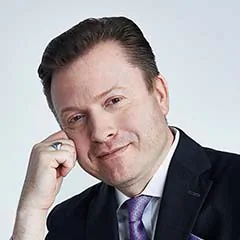
[RUSH TRANSCRIPT BELOW] Why did Patrick Girondi, a successful singer and songwriter, become the founder and CEO of a pharmaceutical company?
Originally from the South Side of Chicago, Girondi dropped out of high school and became a musician and also, quite by accident, a highly successful commodities trader.
In the early 1990s, his young son Rocco was diagnosed with thalassemia, a rare blood disorder caused by a defect in the globin genes.
Girondi was told by doctors that his son would not live to be a teenager.
So Girondi set out to find a cure. His company has been working on developing gene therapies and treatments for rare blood disorders such as thalassemia and sickle cell disease.
He’s now recruiting for clinical trials, and his son will be among the first to receive his new treatment for thalassemia in the coming months.
When I sat down with Girondi to hear his life’s story, he told me: “San Rocco Therapeutics … has become involved in so many different rare diseases, because people would reach out to us. Parents, in desperation, would read about me, find my story, find me. Sometimes through friends. … Sometimes they would come to me after concerts.”
There are 6,000 rare diseases in the world, also called “orphan diseases,” he says, because nobody wanted to invest in expensive research to find a cure.
Girondi has released seven albums to support rare disease awareness, and he is the author of “Flight of the Rondone: High School Dropout VS Big Pharma: The Fight to Save My Son’s Life.”
Views expressed in this video are opinions of the host and the guest, and do not necessarily reflect the views of The Epoch Times.
RUSH TRANSCRIPT
Jan Jekielek:
Patrick Girondi, such a pleasure to have you on American Thought Leaders.
Patrick Girondi:
I’m honored, thoroughly.
Mr. Jekielek:
Your son in 1992 was diagnosed with thalassemia, a very serious disease similar to sickle cell, and you set upon yourself to actually find a cure, and you did. Tell me how this all happened.
Mr. Girondi:
Yes, sure. I’m a rags-to-riches story. I was on Oprah Winfrey’s show, Rags to Riches, Playgirl magazine, one of America’s Most Eligible Bachelors with Sylvester Stallone and Magic Johnson. And I was shocked in October 1992—this is actually my 33rd anniversary—when my son was diagnosed with thalassemia. They said he wouldn’t make it to be a teenager.
Thalassemia is a defective beta-globin gene. And it’s a cousin or sister disease to sickle cell disease, which is also created by a defective beta-globin gene. There were no matches to give him a bone marrow transplant, and I had to figure out what to do.
Mr. Jekielek:
So, I mean, of course, you have nothing to do with the medical sciences here whatsoever, but what got in your head?
Mr. Girondi:
Well, after the anguish, I began reading. My friends went to St. Luke Hospital, the University of Chicago. Of course, back then, the internet wasn’t like it is today. I received miles and miles of faxes. I bought every hematological book or book on hematology that I could possibly get my hands on and learned everything about the disease that I could. I didn’t want to transfuse my son because in 1992, there were still no antibodies for HIV and hepatitis C.
So I scoured the world and found a professor who was using experimental medicine to stimulate fetal hemoglobin. My son and I went to Children’s Hospital Oakland Research Institute in Oakland, where he lived for three months. We were doing a product called arginine butyrate. It was one of the first gene therapies, actually, because it stimulated fetal hemoglobin to produce again. I couldn’t remain there because it was $70,000 for 40 days. My son had to be hospitalized because it was IV [intravenous therapy].
So I moved to Italy, 25 miles away from my grandfather’s town and opened up a medical center, San Rocco Medical Center in Altamura, Italy. My son was being treated there, and it worked until about 2000. By 2000 anyway, the blood had become infinitely more safe, and my son began transfusing every 15 to 20 days.
In 2000, I met a French researcher named Michel Sadelein. He published in Nature magazine that he cured six generations of thalassemic mice. I read it. I met him in Rome when he was at a seminar, and I knew that I had found the cure for my son. I knew it. In 2003, Michel Sadelein was desperate for finance, and of course, as I said in the beginning, I had been a rags-to-riches story. So I had money to spend, and I did.
In 2005, I bought the intellectual property. In 2010, San Rocco Therapeutics delivered the world’s first batch of gene therapy, because up until then, it was made for one person at a time, about a million dollars a person. We were able to make enough for about 10 people for $1.3 million. It’s been an incredible story.
Mr. Jekielek:
So I want to try to understand, you focused this whole time, you focused your work of San Rocco Therapeutics just on this particular therapy, figuring just this particular therapy.
Mr. Girondi:
Yes. So San Rocco is dedicated to this therapy, basically. However, over the years, we’ve become involved in many different rare diseases because people would reach out to us. Parents in desperation would read about me, find my story, find me, sometimes through friends. I’m also a musician, so sometimes they would come to me after concerts. We have actually dealt with dozens of very rare diseases and assisted people whenever we possibly could.
I’m a Catholic and a big follower of St. Francis, actually, and, you know, let me be an instrument of your peace. We did what we could. So San Rocco, we’re specifically a company that will bring accessible gene therapy to the world for sickle cell disease and thalassemia. That’s our main goal. However, we’re a rare disease company.
Mr. Jekielek:
So explain to me, you know, in 2010, so now we’re 15 years from the present, but in 2010 this is a gene replacement therapy, right, that we’re talking about, so explain to me what that is, how that works.
Mr. Girondi:
Gene replacement just means you change basically the engine. So you’ve got a car, right? It’s not working properly. Change the engine. So that’s the beta-globin gene. We use a disabled HIV virus. We put a new gene in it. We give the patient chemotherapy. We take his stem cells. We incubate them with the gene, billions and billions of copies. We infuse the gene back into the patient. Cured. He is now creating adult hemoglobin.
Mr. Jekielek:
And how does that, I guess, stick, if that makes sense? Explain to me how that’s different than just basically taking a treatment, sort of a conventional treatment. What makes the body start producing?
Mr. Girondi:
Because we put the fixed beta-globin gene into the stem cells. From then on out, the body makes the correct beta-globin gene. It’s no longer defective.
Mr. Jekielek:
And the stem cells basically just replenish themselves in the body after this?
Mr. Jekielek:
Yes. I see. That’s remarkable.
Mr. Girondi:
It’s truly remarkable. And it’s kind of funny because I remember in 2005 when I bought the product, and I didn’t really want to buy the product, to be quite honest. Over the years, I’ve had a wonderful trip. In 1995, John Walton of Walmart became my partner. Great guy. Christy, his wife, I love. A wonderful woman.
They had a son, Lukas, who was born in 1987. In 1990, I believe, he was diagnosed with Wilms tumor. Arginine butyrate that my son was on had an application for Wilms tumor. John and I became partners. We were partners until 2004. The Walton family in our project in San Rocco put in about $24 million, all told, from beginning to end.
Unfortunately, John died in a plane crash. I ended up with San Rocco, and I looked to get help. I talked to Bayer. I talked to Novartis. Back then, I think it was Chugai or Sandoz. I talked to all of these pharmaceutical companies because I didn’t feel that I could ever do this myself. They were all very polite; they patted me on the back and told me what a wonderful father I was, but that it was science fiction. It was crazy.
Literally, I’m a trader. I made my money on the Board of Trade in Chicago, the Mercantile Exchange, and then became a member of the New York Stock Exchange, had a Swiss banking license, all of that. So I’m a trader. And they bet 100 to 1 that I would fail because for them, gene therapy in 2005 was science fiction. And so I was lucky. In 2010, we finally had a batch of gene therapy ready to treat patients.
Mr. Jekielek:
And so what happened?
Mr. Girondi:
Well, a lot of wonderful people gathered around. Professor Chris Ballas is one of them, and there are so many of them, like Michel Sadelein and Susan Perrine. I’ll forget all their names. It was like this team effort. Most of them weren’t paid because they knew by that time I was spending only my own money. I didn’t, you know, I raised very little money. Joe Feldman, my partner, got involved. The Feldman family put in money.
But all in all, my company, which is basically 32-years-old, because we were formed in 1993, wasn’t always San Rocco Therapeutics. The name has been changed. But we had a total of 70 investors. Out of the 70 investors, 60 of them invested like $50,000. So we were able to generate all of these wonderful people. Many of them never got a paycheck.
We put our heads together and were able to tweak the product that I bought in 2005 and create a better product. We were the first in the world in 2012; our product was the first in the world to treat a patient. What happened to the patient? We actually treated four patients total, and we decided to use myelosuppression. So myeloablation is when you kill all the bone marrow, and you need to do that, unfortunately.
Mr. Jekielek:
Well, so this is the thing I was trying to get at earlier: how do you get these new stem cells to stick? Right now, you’re telling me how.
Mr. Girondi:
Yes. So in 2012, we erred on the side of caution, and we gave the patients 8 milligrams per kilogram of busulfan instead of 14 to 16. So we killed maybe 30, 40 percent of their bone marrow. One patient was treated off the protocol because of age, but three were treated on the protocol. Two out of three today still have a reduction in transfusions of about 43 percent. So it worked, but only halfway.
John Tisdale, who’s a wonderful friend and the head of gene and cell therapy at the NIH, is a guy who could have gone and made millions and millions, but instead decided to be a public servant. He was always sure that we should have done myeloablation. If you do myeloablation, ablation therapy, you will get the patients cured.
We were the first ones to treat in 2012. Those patients today have a 43 percent reduction. Now we will use myeloablation. Now we will use a product that’s actually manufactured in a more modern way. We have tweaked the product so that it’s actually 30 percent more effective than the old product. We’ll cure these patients without a problem.
Mr. Jekielek:
What’s the situation with your son?
Mr. Girondi:
Rocco is my son and has nothing to do with San Rocco. San Rocco is a patron saint of hopeless diseases, right? During the plague in Europe in the 1400s, he was selfless and a wonderful story for us. But Rocco, who has my grandfather’s name and raised me, is 35, and he’s never complained once. He’s had operations and has had to go in to transfuse hundreds of times now, etc. He has had issues, but thank you. He’s a wonderful man, and he will be cured within six months.
Mr. Jekielek:
So, okay, let me see if I’ve got this straight. You started out at the beginning that transfusions weren’t going to work because of the potential for these diseases with frequent transfusions. You actually got him basic treatment, the one that you mentioned, the sort of first type of treatment. Then he started getting transfusions. Transfusions became safer. Then this product came online, and you were partially able to treat people. And it took basically until today to have a product that can be a complete cure.
Mr. Girondi:
Yes. There are actually two cures in the United States that are authorized gene therapy cures. One is called Lyfgenia by Bluebird Bio. It’s $3.1 million. The other is a CRISPR [clustered regularly interspaced short palindromic repeats] product called Casgevy. Now, CRISPR doesn’t replace the gene; CRISPR edits the gene, meaning that they basically go in and snip the BCL11A gene. The job of the BCL11A gene is to suppress the gamma globin gene, which is fetal hemoglobin.
So when we’re a year-and-a-half old, this BCL11A suppresses our fetal hemoglobin. Then naturally, the adult hemoglobin starts working. So CRISPR snips the BCL. They disable it. Now, with the BCL11A out of the way, the patient is again expressing fetal hemoglobin. There was recently an article that came out last week, actually, stating that you have gene replacement and gene editing.
Now, we all know that no one can afford, or few can afford, $3.1 million or $2.2 million. But the difference is that mine is gene replacement, and our patients will have the adult hemoglobin, which is what nature intended. The patients that do CRISPR, which is called Casgevy, will, for the rest of their lives, express the majority of fetal hemoglobin. There’s no one that can say that it’s possible that fetal hemoglobin may be better for an adult to make than adult hemoglobin. But no one really knows because CRISPR really is brand new. I mean, the first patient was treated, you know, like five years ago.
Mr. Jekielek:
So we still need those long-term studies to see the outcomes of those people. There are people that have been treated both through gene replacement, which is a product that’s similar to what you have, and there’s another product that is editing, like you said. And what does yours bring to the table? The cost becomes more accessible. Is that the idea?
Mr. Girondi:
Ours is about 30 percent more efficacious than the Lyfgenia product. Actually, they have Lyfgenia and Zynteglo. Zynteglo is for thalassemia. Lyfgenia is for sickle cell disease. Lyfgenia costs $3.1 million, and Zynteglo $2.8 million, but they’re the exact same drug. Our product is 30 percent more effective than that product. So there’s no doubt we’re going to be curing these patients.
I’ve made a promise that we would keep the cost under $1 million per patient for the next 10 years. So I think initially it would be about $800,000. These products cost a lot. It costs my company a lot of money to cure patients. But we believe that $800,000 is a price that we can offer accessible therapy that people can afford, that the government of the United States can afford, that the insurance companies can afford, and as well build our company stronger so that we can do more work in the orphan disease field. In the orphan disease field, what does that mean?
Well, there are 6,000 orphan diseases. That means they have to be under 200,000 patients in the United States, 250,000 in Europe. I promise when Rocco was diagnosed, I’ll never forget it, and we went to Pesaro, Italy, to see about a match, and we found out that there was no match in the family. I guess probably the only time in my life I can ever remember being desperate.
I promised the Lord that if he would help me save Rocco’s life, I would dedicate the rest of my life to fighting these rare diseases. Because when he was diagnosed and they told me this word thalassemia, I couldn’t spell it. I could barely pronounce it. Then the explanation and the education about all of these rare diseases and all of these families who are stuck with this egregious, just horrific news. I’m more fortunate than others because I had the resources.
So anyway, that’s what I mean by we will dedicate the rest of my life anyway. After I’m gone, which I’m sure it won’t be that long, I hope that the company is around, and that we can continue to dedicate the resources, but not to making the CEO rich or the company rich. Of course, we want to be good to our investors. We want to make a solid company. We certainly are capitalists, but we’re capitalists kind of in the old-fashioned way where the first one to sacrifice is the boss.
Mr. Jekielek:
So what happened between 2010 and 2025?
Mr. Girondi:
First of all, everything that I’m telling you is documented in a court case in New York Supreme Court. The product was sabotaged by Bluebird Bio and Third Rock Ventures. I didn’t know it, of course. But the product I handed over, I relinquished my control of the product in 2011, believing that a lawsuit was necessary because the Bluebird Bio product was going faster than our product and knowing that the Bluebird Bio product was inferior to our product.
We did discovery, and in the discovery, we found the PowerPoints from Bluebird Bio where they said that the San Rocco product was three to five times more efficient. They had to get a hold of it; they had to destroy our company, basically. And that’s what happened.
In 2021, we settled and got back on the horse. We improved the product with Professor Frank Park from the University of Tennessee, Professor Andrew Wilbur at Southern Illinois University, and John Tisdale at the NIH. I apologize if I forget anybody, but it’s really a team effort. Now we have a product that’s 30 percent better than the approved product and which will cost basically 75 percent less.
Mr. Jekielek:
And with respect to your son, why has he waited this long to go for the cure itself?
Mr. Girondi:
Sure. The cure was only approved in December of 2023. So Casgevy and Lyfgenia were approved in the United States in December of 2023. But as of today, I would guess that less than 50 patients have done the product. A lot of it is because Lyfgenia is in a black box, meaning that when doctors prescribe it, they have to tell the patients that there have been a couple of cases of leukemia in the past.
I don’t think it has anything to do with the beta-globin gene, and neither do most researchers, but sickle cell disease patients have to do hydroxyurea every day or every week, etc., and it’s a little bit different than the thalassemia patients. So, yes, my son wouldn’t have done it because it hasn’t been approved until December of 2023.
Mr. Jekielek:
Well, you’re saying that there are significant side effects that you might be concerned about.
Mr. Girondi:
Yes, you have to be concerned about everything, that’s for sure. Bluebird had two cases, I believe, of leukemia in patients that were treated; it was like 6 percent of the people treated roughly. Generally speaking, sickle cell disease patients will get leukemia anyway, about 3 percent of them before they die. So it was like double. They halted the clinical trials, etc.
However, most people don’t believe that it’s the lentiviral vector. The lentiviral vector, which is the disabled AIDS virus, has actually been in people since 2003 or 2004 with AIDS. They were using experimental AIDS potions. So we don’t believe it’s the lentiviral vector. However, like anything they have to do, my son will have to undergo myeloablation. There are problems with that, with all of that.
However, if you have to wait out and do transfusions for the rest of your life, iron chelations, everything that comes with it, a patient’s health is, of course, recaptured. And for the government and for the health providers, whether it’s one payer as in Italy or in the United States, these patients are costing probably in the United States $150,000 a year anyway. So for us, in five or six years, they’ve paid for our product at that price. $800,000 has paid for itself.
But even in Europe, where prices may be somewhat cheaper, the healthcare provider will find it in their best interest to do our product. But yes, there are always problems, or there could be problems with any medicine. And so far, so good. I think that the results in gene replacement and gene editing are fantastic.
Mr. Jekielek:
Is it fair to say that your product has a lower risk profile, and that’s the reason why your son is doing that?
Mr. Girondi:
Yes, definitely. I mean, otherwise my son will have to continue to transfuse every 15 to 20 days and will have to continue to take the risk with the blood.
Mr. Jekielek:
What is the name of the product again?
Mr. Girondi:
Minirolu. I’m glad you asked me about that.
Mr. Jekielek:
Let’s go back for a moment. Okay, so when it comes to Minirolu, which is your product, the San Rocco Therapeutics product, it has a better risk profile, if I understand. Just kind of explain that to me.
Mr. Girondi:
Yes, we believe it has a better risk profile because it’s 30 percent more efficient than the approved product. So efficacy means you use less product. Less product means less toxicity, if there is any toxicity. But if there is toxicity, it’s less toxicity. So, yes, we believe that it will be safer.
Mr. Jekielek:
But aren’t there trials that would reflect this?
Mr. Girondi:
Again, we will be in patients again within six months in the United States and in Europe. And this administration has been very supportive. Senator Tim Scott, last week, I met with his team, wonderful people. I’ve met with Secretary Kennedy’s people. They’re very supportive. And also in Europe, where we’re dealing, our principal investigator is the Surgeon General of Italy, Franco Locatelli. So everyone’s very supportive.
I would say that most everybody knows who I am. And for that reason, in a certain sense, there’s a bit of trust, and we will be—our clinical trial is still open, but we haven’t treated patients since 2015, I told you that. So now the clinical trial is continuing, and maybe it was best this way, even talking about the court cases and sabotage. Maybe it was best that way because we improved it, right?
So in 2021, when we settled, we were, in a certain sense, forced to look at everything again. We were lucky enough to find researchers like Professor Park at University of Tennessee, Andrew Wilber at Southern Illinois, who I’ve known for a long time, and John Tisdale, because we actually modified the product. We’ve made it safer. We’ve made it more efficacious. The Lord works in mysterious ways.
Mr. Jekielek:
So, and just, so the current treatment, you’re basically wiping out the existing bone marrow.
Mr. Girondi:
Yes.
Mr. Jekielek:
And then you’re using this modified virus to put in,
to, and to basically create stem cells, which have a new gene now replaced, which produces hemoglobin properly.
Mr. Girondi:
Yes, that’s it. You got it. Change the engine.
Mr. Jekielek:
And afterwards, are there kinds of drugs that people have to take?
Mr. Girondi:
No. It’s done. You’re done. I mean, obviously with myeloablation, myeloablative therapy, which you do in bone marrow transplants for 30 days you have to be very careful, and then for 60 days you have to be careful. For 30 days you’re hospitalized, but then you’re done.
Mr. Jekielek:
Fantastic. And so basically, you are at the moment recruiting for your clinical trial. And it sounds like your son’s going to be one of those. OK, now I got it.
Mr. Girondi:
Yes, my son will be one of the first ones. And Minirolu, right, is actually—I called Christy Walton, I don’t remember, last year or something, and I said, Christy, you know, your family’s been so good, and I’d like to maybe name the product after John, her late husband. And she goes, Pat, I don’t think John would necessarily like that. She said that he was always for the little guy, the underdog. John Walton was a wonderful guy. She said, name it after the patients. So, M-I-N-I-R-O-L-U combines the first two letters of four patients.
Mr. Jekielek:
Of the patients back in 2010.
Mr. Girondi:
Yes, back at the beginning. These are thalassemia and sickle cell patients, actually. One, Lou, is one that had Wilm’s tumor. But these are the four patients, kind of the cornerstone of the company that brought it all together. These are for the patients, so we decided to call it Minirolo.
Mr. Jekielek:
Tell me more about these orphan diseases and how the medical system deals with them today.
Mr. Girondi:
So we have 6,000 orphan diseases. In 1983, the Orphan Drug Act was introduced. Marlene Haffner, who at the time they called the godmother of the Orphan Drug Act, is a wonderful woman who I even speak with today, said there’s no money going into curing these diseases because there’s no money in it because there are too few of them. And they came up with these rules and regulations, stimulations. They gave 50 percent tax credit to people who would invest in clinical trials for orphan diseases. Today it’s 25 percent. They would give all sorts of stimulation through finance to companies who would dedicate themselves to curing rare diseases.
And it was wonderful legislation. And that there are 6,000 rare diseases. I believe that the 1983 Act needs to be revisited, to be quite honest, because I think there needs to be some kind of separation. Because you have a disease like sickle cell disease where 100,000 patients can’t be treated like a disease, leukocyte adhesion deficiency, excuse me, where you only have like 100 patients. You have to have different rules, but it was a wonderful piece of legislation, and that’s why they were called rare diseases. In the end, they were orphaned by big pharma, supposedly, and that’s why today they call them orphan diseases as well as rare diseases.
Mr. Jekielek:
And how many companies are there that are trying to go after some of these?
Mr. Girondi:
Up until 1983, there weren’t a lot of them, but in the ’90s and then the 2000s, a lot of companies realized there was huge money in orphan diseases created by the Orphan Drug Act. So now there are hundreds and hundreds of companies that are going after these rare diseases. I would ask, how many of them are successful? Obviously, we all know that it’s not really easy to ever get into clinical trials. We’re one of the few companies of our size, for sure, that ever got into clinical trials.
But there are some—how many? I don’t want to say ethical companies are doing it, but there’s a lot of companies doing it. And I’d like to as well make a statement that I’m all for pharma. And I hate when I hear people say I’m against Big Pharma. You know what, in 1730, 50 percent of the people made it to live to be 30. In 1830, they lived to make it to 35. Today, we make it to almost 80. And we couldn’t have done that without the pharmaceutical companies.
So when people bash the pharmaceutical companies with this bludgeon, I’m against that because there’s a lot of wonderful pharmaceutical companies and we certainly—and I’ve met so many ethical, wonderful people in the pharmaceutical industry. Unfortunately, they’re not all that way. And so we need to have a little bit more, pay a little bit more attention because of price reasons, because of stock and options and warrants and all of those things. But I don’t want to go on.
Mr. Jekielek:
There’s been some significant changes in HHS [U.S. Dept. of Health & Human Services] and its sub-agencies since this new administration has taken on. You mentioned that you’ve spoken with Bobby Kennedy Jr.’s people, the HHS secretaries, and so forth. What do you think about those changes?
Mr. Girondi:
In infant mortality, the United States, last time I looked, was around 64. Italians live to be 82.7 years of age. Overall, Europeans, 81-and-a-half. Americans live to be around 78-and-a-half. And we spend anywhere, depending on how you calculate it, three to five times more per capita. So if nothing else, it tells you that the healthcare system in the United States is completely broken, completely broken.
Now, I’m not going to blame anyone, and I don’t know who did it. I don’t care about Democrats or Republicans, I don’t care about all of that. But anyone who wants to defend the U.S. healthcare system is a bit ingenuine, and I say that to be kind.
Mr. Jekielek:
So you like the fact that there is reform on the horizon.
Mr. Girondi:
I can’t say that everything that HHS is doing is right or wrong. I don’t know everything they’re doing, first of all. But there needs to be a dramatic change. I mean, if it was possible for me, Patrick Girondi, I would just start from scratch. But you can’t start from scratch, because we’ve got millions of people that are already in it. But yes, I welcome Bobby Kennedy, or Dr. Doolittle, if that was his name. Anyone that’s going to bring dramatic change, I welcome.
And like I said; infant mortality, longevity, and cost. Those are the three things that you have to look at now. And you can put all the experts in the world on a panel and they can tell you how everything is great or not great, whatever. Here, infant mortality, longevity, and cost. The United States is in serious trouble with their healthcare system. And again, for anyone who defends it, the kindest word I can use is ingenuine.
Mr. Jekielek:
So that’s fascinating. For you, it’s those three metrics, which are really the measure of a successful healthcare system.
Mr. Girondi:
Yes. We’ll do everything to save our infant children, anything. I mean, it’s the most emotional time in our lives, you know, so infant mortality is huge. And longevity—I mean, what’s more important than, you know, everybody, you know, living a long, healthy life? And then, of course, cost. And so, again, I have to debate people from time to time.
I just got back, actually, from Burkina Faso, where I was invited to give suggestions on what they can do for their 65,000 sickle cell disease patients. But in the end, the United States healthcare is a shambles. I mean, it’s a joke. And not a funny one. It’s tragic, just people trying to figure out if they’re going to pay their heat or they’re going to buy their medicine. I have many people in my family where the doctor says, take this pill every day. But they’re cutting it in half because they just can’t afford it. And all of the crazy deductibles and the nightmares.
I had a friend of mine recently treated; he got surgery on his hip, and you know, he got a $12,000 bill. And then he said, but you told me I could go to that hospital. And they said, yes, but the laboratory of that hospital sends their stuff out to another laboratory. Literally, it is a nightmare. If there’s one negative thing I would say, generally speaking, of the United States of America, it’s the health care system. In my opinion, the secretary of HHS has the toughest job of anyone because it is literally a tragic joke.
Again, I know a lot about the FDA [U.S. Food & Drug Administration]. I’ve dealt with many people with the FDA. There are so many good, dedicated people. John Tisdale is a close friend of mine, probably for between 25 and 30 years. John could have left and made millions and millions and millions, working for some private pharmaceutical company. So there are dedicated people, but the system itself is just so corrupted and so inefficient. And something’s got to be done.
Mr. Jekielek:
What was your advice to the Burkina Faso government about their patients?
Mr. Girondi:
Hydroxyurea is a staple for sickle cell disease patients, and they’re not getting it. And they’re not getting it because hydroxyurea is made by Squibb, and they can’t afford it. However, there are generic products made in India and Nigeria, and that was the biggest suggestion I had. And it was great. They’re great people, very hospitable.
Everything was great, and the other thing that I suggested is a bit off the wall, and that is that when you do research with sick patient cells, it can be cost prohibitive. In other words, I need sick patient cells who have sickle cell disease, so I have to go to—I won’t name the company that we go to—but I have to go to XYZ company. You know, they’ll charge you $25,000, $30,000 for these sick patient cells. So I told Burkina Faso, you’ve got 65,000 patients. Open yourself up a business and sell your sick patient cells to people that are doing research. They were basically the number one and the number two things that I suggested.
Mr. Jekielek:
Interesting. So you’ve been, I mean, you really have had to think outside of the box all the way from the beginning, right?
Mr. Girondi:
I was a shoeshine boy at about six or seven-years-old. After that, I was a busboy. I washed dishes in a hospital at about age 15, then I was a mechanic at about age 16. I went into the military at age 17. Judge Clarence Bryant recommended military or jail. So I chose the military. It was a lot better.
I got out, and I was a truck driver and worked on the docks. Then by kind of fickle luck, whatever you want to call it—it’s a great book, Flight of the Rondone, by the way—I ended up a trader. Like I said, we had three New York Stock Exchange members. We were members of the Eurex, Sofix, the DTB, the Chicago Board of Trade, Chicago Mercantile Exchange, and the Chicago Board Option Exchange—everything. I always had to think outside the box because.
Like I said, I’m Catholic, and I went to a Franciscan seminary. I wear the towel. My sons wear the Franciscan towel. Bobby Kennedy actually wears the towel. I gave him one with the K on it. He, as well, is very fond of St. Francis. So when you want to be ethical and at the same time you want to be effective, and you’re doing it in industries like health care, you don’t have a choice. You have to think outside of the box.
Mr. Jekielek:
So give me a picture of what can happen next.
Mr. Girondi:
Okay, so my dream. I’ve met President Obama. I made music for him, actually, to be quite honest, and did some work. And I’m a completely apolitical guy. And I met Kamala Harris. I met President Trump. I met Vice President Vance. I know Bobby Kennedy and also Senator Tim Scott.
One thing that they all have in common and one thing that they’ve all told me at one time or another is that they support the idea of having accessible gene therapy for our patients, our sickle cell disease patients in particular, because in America we have 100,000 of them. And I can’t even begin to tell you the suffering of these kids, these people, the strokes that they have, the living moment for moment, and not knowing if all of a sudden you’re not able to drive your car, not able to walk. It’s crazy. It’s really so sad and so tragic.
So whether we’re talking about President Trump, who truthed our story, or we’re talking about Chuck Schumer, whom I met once as well, they’re all behind an accessible cure, gene therapy cure, for sickle cell disease and thalassemia. And in my little way, I’m a little guy, not that bright. Like I said, I didn’t graduate from high school. And I won’t be around that much longer. How much time do we have?
But in my own way, I’m praying and hoping that my project can unite Chuck Schumer, and President Trump, and President Obama all together in a certain sense behind this accessible cure for sickle cell disease and thalassemia. And we can all be joyous in it and see that we really have so much more in common than we have in conflict. And that’s become my recent dream. And I hope that I’m strong enough to see it happen.
Mr. Jekielek:
How long until Minirolo could be fully licensed, assuming these final trials go well?
Mr. Girondi:
A year-and-a-half, two years. But we’ll be in patients within six months, both in the United States and Europe. And then a lot’s going to depend on the administration, how they see things. But yes, I think that we could be a product within a year-and-a-half.
Mr. Jekielek:
A final thought as we finish?
Mr. Girondi:
If I made any errors in speaking or wasn’t as articulate as I should have been, I apologize. My favorite poet, an actor in Italy, his name was Toto. He said that he took his heart to school and tried to teach it how to read and write, but his, as mine, is an illiterate heart, and we were only able to learn one word: love.
Mr. Jekielek:
Patrick Girondi, it’s such a pleasure to have you on the show.
Mr. Girondi:
Thank you very much. I’m honored. I love your show. The people that you bring on here are incredible. I compliment you for all the good you’re trying to do for our country and our world.
This interview has been partially edited for clarity and brevity.
Read More
Popular

Related Videos

American Thought Leaders
American Thought Leaders
American Thought Leaders
American Thought Leaders
American Thought Leaders
American Thought Leaders
American Thought Leaders
American Thought Leaders
American Thought Leaders
American Thought Leaders

American Thought Leaders
American Thought Leaders
American Thought Leaders

American Thought Leaders