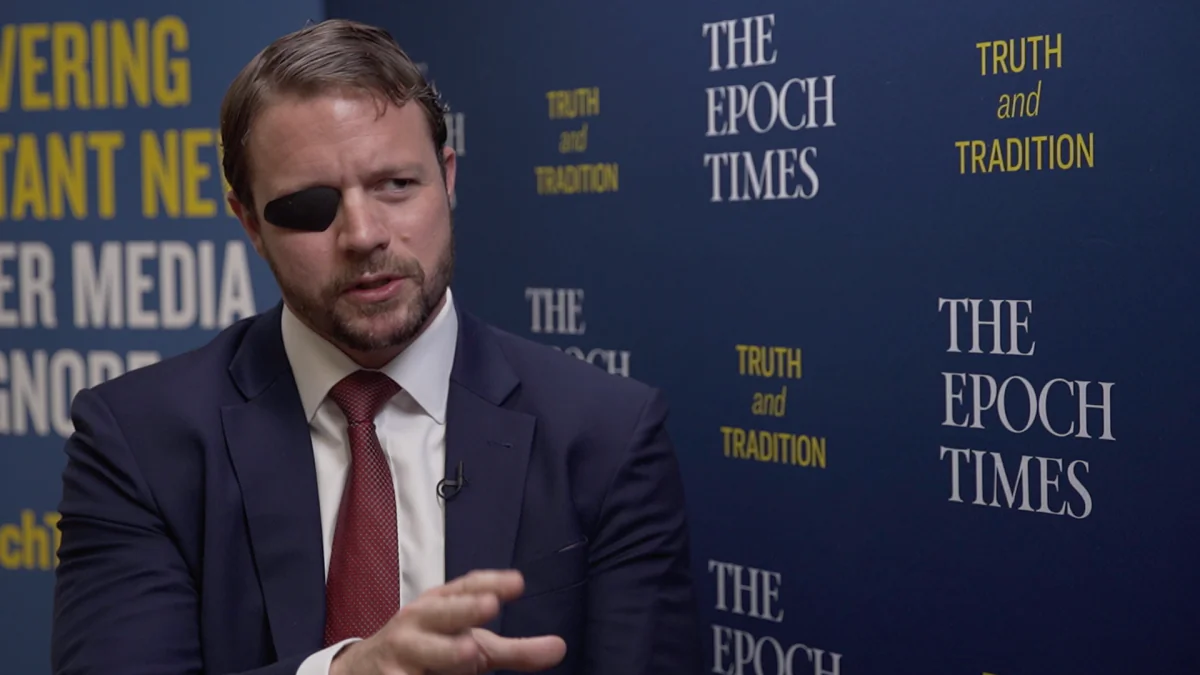
At the Western Conservative Summit, we sit down with Congressman Dan Crenshaw to discuss what he describes as a “culture war” with the left, based in Marxism, identity politics, and an “ideology of resentment.”
We also look at a variety of Democratic policies, including the Green New Deal, student loan forgiveness, and what effectively amounts to open borders, in Crenshaw’s view.
Jan Jekielek: Congressman Dan Crenshaw, it’s great to have you back on American Thought Leaders.
Rep. Dan Crenshaw: Glad to be with you all.
Mr. Jekielek: So I follow your Twitter feed quite a bit, and you’re quite prolific. … You took a very interesting approach to the border issue because, obviously, this is really important to you as a Texas representative. And you talked about, let’s analyze the Democratic position on the border. And you laid out some things on Twitter, but I’m wondering if you could go a little more in-depth for us because that’s kind of a different way of looking at the border at the moment.
Rep. Crenshaw: Sure. I mean, depending on what you mean, exactly what you’re referring to, I would just say what the Democrat position is and, more importantly, how it’s changed. It’s changed radically. One thing us conservatives like doing is pulling up videos from not too long ago of [former] President Obama, from Chuck Schumer, or whoever it might be, really talking exactly like Trump talks about the border and about immigration. We have [former] President Obama saying: Listen, do not come here. Do not come across the river. It’s dangerous. You will be sent back. That’s President Obama.
So what changed? What changed is President Trump. I think the left is deeply triggered by everything he does, and they want to be against him no matter what. And I think their general policy direction has also just shifted dramatically as they move from what used to be sort of a labor party into a party that is driven by new Marxism. It’s driven by identity politics. And it’s driven by this feeling that they can gain power if they just promise certain groups, certain things.
And right now, they’re catering and pandering to the immigrant community, specifically. Now, I don’t think the immigrant community is convinced, especially people who are here legally. I think they like that they came here legally, and they feel like they’re being cut in front of when we just let people across the border. So this open border policy, and it really is that. I don’t think we’re being unfair with that accusation. That’s the basis of it. And it really is no asylum reform, no border wall, no enforcement internally. And that’s essentially open borders. That’s essentially amnesty for all. And that’s not a good policy at all. It’s bad for America.
Mr. Jekielek: So the next Democratic primary presidential debate is going to be held in Houston not too far from you. What do you expect is going to happen there?
Rep. Crenshaw: Another circus. It’s a very entertaining circus from the Democratic primary debates, as usual. They’re going to keep going as far radical … as far left as possible. I hope that given that we’ll be in Houston, given that we’ll be in the energy capital of the world, I hope that they’ll ask about the Green New Deal. And I hope that they’ll ask about their environmental policy and the desire to completely eradicate fossil fuels from our energy consumption and profile. But because when you’re in Houston, you’re talking about hundreds of thousands of jobs being lost with the Green New Deal. And not to mention the dramatic effects on our economy and dramatically higher energy prices, electricity bills, all of that.
But you’re in Houston. So let’s talk about your actual environmental plan, and let’s compare that to what we’re talking about, which is technology-driven, carbon capture, nuclear, exporting natural gas to dirty coal-burning countries. Let’s talk about actual solutions that will both help our economy and reduce overall emissions. But they don’t want to talk about that because what they really want is a socialist takeover of the economy. That’s what the Green New Deal is about. We need to hold them accountable while they’re in Houston.
Mr. Jekielek: So a number of people have said—and actually you did moments ago as well—that this is kind of bribery around certain issues that are important to people. There’s one that jumps out to me, which is cutting student debt, which is massive, and a lot of people are suffering under it. It strikes me as an attractive proposition.
Rep. Crenshaw: If you promise me free money, I think that’s attractive, sure. But this is irresponsible though. But this is the basis of their entire political philosophy. We’re going to promise people free stuff because we want power. We’ll do whatever it takes to get power. That’s their political philosophy in a nutshell. There are no principles driving that. That’s why the left is scary. All right? You should have principles. You should have governing principles that you abide by.
I think conservatives do have that. We focus on individual liberty, personal responsibility, local control versus centralized bureaucracy, fiscal responsibility. There’s certain things that drive us and drive our decision making. They don’t have that. They just want power. And if you just want power, a good way to do that is to promise people stuff. The student debt issues is an example of that. “Medicare for All” is an example of that. These are not realistic promises, but they know that people don’t really know that. And they’re willing to lie to people, and they’re willing to do it shamelessly. And I think that’s just abhorrent.
Mr. Jekielek: So you see no principles, but what about identity politics? Isn’t that a sort of set of principles?
Rep. Crenshaw: It’s a strategy. It’s a strategy. I wouldn’t call it a principle. I mean, it’s a strategy in which you pit people against each other. You promise people power over another group. It’s really terrible stuff. It’s tribalistic. It’s actually how human beings lived for thousands of years. It’s really only in Western civilization that we kind of grew out of that, when we started to realize that, yeah, you can keep dividing people up, eventually you get down to the individual. Well, that’s individualism. I mean, that’s why we actually, we believe in individual merit and character. It’s not what group you’re a part of. It’s your character. It’s who you are and how you compete within this free society. So, no, I don’t think identity politics is a principle at all. And if it is, I’m not sure what kind of principle, except a real bad one.
Mr. Jekielek: But it seems to be dominating not just political discourse in some cases, but even what people will feel comfortable in saying or not. I mean, someone pointed out to me very recently, I can’t even remember who, but I was apprehensive to say a number of things, and I realized, my goodness, it’s because I’m kind of suffocated by this political correctness.
Rep. Crenshaw: Sure. We all are, yeah, the political correctness. Yeah. We all feel that way. As outspoken as I am so conscious of that … and listen, our society and our culture will always evolve in that way. We don’t talk the same way as our grandparents did. And maybe that’s fine. That’s not bad, but it becomes bad when you use it as a club to wield against your opponents. And that’s really what they do. They weaponize these words, they weaponize political correctness.
It’s one thing to evolve as a culture. I think that’s natural. I think it’s natural to think that in a hundred years we’ll look back on now and think that some of the things we say and do are just crazy. You know? And we’ll all just agree on that. Just the same way we look a hundred years back and the way people treated each other, maybe we look down on that a little bit. That’s fine. That’s growth. But that’s not what they’re doing. Right? They’re weaponizing it. And I don’t even think they believe a lot of the things they say. I don’t think they’re truly outraged sometimes, but they’re doing it as a political tactic. And it’s not good. It’s very unhealthy. It’s very divisive.
Mr. Jekielek: What do you make of this infighting that’s happening right now between, let’s say, the “justice Democrats” and the more moderate—and I don’t know if you agree with this—but the more moderate Democrats of like Speaker Pelosi.
Rep. Crenshaw: Yeah. She’s the moderate now, right? Well, it’s funny to watch. And that’s all we can do as conservatives is sit back and watch the show. In a different sense, we dealt with the same thing with Freedom Caucus versus leadership. I think what’s happening on the left is much more extreme than that, but it’s … here’s how I analyze this. This was always going to happen. Well-intentioned liberalism, moderate liberalism, and I wouldn’t even put Nancy Pelosi in that, but there are certainly moderate liberals out there, because it is based on promising people things and promising people nice things, it will always get to this point of democratic socialism. You will always get to that Marxist ideology.
Mr. Jekielek: Interesting.
Rep. Crenshaw: You have to. You have to. If I’m going to promise you more stuff, and if I’m always going to tell you that there’s an inequality and that there’s an injustice that you’re facing, well, then I’m going to convince you that government needs to step in and fix that injustice that keeps piling on itself because there’s no end it.
Mr. Jekielek: I see.
Rep. Crenshaw: Yeah. And so it’s going to end this way. This is really foreseeable. And they have to lie in the bed that they made. And the identity politics issues is rearing its head, too. I mean, when AOC is calling Nancy Pelosi a racist. I mean, where are we? When Nancy Pelosi finds herself being defended by us? We’re like, Nancy, no, the president … the president’s like, Nancy Pelosi’s not a racist. Because she’s not. It’s absurd to say that, but that’s the kind of club that they wield because their ideas are not strong enough. If your ideas aren’t strong enough, it’s very easy to use those tactics, those identity politics tactics.
Mr. Jekielek: You mentioned that this is a kind of neo-Marxist approach. Can you explain that a little bit more?
Rep. Crenshaw: Well, so neo-Marxism or maybe just Marxism, however you want to define it, it’s this ideology of resentment, right? … Marxism is inherently identity politics. It’s more socio-economic based. They’ve taken that, they still use the socioeconomic identity politics. Look at Bernie Sanders, for instance. That’s really his schtick. But it’s evolved into not just socioeconomic, but race and gender and sexual orientation, all of these things. And they pit people against each other. That’s effectively what it is.
And then, of course, you get into the redistribution of wealth and all that, the removal of any human incentive, any human ingenuity because you are there to serve the collective. This is what they believe. And they believe in a centralized authority that is there to serve the collective. This is why they want to abolish the electoral college. This is why they want to pack the Supreme Court. They want centralized authority. They love bureaucracy. They love that authority in Washington. They don’t like it when states do what they want. They don’t like it when localities do what they want. They want to be able to tell you what to do. They want to be able to form your human nature.
And we don’t believe in that. Human nature is not … it’s not something you can control. All right? We can create a system that, I guess, takes on the rougher edges of human nature and allows us to live free and encourage morality. But that’s the role of government to protect your rights and protect you from others infringing on your rights. That’s the proper role of government, but that’s not what they believe.
Mr. Jekielek: We could talk about this all day. I want to kind of flip it around a little bit. You’re, I think, obviously, a patriot–part of the reason you’re here today, I think. And you served in the military, everyone knows that. … What motivated you originally to serve?
Rep. Crenshaw: In politics or the military?
Mr. Jekielek: In the military, first.
Rep. Crenshaw: Oh, oh. Very young age. I heard stories of the SEAL teams. I read books about it. This is a very typical story among SEALs. Most of us wanted to be a SEAL from a very young age, since we were kids. And frankly, that’s what gets you through it because you never had a choice. Once you get to BUD/S, and it’s the worst experience of your life or the best experience depending on how you look at it, but you’re failing every minute. I mean, every other moment is a failure. And to be able to get through that and not ring the bell or quit, you need to have never given yourself a choice. And that’s why so many of us just always believed that would be our destiny and what we would do.
Mr. Jekielek: And how much was the idea of serving America a part of this as opposed to just being a SEAL?
Rep. Crenshaw: Well, I think it evolves. I think most of us would have that same story. I think at first it’s like I just want to be a SEAL. I’m a kid–I want the adventure, I want the elitism, I want to go to war. It evolves. It evolves as you age and mature. And it becomes a mix of all of those things, of patriotism. And there’s obviously a very deep sense of patriotism in the SEAL teams and special operations community and in the military at large. And so it’s a mix of all those things because if you just want to serve your country, there’s plenty of ways to do that. You don’t have to go be a SEAL. So there’s other reasons that have to be driving you towards that.
Mr. Jekielek: The reason that I’m asking you about this, is I saw that you called out this New York Times article that came out, I think, a couple of days before the Fourth of July, basically calling the greatness of America a myth and you took some significant issue with that. Fascinating timing. I think to people that are patriotic, [it’s] kind of a challenge. I want to understand what you were thinking when you saw this.
Rep. Crenshaw: Well, it’s emblematic of the culture war that we’re finding ourselves in. The culture war as we speak about it has many fronts. One of them is this question of whether America is good or bad. It’s really that simple. Some people hate America, some people don’t. So there’s those on the left who had argued that the only way to really love your country is to change it fundamentally–throw out everything and move towards their utopia. That’s their definition of love. I don’t think that’s a good definition of love. If you love your spouse, you don’t fundamentally want to change them. So I think–
Mr. Jekielek: That’s very interesting, what you just said.
Rep. Crenshaw: And it’s also a deep lack of appreciation for our founding principles and what they really mean, because the common thing that you’ll hear, whether it’s The New York Times or I think Beto [O’Rourke] said it recently: This country was founded on white supremacy. This country is founded on bad, bad things. Well, no, it’s not. And do your reading. Read anything about our Founding Fathers. Read our documents. These are not bad documents.
In fact, we abolished slavery. We abolished Jim Crow. Martin Luther King, Jr. got the civil rights movement underway using the arguments of the Founding Fathers that all men are created equal. So you can make the argument that America didn’t always live up to those principles, but you cannot make the argument that those principles are bad. OK? It just took society some time to catch up because, well, they’re human beings. And it was … living in a world where these atrocities were normalized. And we had to grow out of that. And we use the arguments of the founding documents to grow out of that.
And to not understand that is, I think, willful ignorance, willful ignorance, and just, it reflects a very deep hatred for this country that is really problematic. If you don’t have a sense of duty, a sense of loyalty or a sense of patriotism to your country, your country falls apart. And sometimes I think that’s what they want because they want to create their own different kind of utopia. And if they need to tear at the few things that bring us together, whether that’s the Pledge of Allegiance or the national anthem or the American flag, they tear at those things because those are the few things that hold us together. It’s not skin color. It’s not geographic area. It’s not ethnicity. It’s not religion. It’s those ideas. And they’re tearing those apart because there is a culture war underway about the heart and soul of the country.
Mr. Jekielek: There was a really interesting point made in an interview I had earlier with Larry Elder, actually. And he mentioned how–I think this is a quote from Thomas Sowell–it’s our ability to overcome the problems inherent to diversity that have contributed to America, not the diversity itself. I thought that was a fascinating juxtaposition.
Rep. Crenshaw: Right. Yeah. You can always rely on Thomas Sowell for some of the best quotes ever done. We quote him often. So, yeah, that’s exactly right. Diversity in and of itself is not a laudable goal. Right? Learning to live within diversity and accepting that is a good goal, and you do that by respecting individuality. That’s how you do that.
Mr. Jekielek: So, Dan, you were talking about the National Defense Authorization Act, the NDAA, a little while ago, and you were mentioning that it is being passed in a partisan way. Can you explain a little bit what you mean there?
Rep. Crenshaw: Yeah. And it’s a shame because it’s usually not. That is generally one of those pieces of legislation that is bipartisan. Legislators like working on it because it tends to be bipartisan. It’s something you can get done and be proud of. But not this time, not in 2019. So there was a lot of poison pills I think the Democrats put in there, a few of which I’ll name. They, specifically, with border security and Trump’s decision to reprogram money for military construction, use it for the border wall. Problem is what the Democrats said to try and prevent that is they effectively prevented all reprogramming of money. This is really bad for military leaders. The Department of Defense does this regularly. They have to, it’s a very complex organization. Sometimes you need to move money around.
Rep. Crenshaw: Military leaders that I talked to are very concerned about this provision. Now, will it probably get stripped out in the conference? Yeah, I think it will. I don’t think the Senate will let this happen. That’s one of the problems. They have other issues in there. Like the Department of Defense has to give 30 days notice if they’re going to put troops at the border. That’s absurd. That’s absurd. The whole point of putting troops at a border is because it’s an emergency situation, you need somebody there now.
These are just swipes at the president. That’s all it is. They’re not built on good policy, any kind of good-faith policy. A lot of the amendments that came up later, too, were also very problematic, so it made the bill even worse. And so it’s sad that it became a partisan bill and we should just be focusing on funding the necessities of our military.
Mr. Jekielek: So are we in a place now where it’s just simply anything the president wants to do is going to be wrong?
Rep. Crenshaw: Yeah, we’re definitely in that place. According to Democrats, that’s right. I mean, I could scratch my head and think of some examples that would refute that. There might be something. I know there have been some things that have been passed in a bipartisan way–prison reform, for instance, or criminal justice reform. We can hang our hat on some things.
I’m hopeful that USMCA approval gets to that point. The Democrats have been extremely reluctant to even talk about it, support it at all, even though it’s an easily supportable piece of legislation that we should be passing. And it’s time-sensitive. We need to pass it because of internal politics in Canada and Mexico. There’s all these reasons for that. And it’s good for America. So I hope we can get to that point on the USMCA.
Mr. Jekielek: So speaking “good for America,” the theme of this conference that we’re at now is religious liberty. Tell me a little bit about what brings you here? What’s your inspiration around this?
Rep. Crenshaw: Well, I’m always happy to come to an event where we’re promoting conservative values, promoting Judeo-Christian values because that is the bedrock of Western civilization, and we should recognize that. It’s going to be part of my talk tonight. And so anytime I can come and deliver the arguments, I hope, in a way that people haven’t heard so I can arm them with the right arguments to tell people why conservatism is the right way, is the right way to govern, it’s the right way to run a culture.
Mr. Jekielek: Well, why don’t you give me a quick thumbnail sketch for the benefit of our viewers.
Rep. Crenshaw: Well, we talk about cultural narratives, so that’s what I’ll talk about tonight. We’ll talk about cultural narratives and foundations and principles that make our country sustainable and enduring. And this is the basics. Nothing you haven’t heard before, but we’re going to go into depth on these and why they matter and why you can’t live without them. Personal responsibility, mental toughness, discipline, loyalty to your country, moral virtue based on Judeo-Christian virtue and liberty and really what these mean and how they’re connected. So it’s going to be a good talk.
Mr. Jekielek: Incredible. Well, I’ll definitely join now. I think this is the last interview of the evening. Any final words for your constituents, our audiences?
Rep. Crenshaw: Get out and vote. We need you.
Mr. Jekielek: Dan Crenshaw. Pleasure to have you.
Rep. Crenshaw: Thank you.
This article has been edited for clarity and brevity.
American Thought Leaders is a new Epoch Times show available on Facebook and YouTube.
 Friends Read Free
Copy
Facebook
Tweet
Friends Read Free
Copy
Facebook
Tweet


![[WCS Special] On Marxism, Identity Politics, & the Left’s ‘Ideology of Resentment’—Rep. Dan Crenshaw](https://img.theepochtimes.com/assets/uploads/2019/07/25/Dan-Crenshaw-205x123.png.webp)