Commentary
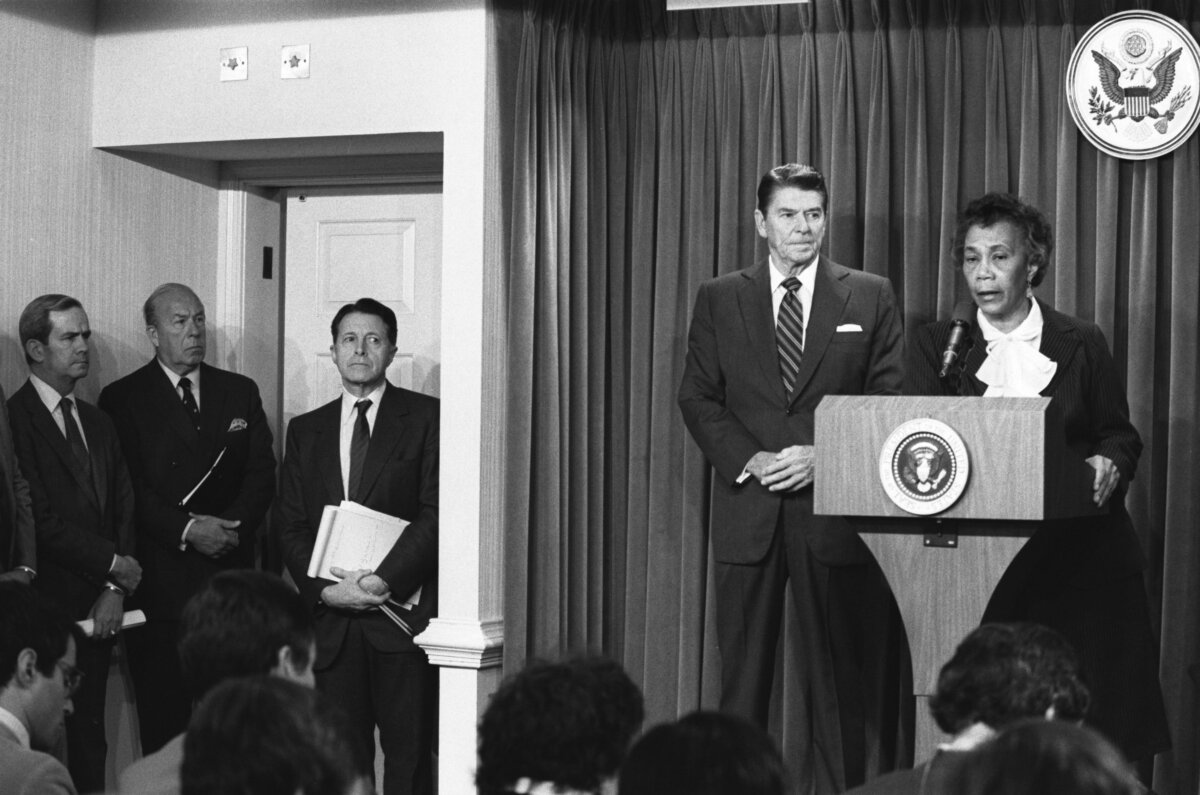
My first political memory—I had not followed politics until I was perhaps a junior in college—was the quick one-and-done invasion of the island of Grenada ordered by President Ronald Reagan in the war against communism. It seemed to me to be a beautiful victory. I was thrilled that the military action divided the campus into warring tribes and I could join one, in this case on the side of the Cold Warriors and against the worrywarts on the left in all the soft disciplines.
Only much later did I find out that this action was not what it seemed. The supposedly saved students were never in grave danger, and it is unclear whether or to what extent the small island had somehow become an actual Soviet outpost. The small adventure was likely crafted for maximum domestic political returns, which were huge at the time.
The intensity of these debates grew over time, and my plunge into brazen partisanship arrived with the 1984 election, which seemed to me a clear case of good and evil. It was capitalism versus communism, freedom versus tyranny, strength versus weakness. Looking back, of course, I realize just how much these prepackaged ideological paradigms are a form of political marketing designed to create digestible election snacks. But at the time, it felt good to be part of a big struggle.
Upon graduation and my first real job, the opportunity arrived to travel to Nicaragua to see the Cold War in action. At the time, the Sandinistas were in control of the country. The Reagan administration supported the “Contras,” who were said to be freedom fighters rolling back Soviet imperialism. The world’s eyes were all on this tiny and very poor country as some kind of arena in which the prizefighters (America vs. the Soviets) were duking it out.
How could I resist such a trip?
We stayed there for about two weeks. Looking back, it was the beginning of a new sophistication for me in understanding international politics. What I found was a very poor country with an ongoing and seemingly unending political conflict between two factions. One was in power and one wanted power. What I did not see was much evidence of a grand ideological struggle. The country was, yes, receiving some token of support from the Soviets such as was available, but interviews with top Sandinista officials elicited nothing approaching Marxist-Leninist dogma.
I looked far and wide for Contras and never found them. What I did find instead were poor people who were working very hard to earn a living in whatever way they could. They were making soup, selling bags of cola, and doing currency exchange. I saw 7-year-old kids with high-level math skills who could trade dollars for the local currency at constantly shifting rates of market exchange. It occurred to me that the math skills of Nicaraguan peasant children far exceeded those of American kids.
Did I find any communists? Yes. There was a bar set up in Managua that sold the local brew, which was watery and not great. But it was there, and it was a place to be. Most of the customers—maybe the owners, too—were West German theological students who had come to the new utopia to see how the system worked. They were eager for all sorts of conversations about libertarian theology and higher criticism in the Marxian tradition. They brought copies of Soviet Life to hand out. This was the only evidence I saw of anything resembling Soviet influence.
One night, I went to the movies, which I enjoyed because in those days I smoked a pipe. They let me smoke in the theater. I cannot describe the joy of watching my smoke lift up through the projection light from the rear of the theater. It looked like a scene from a film noir made in the 1940s. On the way back to the hotel, I rode in a taxi with some American women who were raging that Hollywood sends only B movies to poor countries, which is why the film was so bad. Wow, that’s some kind of wicked imperialism right there.
At the hotel, I made friends with Gary Merrill, former husband to Bette Davis and an aging actor himself. He was a great guy, very friendly, but a truly dedicated communist. He praised the Sandinista soldiers as behaving just like Jesus. That struck me as implausible. More interesting to me was that he was wearing a dress. I asked why. He said that because Nicaragua is a free country and he can do that here, whereas he could not do that in the United States.
We agreed to meet again for breakfast, which I enjoyed. Later that afternoon, I saw him again, this time in pants. I asked why he was wearing pants. He said that he had meetings with some Sandinista officials. Fearing that there might be some remnant of conservatism in them, he decided to play it safe and not wear the dress.
Anyway, those were my exposures to communism on that trip. I never met a Contra, but I did spend time with Violetta Chomorro, who was running the opposition newspaper in town (which was somehow not censored). Her husband had been murdered by communists and she had political ambitions herself. She later became president of the country, before she was voted out in favor of Daniel Ortega, who was president then and again now.
Sensing that the story we were getting in the United States didn’t quite fit with the realities I saw, I read “Nicaragua: Revolution in the Family” by the brilliant journalist Shirley Christian. In her telling, there were several wealthy families in Nicaragua that were forever fighting over who gets to rule the country, and invariably whichever faction wins, the losing faction is politically punished through every means possible. In her view, ideology plays very little role at all in the country. Instead, it was merely being used as a political football kicked around by the superpowers.
This for me was the beginning of a deepening perspective on international affairs. Things are not always as they seem. The version of events that is fed back to people via mass media is canned, shaped, and curated to match domestic political priorities. There are myriad complexities in every country that defy the capacity of distant observers to understand.
This became incredibly obvious in the post-Cold War world. Instead of dialing back its military commitments, the United States ramped them up to push various causes. The biggest skirmish early on was George H.W. Bush’s rollback of Iraq’s supposed stealing of Kuwait’s oil reserves. The U.S. military engaged in an all-out effort to restrain Saddam Hussein, with the message to the world that aggression would never stand. The United States would police this for the world.
That was when the post-Cold War world began. I would not call it the “end of history” as I and so many others believed, but a new age of wars, nation building, subterfuge, spying, militarism, shifting alliances, border conflicts, and terrorism, culminating in the attacks on the United States on Sept. 11, 2001.
The United States responded by invading one country that was not involved but was falsely accused of building a weapon of mass destruction—Iraq. Just before came the invasion of Afghanistan, which was only tangentially connected. At the time, I wondered how in the world the Americans believed that they could achieve in Afghanistan what the Soviets and the British Empire before them had failed to achieve there.
Sure enough, both adventures were spectacular failures, and only the beginning of a string of messes including Libya and Syria, which created a demographic upheaval in Europe because of the resulting refugee crisis.
That’s a huge amount of history as seen through my own eyes, all of which points to the same lesson. If there is a paradigm of understanding of some foreign place that is easy to communicate, fits with prevailing ideological paradigms alive in one’s own country, and is made up of saints to canonize and witches to burn, it is more than likely to be false.
Acting on false information creates unexpected quagmires that can result in untold amounts of human suffering. Adding to the problem is artificial intelligence, which was apparently deployed by the International Atomic Energy Agency in its assessment of Iran’s nuclear ambitions, an assessment that was refuted too late to stop the bombings. Here is a major problem: machines doing the thinking that should be done by humans with evidence. AI is no better than dogmatic ideology in making prudential judgments.
My opening Nicaraguan story has a fascinating coda. When nearly every government in the world shut down for COVID-19, only a few governments in the world declined to violate the rights of their citizens in the name of public health. One of those governments was Nicaragua. The decision-maker was our old friend Daniel Ortega, who said that his people were too poor to hide from a virus and that going along with the World Health Organization would only exacerbate poverty in his country.
Do you see what I mean about the complexities of time and place? They are largely inaccessible by foreign powers that imagine that they can control every outcome. They cannot. What this insight requires above all else is humility in the conduct of foreign policy. It is easy to draw up lists of enemies and much harder to understand another nation well enough to craft policies that lead to the best possible outcomes for everyone in the long run.
Views expressed in this article are the opinions of the author and do not necessarily reflect the views of The Epoch Times.
 Friends Read Free
Copy
Facebook
Tweet
Friends Read Free
Copy
Facebook
Tweet