
Commentary
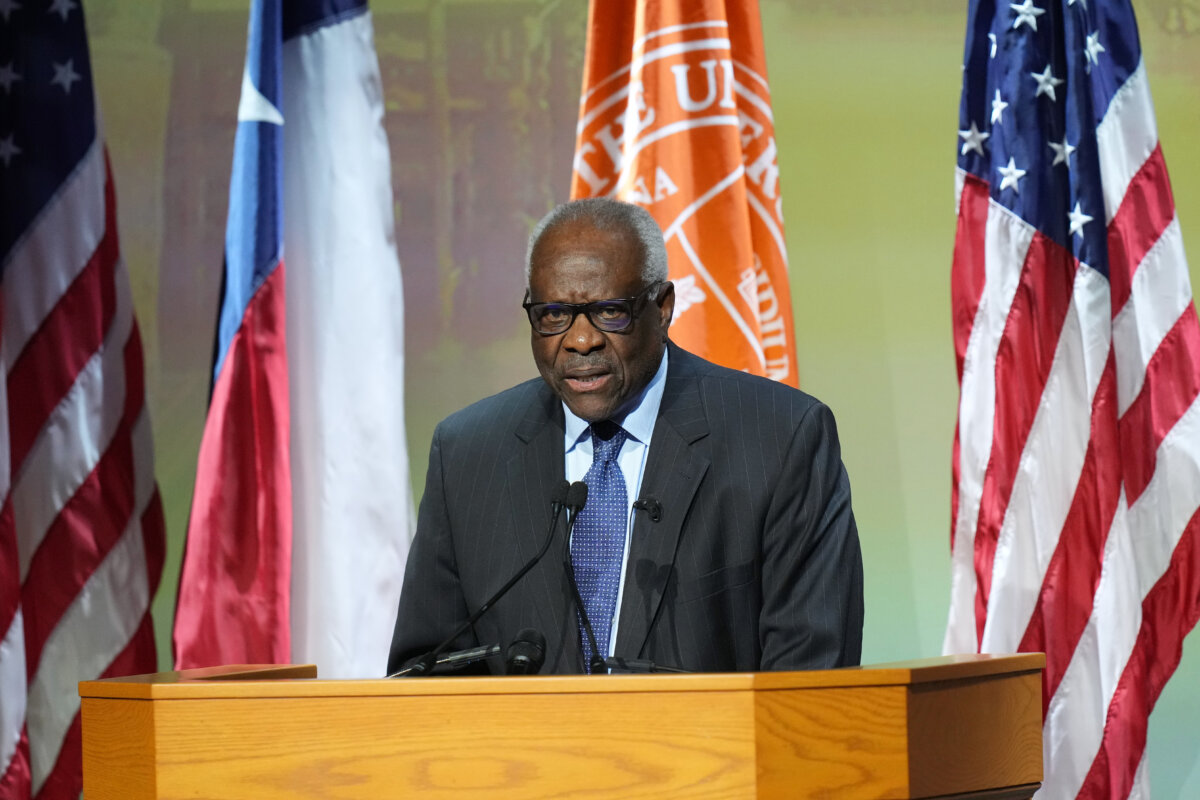
At an April University of Texas gathering to mark the 250th anniversary of the Declaration of Independence, Supreme Court Justice Clarence Thomas delivered a message that was both a celebration and a warning. The question he posed was not simply what the Declaration meant in 1776, but whether its principles can endure in the years ahead.
Thomas’s argument rested on a premise that has long defined his jurisprudence: America is not just a political arrangement. It is a moral proposition. The Declaration’s claim that all men are created equal and endowed with unalienable rights is not a historical curiosity. It is, in his view, a statement of enduring truth—one that demands not just agreement but commitment.
This distinction matters. Appeals to liberty and equality are now common across the political spectrum. But as Thomas suggested, such language becomes hollow if it is detached from its source. If rights are treated as flexible constructs rather than fixed realities, they cease to bind us. They become tools—invoked when useful, discarded when inconvenient.
In the American tradition, rights are not granted by government. They are understood to precede it. Government exists to secure rights, not to redefine them. This principle has shaped the nation’s greatest moral achievements. The abolitionist movement, the struggle for civil rights, and other American reform movements did not reject the founding ideals. They appealed to them. They argued that the nation had failed to live up to its founding principles—not that the principles themselves were flawed.
In this sense, the Declaration is not an obstacle to progress. It is its foundation. It provides a fixed standard against which injustice can be measured. Remove that standard, and the language of rights becomes unhinged—subject to reinterpretation according to shifting political fashion.
Central to his remarks were what Thomas described as a competing set of first principles: those of progressivism. He argued that these adversarial principles entered American culture in the early 20th century and that they were a deliberate departure from the founding vision. Progressivism’s most influential advocate, President Woodrow Wilson, insisted that the Constitution and the principles behind it were no longer adequate to the needs of a modern society. Government, Wilson asserted, should evolve with historical change.
This shift was not merely practical. It was philosophical. Progressives rejected the idea that rights are fixed and universal. In their place, they advanced a more fluid understanding—one in which rights emerge from social conditions and are shaped by political developments. In this view, liberty is not something that existed prior to government. It is something defined and administered by it.
Thomas contended that this framework did not originate in the American experience. Progressives openly drew from European models, particularly the centralized, administrative state developed under Otto von Bismarck in Germany. These systems placed greater trust in expertise and bureaucracy and much less in the judgment of ordinary citizens.
Elite scholars like John Dewey provided the intellectual scaffolding for this transformation. Dewey criticized the founders for treating their principles as timeless truths. In his view, such ideas were historically conditioned—relevant to their era but not binding on future generations. Progressive intellectuals almost always favored change over permanence.
But as Thomas made clear, this redefinition has consequences. If rights are no longer inherent but constructed, they become contingent. Their scope depends on those who interpret and enforce them. Authority shifts away from the individual and toward the state—more specifically, toward those who claim the expertise to manage it.
This helps explain progressive skepticism toward self-government. Wilson himself expressed open disdain for the political capacities of ordinary Americans, describing them in unflattering terms and lamenting that they exercised too much direct influence over public affairs. He favored a system in which decision-making would be entrusted to trained administrators, insulated from popular pressures. Such views, Thomas suggested, are fundamentally at odds with the principles of the Declaration. A government premised on natural rights and popular sovereignty cannot easily coexist with one that treats both as provisional.
The consequences of this tension are not just theoretical. Thomas pointed to 20th-century history, in which ideologies that subordinated individual rights to broader visions of progress produced catastrophic results. Regimes led by figures such as Joseph Stalin, Adolf Hitler, Benito Mussolini, and Mao Zedong demonstrated how expansive state power, justified in the name of historical necessity, can lead to immense human suffering.
Thomas did not say that American progressivism is identical to such regimes. But he did suggest that they share a common premise: that rights are subordinate to evolving conceptions of the collective good. Once that premise is accepted, limits on the power of government are far less secure. He also noted that this kind of reasoning influenced developments in American society. Legal decisions such as Plessy v. Ferguson, which upheld segregation, and Buck v. Bell, which sanctioned forced sterilization, reflected a willingness to treat rights as contingent on social conditions and expert judgment. These were not aberrations in a vacuum. They were, in part, products of an intellectual climate that had moved away from the Declaration’s fixed principles.
The broader implication is difficult to ignore. When rights are defined by government, they are necessarily unstable. They can expand, but they can also contract. Their durability depends less on principle than on power.
Thomas’s warning wasn’t a call to reject change. American history is, in many respects, a story of genuine moral progress. Extending rights to those who were once excluded is a real achievement. The real question is this: How should progress be understood? If it represents a deeper realization of the principles articulated in 1776, then it remains grounded in a stable framework. If it represents a departure from those principles—replacing them with new ones derived from shifting intellectual fashions—the foundation itself begins to crumble.
This has consequences beyond law and politics. People who no longer share a common understanding of the source of their rights will struggle to agree on their meaning. Disputes that might once have been resolved through shared principles become contests of will, mediated by forces whose authority grows as consensus declines. The result is a paradox. In attempting to make rights more responsive to changing circumstances, we risk making them less secure. What is gained by flexibility is lost in permanence.
Critics of the Declaration often emphasize its contradictions. A generation that proclaimed equality also tolerated slavery and excluded many ordinary people from political life. But while important, this observation does not resolve the issue. The failure to uphold a principle does not invalidate the principle itself. It is precisely because the principle exists that the failure can be identified and corrected.
Indeed, it was the language of the Declaration that made reform possible. To abandon that language—or to redefine it beyond recognition—is to risk losing the very standard that can support progress in the future.
Thomas concluded with a reminder that the Declaration is not merely a document to be admired, but a commitment to be lived. The men who signed it pledged their lives, their fortunes, and their sacred honor. That level of devotion is difficult to replicate, but it underscores the seriousness of their undertaking.
The question today is whether enough Americans retain that commitment. It is easy to affirm principles in the abstract. It is far more difficult to defend them when doing so carries a cost—when it invites criticism, jeopardizes opportunity, or places one at odds with conventional wisdom. Yet this is precisely what is required for the preservation of such principles. A free society depends not only on its institutions but also on the willingness of its citizens to uphold the truths on which those institutions rest. The erosion of these truths rarely announces itself in a dramatic way. It occurs gradually, as language is altered, as assumptions shift, and as convictions give way to convenience.
The anniversary of the Declaration invites celebration, but it also demands reflection. If the document is treated as a ceremonial icon—honored in speech but neglected in practice—then the American experiment may become something fundamentally different from what it was intended to be.
Ultimately, Thomas’s 250th anniversary message is one of civic responsibility. The endurance of the principles of 1776 is not guaranteed. They must be understood, lived, and defended. That is not a task for institutions alone. It’s a task for citizens.
Importantly, it’s a task that cannot be put off indefinitely.
Views expressed in this article are the opinions of the author and do not necessarily reflect the views of The Epoch Times.
 Friends Read Free
Copy
Facebook
Tweet
Friends Read Free
Copy
Facebook
Tweet