
Commentary
When I lived and worked in Atlanta, for two years I regularly went downtown to study in the Atlanta–Fulton Central Library. It had in its collections some materials I needed for a book I was writing about the 1906 Atlanta riots. I had to go there to see them, but if the materials had not been housed inside, I would have never gone back after my first visit. The architecture of the building is precisely the opposite of the kinds of spaces and materials that encourage and reinforce curiosity about the past.
The building was completed in the 1980s. It was the last major project of famed architect Marcel Breuer, a leader in his later career of the so-called Brutalist school of design.
Brutalism arose in midcentury and favored stark, minimalist, monochromatic structures in steel, glass, and concrete that fit the mood of Europe after the devastation and death of World War II. No ornamentation, no fluted columns and decorative carvings, no Roman arches, no historical markers, just the bare elements of construction.
In regions behind the Iron Curtain where communism and socialism prevailed, Brutalism acquired a political valence: The elimination of classical elements amounted to a rejection of bourgeois values and the affirmation of a classless society. More famous examples of Brutalism include the Geisel Library in San Diego, Boston City Hall, Habitat 67 in Montreal, and Unité d’Habitation in Marseille, France.
Intellectuals and academic theorists like to talk about Brutalism. It’s an identifiable style, and it’s an idea, too, a movement conceptualized by very smart people such as Mies van der Rohe. It makes for good seminar discussion, it stands for something, it’s thought-provoking. But none of that changes the actual experience of ordinary people, nonexperts who enter and work inside these cold concrete blocks and have no time for or interest in theorizing upon them.
Twenty-five years ago, I stepped out of the subway onto Peachtree Street and faced a monolith with an altogether forbidding front. I had three hours of work to do when I visited, and the industrial concrete forms of the stairways, the absence of polished wood paneling, and the bizarre ceiling with square and circular shapes that reminded me of the inside of a spaceship made for a sterile atmosphere.
My impression was not unusual. This year, Boston Mayor Michelle Wu and the Boston Landmarks Commission gave landmark status to Boston City Hall. However, if they had left the decision up to Boston residents, that never would have happened. When The Boston Globe polled readers on the question, fully 75 percent of them answered, “No.” People in the area hate it.
Buildings such as the Atlanta library and Boston City Hall have been built all across the country since midcentury, many of them federal government offices. They have an uninviting aspect; they scorn the architecture of the Lincoln Memorial, the Chrysler Building, Grand Central Station, and other still beloved structures, and they subtly demoralize the people who work there every day. They’re inhuman.
And so we should appreciate the new executive order that has just come from the White House, “Making Federal Architecture Beautiful Again.” It cites the Founders and their approval of “classical architecture of ancient Athens and Rome,” along with the classical layout of our nation’s capital, designed by Pierre L’Enfant. From there, the order regrets the turn away from classicism and toward designs that have no such distinguished aims, in particular, “modernist and brutalist ones.”
From now on, according to the order, federal design shall favor the “traditional and classical,” “respect regional architectural heritage,” and “command respect from the general public.” Civic buildings should convey a dignified message, not an irreverent and off-putting one, as if the architecture were honoring the public services taking place inside. Acceptable styles shall include Renaissance, Neoclassical, Georgian, Greek Revival, Beaux Arts, and Art Deco; the unacceptable include Modernist, Brutalist, Postmodern, and Deconstructionist approaches.
Long ago, from the 1880s to the 1920s, the fabulously wealthy steel magnate Andrew Carnegie funded the establishment of public libraries in large and small towns all across the United States. It was a noble undertaking by Carnegie, who regarded the public library as a crucial democratic institution.
Poor families with talented kids, but without the money to buy books, now had an equalizing option. But that’s not the only thing memorable about the project. If you do a web search using the words “Carnegie library,” and then click on “Images,” dozens of pictures will come up showing buildings in Charlotte, North Carolina; Jefferson City, Missouri; Mansfield, Ohio; San Jose, California; Kansas City, Kansas; Pittsburgh; and Lewistown, Montana, among other places. Nearly every one, in some aspect, is an architectural gem, with arched windows, Ionic columns, rusticated foundations, dentils, and other classical elements.
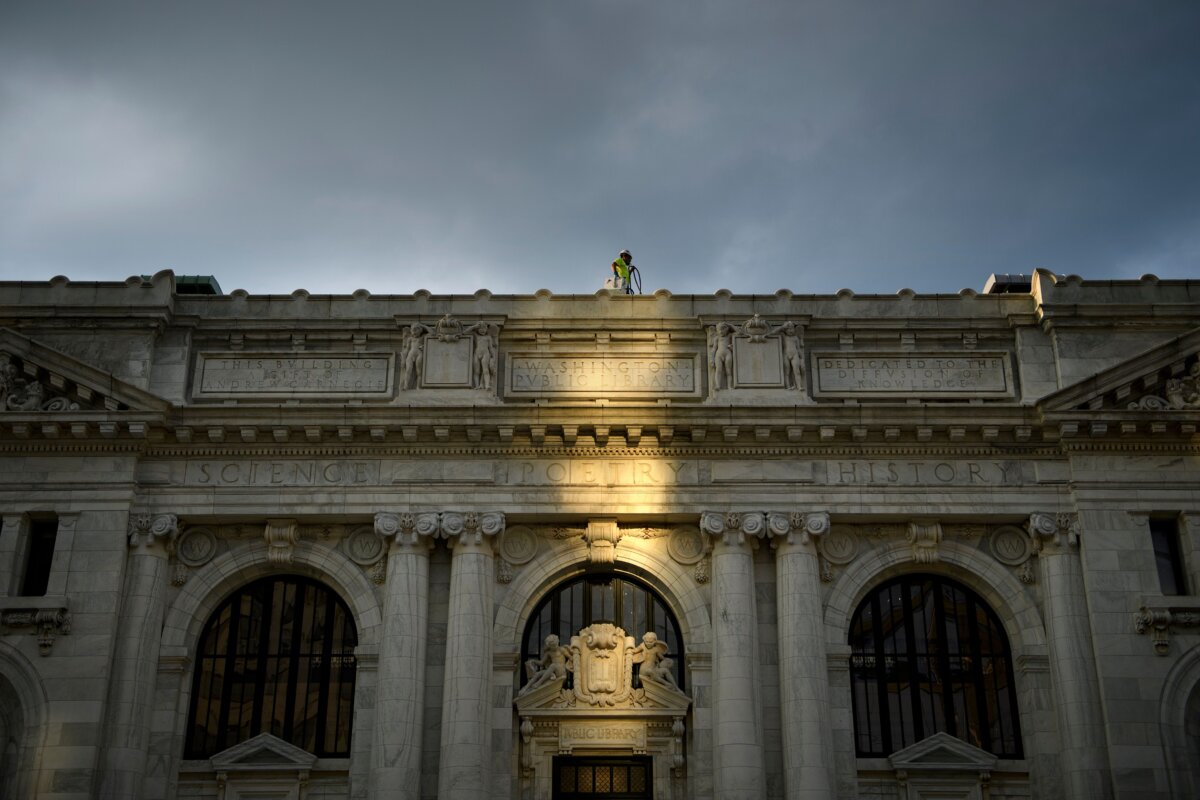
The Carnegie Library in Washington, for example, built in 1902, is a magnificent Beaux Arts design. Others are more modest, but still welcoming and stately. Let us hope that this executive order produces more buildings like them.
Views expressed in this article are the opinions of the author and do not necessarily reflect the views of The Epoch Times.
 Friends Read Free
Copy
Facebook
Tweet
Friends Read Free
Copy
Facebook
Tweet