
Commentary
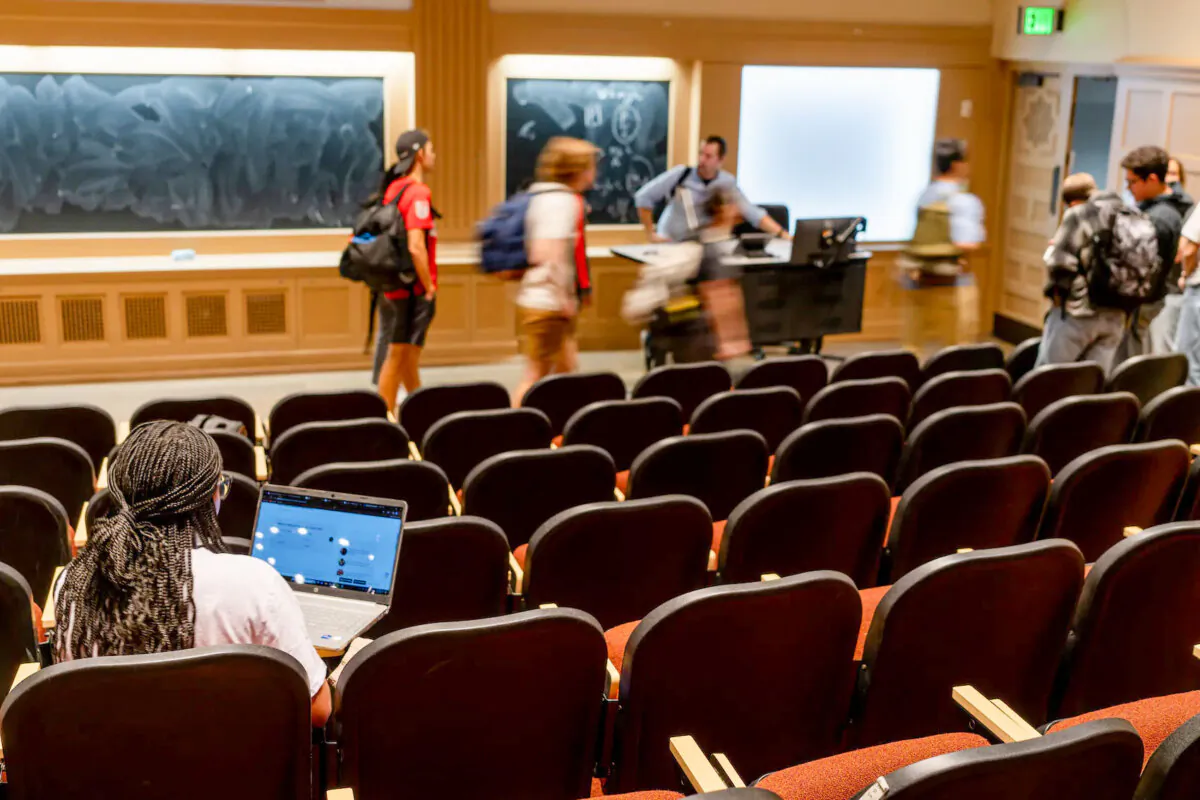
For college teachers whose instruction is all about reading and writing, the advent of artificial intelligence (AI) is a disaster. They’ve never faced a challenge like this before. They assign novels, plays, artworks, treatises, and historical tracts, but students don’t have to study them anymore, not carefully. When AI can provide a handy summary of the books that the student can regurgitate more or less sufficiently on the midterm, why read them in full? If short essays and research papers are required and AI can produce them with but a few tailored requests from the kids, why write those pages themselves, especially as AI gets better and better at disguising its involvement?
Professors feel like they’re in an arms race they can’t win. Every time new software comes along to detect AI input, a new AI tool promises ways around it. The language of the machine is getting better and better. I asked an education researcher the other day: “Isn’t AI prose just like elevator music? It’s clear, yes, and the grammar and punctuation are correct, but it’s so bland and flat and colorless.”
He laughed and replied, “Yes, maybe six months ago that was true, but now you can get it to add any kind of style or edge you like, or just make the sentences more interesting, if you ask it to do so.”
That makes the cheating harder to identify, particularly when a teacher has 30 papers to grade and the term ends in just a few days. It takes too much time to investigate when the signs of borrowing are too subtle. And if a student describes well the plot of a novel, say, in the course of taking a test, the teacher can’t tell if the student read the actual book or only an AI condensation.
In the old days, students resorted to simple plagiarism, copying someone else’s work that actually preexisted, but AI provides original, unique work for each request. Or students turned to CliffsNotes study guides, which summarized works just as AI does.
In both those old cases, the actions took a lot more work than it takes to use AI; students needed to find the prose they wanted to copy or go to the campus bookstore to purchase a CliffsNotes guide. AI delivers a customized product right to the student’s dorm room, straight to the laptop screen and ready to use after a few individualizing directions from the user. It’s like a personal assistant—not a teacher or tutor but a gopher or intern. It does the work, the boss gets the credit. Yes, the student does learn something, but not nearly as much as he would have if he had read the book and written the paper himself.
The humanities are a special case. In the sciences, students don’t have to read Isaac Newton’s writings on gravity and force. They just have to learn the laws (“force equals mass times acceleration”) and apply them to situations. Charles Darwin’s “On the Origin of Species” is a historic publication, but biology students don’t often read it. They don’t have to. Science is progressive; the original formulation of a theory needn’t be studied, not after later scientists have pared down the core findings and refined them. Occam’s razor applies: The simplest expression is the best.
The humanities operate on another assumption. They demand focused attention on the original object: the thing itself, not simplified versions of it. A plot summary of “Hamlet” tells you what happens in the play, but it leaves out the language in which the action unfolds. AI can describe the characters in the play, but reading what AI says about them is an experience wholly different from and inferior to hearing what the characters themselves say. Think of it as parallel to the difference between hearing a song and hearing a description of the song.
That’s the reading problem with AI: It breaks the direct appreciation of the full work, its language, art, and entire meaning. The writing problem is more obvious: It fails to instill verbal skills, which only come with lengthy practice and coaching. AI saves them the labor of improvement, which is one reason students love it. (Writing is one of the least favored tasks; students loathe freshman composition requirements.) AI is so easy and fast, and the final product is so much better than what the student can produce on his own, that the temptation is irresistible. Verbal facility stagnates.
What to do? Here are some suggestions:
- Ban all screens from class; have students bring real books and orient presentations toward immediate concentration on specific passages, images, scenes, and so forth.
- Conduct in-class quizzes on the previous day’s reading, asking questions about specific elements in the works so that AI summations will be of limited help.
- Assign rough drafts that must be discussed and revised in office hours; students will soon realize that reliance on AI will become clear as they fumble to explain words and ideas not of their own making.
- Finally, if teachers have the time, they should conduct oral exams at the middle and end of the semester, not written exams.
The purpose of these tactics is to retain the integrity of the humanities, to keep the studies true to the works they aim to preserve and pass on. Twenty years ago, many professors believed that the digital advent would assist kids with reading and writing assignments and that learning would improve. Today, digital tools are doing those assignments for them.
From now on, then, the humanities should adopt a low-tech posture, an adversarial attitude toward digital enhancements. The humanities must serve as a counterculture, a zone of no screens or keyboards. Be proudly Luddite. Such an antiquated call may prove successful, given the indications among members of Gen Z that social media, games, and videos often exhaust them. As humanities enrollments and majors have been plummeting in recent years, it’s an experiment worth trying.
Views expressed in this article are the opinions of the author and do not necessarily reflect the views of The Epoch Times.
 Friends Read Free
Copy
Facebook
Tweet
Friends Read Free
Copy
Facebook
Tweet