Commentary
Deep inside the National Baseball Hall of Fame Library resides a letter from one of America’s most important baseball fans: Franklin Delano Roosevelt. The letter was written on Jan. 15, 1942, just a day after receiving a letter from Kenesaw Mountain Landis, the commissioner of Major League Baseball (MLB). It had been just five weeks since America had been attacked by Japan and had thus followed with a declaration of war.
Landis requested Roosevelt’s advice on “whether professional baseball should continue to operate.” With America now at war, millions enlisting in the military, and many others contributing to the war effort, was it even proper to play the game during these extraordinary times?
Roosevelt’s response was quick yet thoughtful. “I honestly feel that it would be best for the country to keep baseball going. There will be fewer people unemployed and everybody will work longer hours and harder than ever before. And that means that they ought to have a chance for recreation and for taking their minds off their work even more than before.”
The 1942 baseball season continued, giving Americans a necessary reprieve from thinking about the war. Nearly 60 years later, America would need baseball again.
‘Our Country Is Strong’
On the morning of Sept. 11, 2001, four planes were hijacked by Islamic terrorists. One crashed in a field in Shanksville, Pennsylvania, thanks to the courage of its passengers to overwhelm the terrorists. Another struck the Pentagon, and two more struck the World Trade Center. The shockwaves of the attacks rippled across the country and the world. The images of plane debris strewn throughout an empty field, the smoke emitting from the gaping hole in the Pentagon, and the horrific moment when the Twin Towers collapsed, forced the country to stand still, glued to television screens, wondering how something so evil could happen here, and whether the nation would ever recover.
Suddenly, the most secure country felt vulnerable. The freest people felt shackled by fear. Normalcy seemed an impossibility.
President George W. Bush addressed the nation that night. In a moment of terror, he brought a sense of calm. More than that, he brought a sense of resolve. “These acts of mass murder were intended to frighten our nation into chaos and retreat,” he said. “But they have failed; our country is strong.”
That strength was displayed by the bravery of rescue workers in Washington and New York trying to reach as many victims as they could, even at what for many would be the cost of their own lives. Even average citizens on the streets of New York City assisted others away from the rubble and suffocating dust. As Bush stated, “Today, our nation saw evil, the very worst of human nature. And we responded with the best of America.”
But the country was in shock. When the shock subsided, would clarity invoke that chaos and retreat? Or would it invoke continued courage, compassion, and determination?
‘I Can Hear You!’
The news cameras continued to roll, showing the extensive damage. Rescue workers—firefighters, police officers, paramedics—were seen working tirelessly, endlessly. Or as Roosevelt would have described it, they were working “longer hours and harder than ever before.”
Just as with World War II, Sept. 11 presented the opportunity for fearless leadership. President Bush exemplified it three days after the attacks when he joined the rescue workers at Ground Zero. Bullhorn in hand, he made one of the greatest improvised presidential speeches in history. An off-the-cuff response to a worker who had yelled that he couldn’t hear the president, President Bush yelled in the bullhorn, “I can hear you!” The applause was immediate. “I can hear you. The rest of the world hears you. And the people who knocked these buildings down will hear all of us soon.”
It was a moment of political resolve. A prediction of military retaliation. A promise of dispensed justice. But what about the Americans, specifically in New York City and metropolises across the country? Even with President Bush’s encouraging and inspiring words, he was still standing atop the rubble of what had been the world’s tallest buildings and the image of economic stability. When would a sense of normalcy return?
A Return to Baseball
Immediately after the attacks, baseball was halted. MLB Commissioner Bud Selig struggled with when to continue the season. Was the resumption of the game even necessary or proper? Further, could baseball again comfort a dismayed and grieving nation? Could it shine another light during America’s darkest days?
Baseball players rightfully compared the game to America’s new reality. “It doesn’t take a rocket scientist to figure out sporting events are absolutely meaningless compared with what’s going on in Washington and New York,” said St. Louis Cardinals slugger Mark McGwire.
Baltimore Orioles shortstop Cal Ripken Jr., who was playing the last season of his 21-year career, said, “Baseball is a great sport. It’s fun, it’s entertaining, it provides a service to society. But in the grand scheme of things, it’s very minuscule.”
The statements were all true. The sentiment, appropriate. But baseball would prove to be much more than entertainment or a mere service to society.
Selig made the momentous decision to resume play on Monday, Sept. 17. It was the longest regular-season stoppage since 1918.
After six days of stoppage, the game returned to the diamond. And just as it had been nearly 60 years prior, it was “best for the country to keep baseball going.”
Something to Smile About
The first game was played in St. Louis against the Milwaukee Brewers. American flags and patriotic signs were scattered throughout the stadium. The evening game began with legendary Cardinals announcer and World War II veteran Jack Buck standing at a podium waiting for the chants of “USA!” to die down. The 76-year-old Buck, who had retired the season before, stated, “I don’t know about you, but as for me, the question has already been answered. Should we be here? Yes. Should we show others how to demonstrate our resolve? Yes.” The cheers were for his words, but also for the hundreds of St. Louis rescue workers being honored on the field. Fans stood as Buck read a poem called “For America,” followed by a 21-gun fireworks salute. The light of baseball was again reaching into the darkness that had been cast over the country.
The first game in New York took place on Sept. 21 at Shea Stadium, home of the New York Mets, which had also become a temporary rest and supply hub for rescue workers. As the Mets prepared to come back home to play, Mike Piazza, the team’s All-Star catcher, told a reporter, “I really don’t know what to say except how bad we feel and how secondary sports is right now. And how we just have to pull and pray, and try to find some way to move on.”
Piazza would get a chance to help New Yorkers move forward. That night against one of their archrivals, the Atlanta Braves, Piazza walked to the plate. It was the eighth inning and the Mets were losing 2-1. With a runner on base, Piazza smashed a fastball over the centerfield wall, giving the Mets the lead. The fans of New York were raucous with joy. Even the first responders, who had been honored at the beginning of the game, laughed and hugged over the home run. New Yorkers, in the midst of immense grief, were given something to smile about.
A Demonstration of Resolve
The New York Yankees played their first game back at Yankee Stadium four days after Piazza’s now-iconic home run. More importantly, they would reach the World Series. Although they won all three games played in New York, they would lose the seven-game series to the Arizona Diamondbacks. But it was the first game at Yankee Stadium—Game 3—that everyone most fondly remembers.
On Sept. 20, 40 days prior to Game 3, President Bush had addressed Congress and the nation. Hoping to guide the country through this wilderness of fear and trepidation, he implored Americans “to live your lives, and hug your children. I know many citizens have fears tonight, and I ask you to be calm and resolute, even in the face of a continuing threat.”
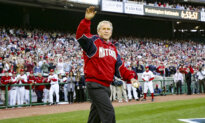
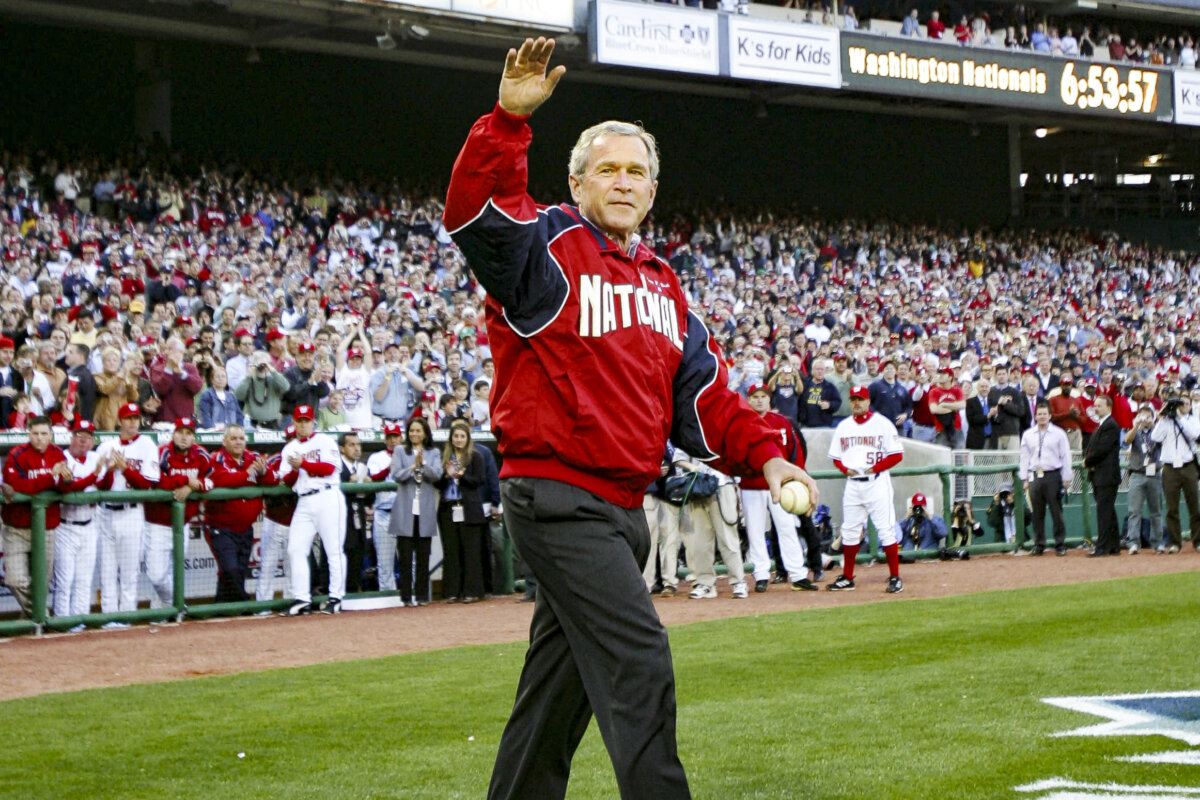
But was such a thing possible, especially so soon after the attacks? President Bush demonstrated that it was possible on Oct. 30 at Yankee Stadium. Despite the “continuing threat,” the president prepared to throw out the first pitch of Game 3. Donning a fleece pullover gifted to him by the Fire Department of New York, which covered a bulletproof vest, President Bush walked confidently to the mound, waving to the crowd as he did.
The Healing Moment
Prior to walking onto the field, he had been in the bowels of the stadium throwing warmup pitches. Yankee shortstop Derek Jeter stopped by to meet the president and gave him some advice. Throw from the mound and don’t bounce the pitch, otherwise the New Yorkers would boo him. “This is Yankee Stadium,” he quipped. President Bush took the advice to heart.
Standing on the mound, President Bush reared back and threw a perfect strike to Yankees catcher Todd Greene. The roar of the crowd signaled their approval. The pitch signaled something else. The confident toss exemplified the American spirit. Resolved, unwavering.
“You can use all the words to describe it. It was hair-raising, different. Just an awesome healing moment for our country,” Greene recalled.
It was proof that Americans would not be bowed by terror. They would not cower in fear and lock themselves away, waiting for the dark days to pass. No, they would help each other overcome the tragedy. They would live their lives and hug their children. They would assemble in stadiums. They would play baseball.
Baseball has and always will have a special place in the hearts of Americans. It has been a light during the country’s darkest days and a salve to the nation’s greatest wounds.
Perhaps few understood the power of baseball better than one of the game’s biggest fans. Roosevelt, who threw 11 ceremonial first pitches, including two for the World Series, explained it best, “Baseball has been called the national pastime and rightly so because it stands for the fair play, clean living and good sportsmanship which are our national heritage. That is why it has such a warm place in our hearts.”
Views expressed in this article are the opinions of the author and do not necessarily reflect the views of The Epoch Times.
 Friends Read Free
Copy
Facebook
Tweet
Friends Read Free
Copy
Facebook
Tweet