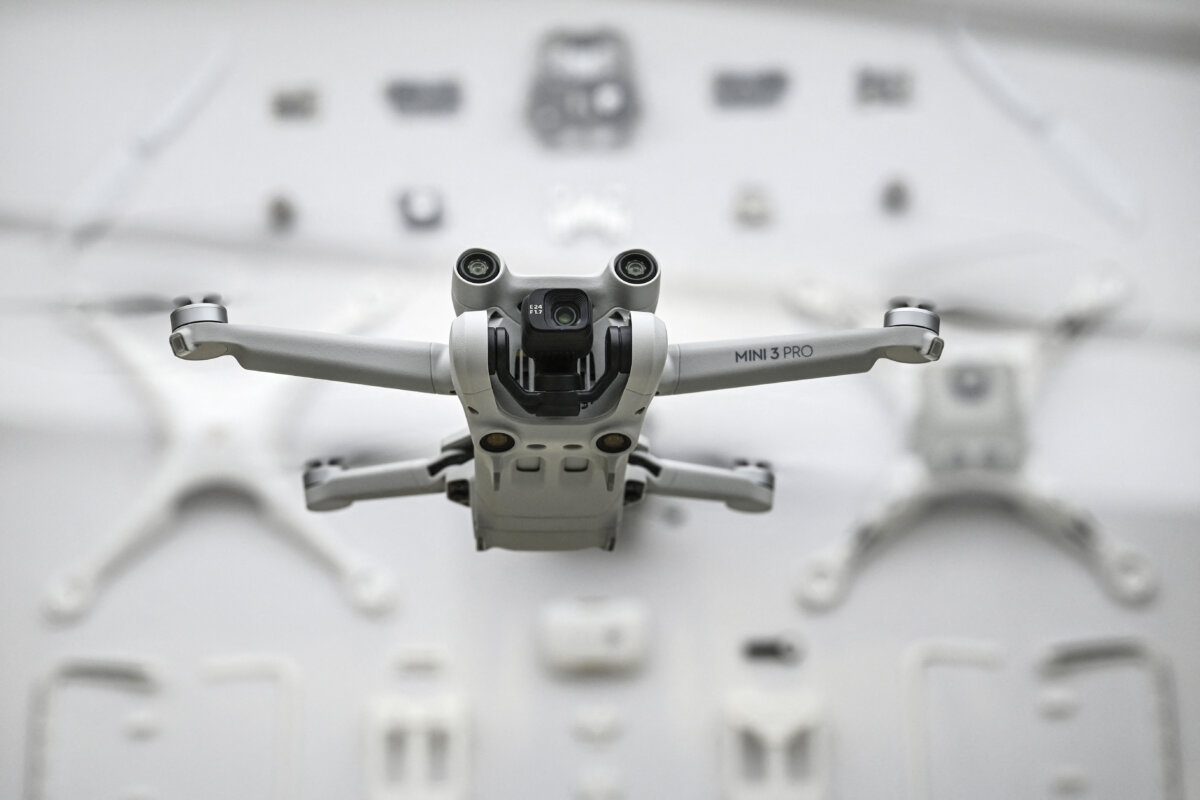

The Canadian government owns at least 1,600 Chinese-manufactured drones across more than 20 ministries and public service departments, according to documents tabled in Parliament this week.
The RCMP is the largest drone user with a fleet of 1,027 as of May, far surpassing any other government organization, according to documents filed on Sept. 21 in response to an inquiry from Conservative MP Eric Melillo.
The question sought to determine which government agencies operate Chinese-manufactured drones and what security measures they implement during deployment.
The Department of National Defence and the Canadian Security Intelligence Service declined to release the information, citing “national and operational security considerations.”
“These systems are used in limited and controlled contexts, including testing and training activities,” National Defence said in the document.
RCMP Commissioner Michael Duheme told reporters this week that the federal policing agency limits the use of Chinese drones to “things that are non-national security in nature.”
According to the order paper, other departments using Chinese drones are Fisheries and Oceans Canada, which had 287, Environment and Climate Change Canada with 76, the National Research Council Canada with 70, and Natural Resources Canada with 53.
Agriculture and Agri-Food Canada had more than 30 China-made drones while the Transportation Safety Board of Canada had 21, and Public Services and Procurement Canada had 20.
Correctional Service Canada has a fleet of 12 Chinese drones that it said it uses under strict conditions, including mandatory memory deletion after each use.
“The Correctional Service of Canada reviewed independent reports which included cybersecurity and testing reports, and found no critical vulnerabilities, hidden backdoors, or evidence of unauthorized data transmissions in relation to the devices being manufactured in China,” the documents said.
The Canada Border Services Agency (CBSA) said it uses six Chinese-made drones that “do not have data cards and are not connected to any networks.”
The other agencies to submit numbers had fewer than 10 or none at all. Parks Canada said it didn’t submit its inventory because it couldn’t access them on time. though it noted it “has not conducted security assessments specifically focused on drones manufactured in China.”
Several of the departments noted security measures like limited network connectivity and restricted collection paired with encryption, while some agencies had few measures in place.
Environment Canada said it has not done any specific “formal security assessment” and the Transportation Safety Board of Canada said the photos taken documenting collisions are not classified.
Drone Use
The release of the figures comes a few weeks after Prime Minister Mark Carney said the Canadian military had only 2,000 drones in its infantry, but would need millions more in the years to come.
Carney made the comment during a Sept. 10 press conference with Ukrainian President Volodymyr Zelenskyy during which he announced Ukrainian drone manufacturers will collaborate with Canadian firms to advance drone technology.
Carney said one-third of the drones produced through the initiative will be sent to Ukraine for use in its war with Russia and the remaining two-thirds will be used to strengthen Canada’s domestic capabilities, including territorial and coastal surveillance.
The Ontario government introduced constraints on China-produced drones in May, forbidding their use in “highly sensitive” Ontario Provincial Police operations.
Public and Business Service Delivery and Procurement Minister Stephen Crawford said in a May 20 press release that the province also plans to phase them out altogether over time.
“Now more than ever, it is critical that we are protecting our province’s data and safeguarding our security against bad actors,” Crawford said. “Banning government use and future purchases of Chinese-made drones is another important step in our plan to protect Ontario and better leverage Canada’s world-class drone manufacturing sector.”
 Friends Read Free
Copy
Facebook
Tweet
Friends Read Free
Copy
Facebook
Tweet