
Commentary
Amid rising threats from the Chinese regime, the Trump administration is fast-tracking arms sales to Taiwan as part of a broader strategy to deter Chinese aggression and reinforce U.S. alliances in the Indo-Pacific.
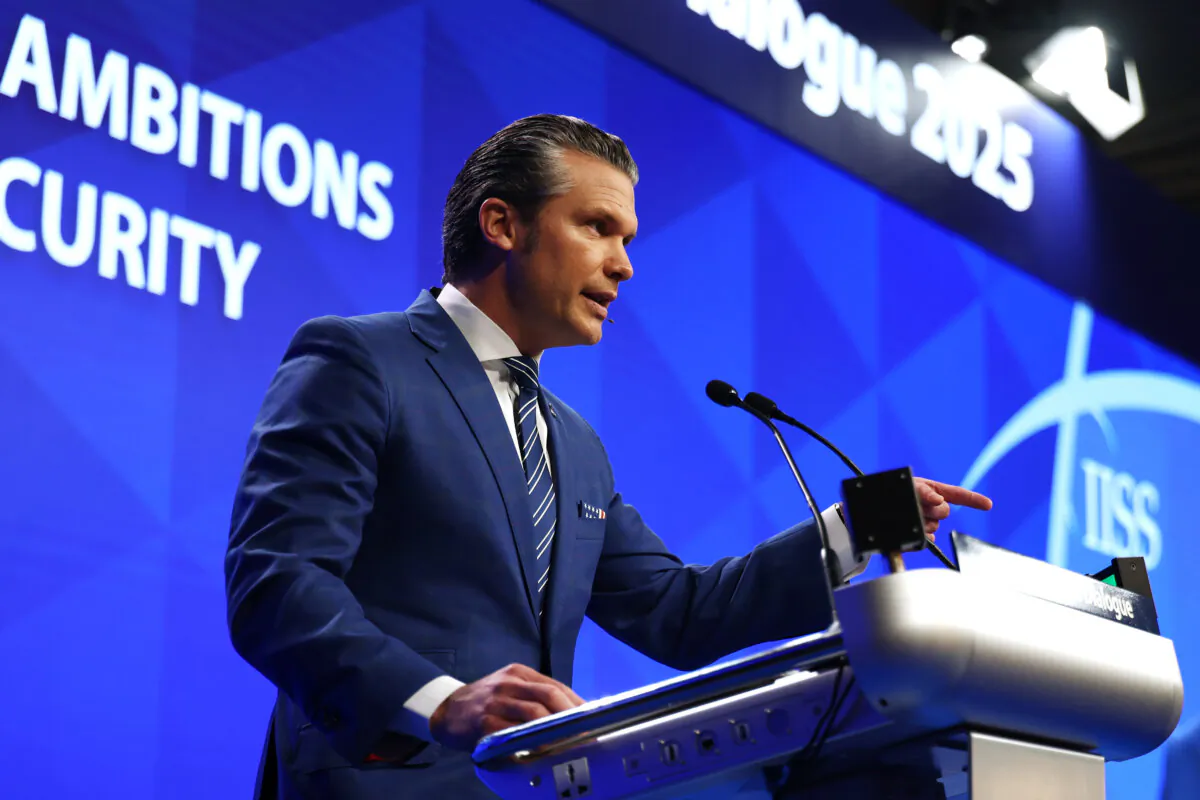
At the 2025 Shangri-La Dialogue, held in Singapore from May 31 to June 2, U.S. Secretary of Defense Pete Hegseth issued one of the clearest warnings yet about Beijing’s military ambitions.
“Every day you see it. China’s military harasses Taiwan,” he said, citing China’s rapid military buildup and daily rehearsals for a potential invasion of the island nation.
Hegseth’s attendance at the Shangri-La Dialogue, an annual defense summit that gathers Indo-Pacific and global security leaders, was meant to counter the Chinese regime’s influence in the region. Beijing, by contrast, sent only a low-level delegate, likely to avoid direct confrontation. While China kept a low profile, Hegseth used the opportunity to warn of a “real and potentially imminent” threat from the Chinese Communist Party (CCP), as the Trump administration unveiled its plan to cut red tape and fast-track weapons deliveries to Taiwan and other key regional allies.
Just weeks earlier, in March, Congress launched a new task force to accelerate U.S. arms deliveries to key allies, particularly in the Indo-Pacific. The group is tasked with identifying delays in weapons shipments and ensuring timely fulfillment of commitments, focusing on Taiwan, South Korea, Japan, and Southeast Asian partners. Taiwan alone faces a significant backlog, nearly $22 billion in pending U.S. weapons, according to estimates from the Cato Institute.
To address these issues, President Donald Trump also signed an executive order on April 9 to reform the foreign defense sales system by cutting regulatory delays and prioritizing rapid transfers to strategic partners such as Taiwan, bolstering both allied readiness and the U.S. defense industrial base.
Hegseth stated that Beijing is “credibly preparing” to use military force to shift the balance of power in the Indo-Pacific, citing CCP leader Xi Jinping’s public order for the People’s Liberation Army to be capable of invading Taiwan by 2027. The defense secretary noted that China is already building and training for such a scenario.
However, Hegseth underscored Washington’s commitment to Taiwan’s defense. “Any attempt by Communist China to conquer Taiwan by force,” he warned, “would result in devastating consequences for the Indo-Pacific and the world.”
While he did not explicitly state that the United States would fight for Taiwan, maintaining the traditional posture of strategic ambiguity, the question of whether Washington would intervene appears far less ambiguous under Trump than it was under the previous administration.
On May 21, Rep. Scott Perry (R-Pa.), along with Sen. Rick Scott (R-Fla.) and Rep. Tom Tiffany (R-Wis.), introduced the Taiwan PLUS Act to strengthen U.S.–Taiwan defense ties and accelerate weapons deliveries. The bill grants Taiwan preferential treatment similar to that afforded to “NATO Plus” allies such as Japan, Israel, South Korea, and Australia.
The bill raises the financial thresholds that trigger congressional oversight and shortens the review period for arms sales from 30 days to 15 days, aiming to eliminate bureaucratic delays and speed the delivery of critical weapons systems. Taiwan would also be eligible for certain fee reductions and waivers, with this preferential status lasting for five years, subject to renewal by the State Department if it continues to serve U.S. national security interests.
The Trump administration’s effort to expedite arms sales to Taiwan and regional allies reflects a broader shift toward preemptive deterrence. Hegseth announced the first overseas deployment of the NMESIS mobile anti-ship missile system to the Philippines, where it was used in joint exercises with Filipino forces. The U.S. 3rd Marine Littoral Regiment, one of the military’s most advanced units, positioned the system in the Batanes Islands near the Luzon Strait between the Philippines and Taiwan.
At the same time, Trump revealed plans to significantly expand arms sales to Taiwan in his second term, aiming to surpass the $18.65 billion approved during his first term, more than twice the total under the Biden administration. The new weapons packages are expected to include missiles, munitions, and drones.
Taiwanese officials reiterated their commitment to strengthening self-defense and deepening cooperation with the United States, while China strongly condemned the sales, warning that they could heighten tensions in the Taiwan Strait.
Beijing has predictably responded with threats, calling U.S. arms sales to Taiwan a “red line that cannot be crossed,” the CCP-run Global Times reported. Foreign Ministry spokesperson Lin Jian demanded that the United States immediately halt all sales and warned that Beijing’s determination to defend its sovereignty and territorial integrity is unwavering.
Shortly after the U.S. plans were reported, Beijing added 10 U.S. companies to its “unreliable entity list” for their involvement in arms and military-technology cooperation with Taiwan—part of the CCP’s escalating economic and diplomatic retaliation against efforts to strengthen Taiwan’s defense.
Taiwan, meanwhile, has said that it seeks to boost deterrence and deepen security ties with Washington. On May 28, President Lai Ching-te met with a U.S. congressional delegation led by Sen. Tammy Duckworth (D-Ill.), who has championed key legislation such as the TAIWAN Security Act, the Taiwan and America Space Assistance Act, and the STAND with Taiwan Act, a bipartisan bill reintroduced in 2024 that mandates sweeping sanctions against the Chinese regime should it invade Taiwan.
As 2027 approaches, Washington and Taipei are preparing for any potential moves by the CCP.
Views expressed in this article are the opinions of the author and do not necessarily reflect the views of The Epoch Times.
 Friends Read Free
Copy
Facebook
Tweet
Friends Read Free
Copy
Facebook
Tweet