
Commentary
The closure of the Strait of Hormuz has shifted global attention to Bab el-Mandeb, where U.S. naval dominance gives Washington the advantage over China in controlling a critical energy choke point.
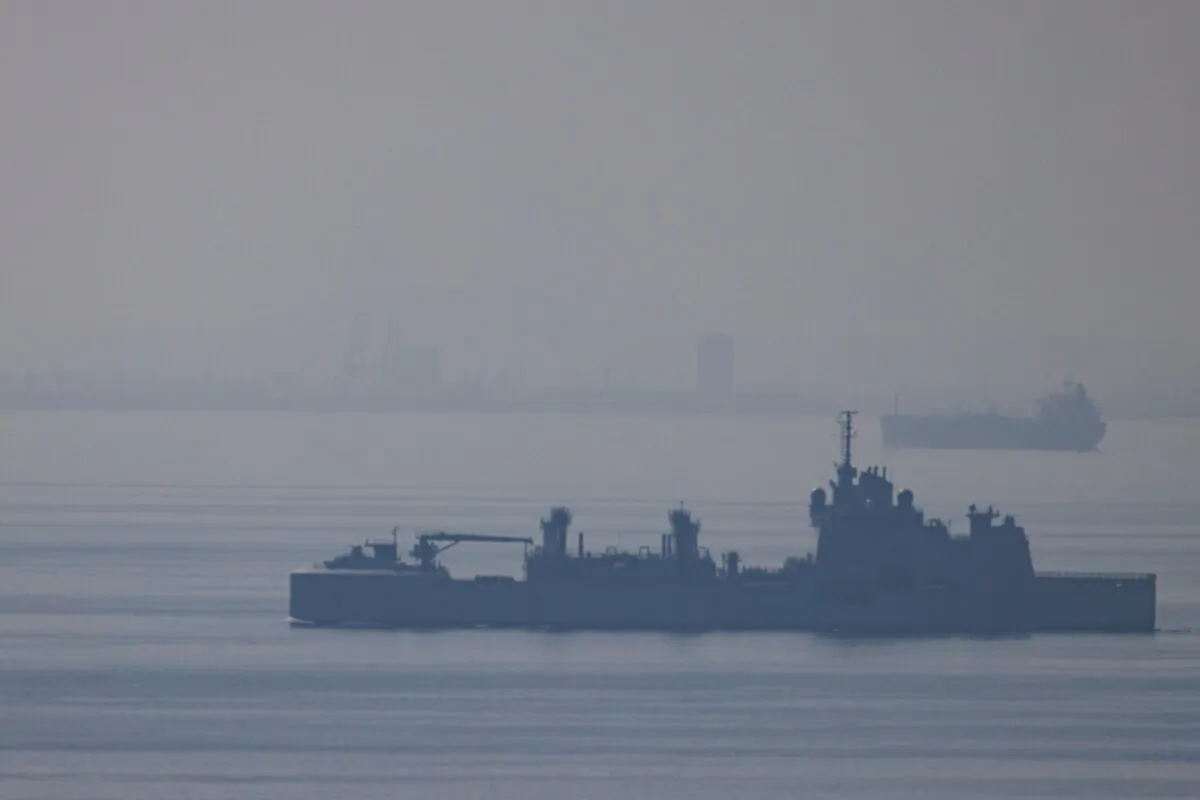
The U.S.–Iran conflict has intensified competition between the United States and China over energy. The disruption caused by the effective closure of the Strait of Hormuz has underscored how vulnerable global energy markets are to choke points, making other critical transit routes even more important. With the Strait of Hormuz effectively closed, attention has shifted to alternative maritime corridors such as Bab el-Mandeb, where control over energy flows is increasingly contested.
Bab el-Mandeb, the “Gate of Tears,” is a corridor barely 18 miles (30 kilometers) wide at its tightest point, carrying roughly 12 percent of global maritime trade daily. Ships moving oil from the Persian Gulf to Europe must travel north through the Arabian Sea, into the Gulf of Aden, through Bab el-Mandeb, into the Red Sea, and through the Suez Canal into the Mediterranean, making the strait the southern entry gate to a corridor that cannot be accessed any other way.
If either choke point is blocked, the entire route fails, forcing ships to reroute around the Cape of Good Hope, adding 3,500 nautical miles and 10 to 14 days per voyage.
When Houthi terrorist group attacks disrupted the Red Sea starting in late 2023, ships avoided the Bab el-Mandeb rather than proceed toward Suez, collapsing canal transits to 877 by October 2024 from 2,068 in November 2023, according to Lloyd’s List Intelligence. Legally, the strait falls under the jurisdiction of three coastal states, Yemen to the northeast and Djibouti and Eritrea to the southwest, with no single country holding complete command.
In practice, the United States and China have each established a military presence on the Djiboutian shore, with China’s People’s Liberation Army Support Base sitting seven miles from the U.S. base of Camp Lemonnier, making Bab el-Mandeb the one choke point where both powers compete for influence in close proximity. Camp Lemonnier is the only permanent American military base in Africa, hosting U.S. Africa Command’s Combined Joint Task Force–Horn of Africa with more than 5,000 military and civilian personnel.
The base serves as a platform for counterterrorism missions and crisis response operations, including the 2023 evacuation of U.S. Embassy personnel from Sudan. A second facility, Chabelley Airfield, began operating U.S. military unmanned aircraft in September 2013 after the Djiboutian government asked the United States to relocate drone operations away from the international airport.
Camp Lemonnier operates within a broader U.S. military architecture in the region. The U.S. Fifth Fleet, headquartered in Bahrain, directs naval operations across the Persian Gulf, Red Sea, and Arabian Sea. Diego Garcia base in the central Indian Ocean provides the logistics depth. It supplies pre-positioned ships, fuel, and munitions that sustain forward operations across both theaters.
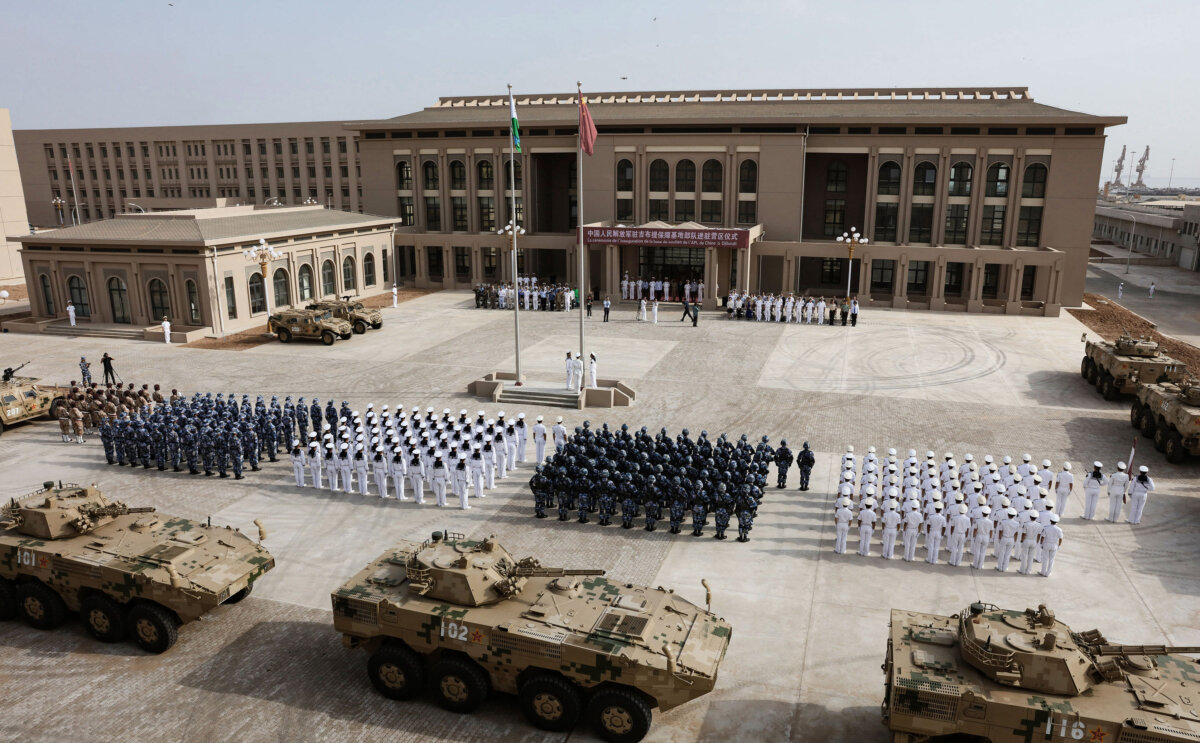
China’s People’s Liberation Army Support Base in Djibouti is its first and only official overseas military facility. It sits adjacent to Camp Lemonnier near the Chinese-operated Port of Doraleh and was built in about 2017. The United States had blocked a Russian base in Djibouti in 2014 and invested $1 billion upgrading Camp Lemonnier, but was “blindsided” when Djibouti approved the Chinese base two years later.
The proximity has generated persistent friction. In May 2018, the U.S. Air Force reported that military-grade lasers had been aimed at the eyes of American pilots, with the incidents originating from the Chinese base. Beijing denied responsibility.
The two bases represent rival anchors at the same choke point, but they are not equivalent in capability. China’s facility is a support installation designed for logistics, resupply, and noncombatant evacuation, not a combat force. It has no carrier strike group and no independent power projection capability beyond its perimeter.
The asymmetry becomes most pronounced when the reinforcement problem is examined. Any Chinese naval force dispatched from the mainland to Djibouti must travel along one of two routes. It can pass through the Strait of Malacca, where the United States is positioned to interdict via its major defense partnership with Indonesia and existing access to Singapore’s Changi Naval Base. Alternatively, it can travel around the western coast of Australia and across the Indian Ocean, where U.S. Fifth Fleet assets and Diego Garcia form a logistics network China cannot replicate.
There is no route from China to Djibouti that does not pass through or near U.S.-influenced maritime space. In a conflict, China’s Djibouti base could be effectively isolated, cut off from reinforcement, resupply, and replacement vessels. China has been building toward a blue-water navy capability, but has not achieved it in any sustained operational sense. It has no second overseas base capable of supporting extended naval operations and no combat-tested carrier strike group doctrine.
China’s Djibouti installation is therefore a fixed forward position with no self-sustaining logistics chain, making it a potential liability as much as an asset in a shooting war.
China has pursued a longer-term hedge through what analysts call the “String of Pearls,” a network of port access agreements across the Indian Ocean, including Gwadar in Pakistan, Hambantota in Sri Lanka, and sites under discussion in Burma (also known as Myanmar) and Tanzania. None of these are operational military bases, but they represent potential future resupply nodes that Beijing is developing, as it understands the vulnerability of its Djibouti base.
Bab el-Mandeb is therefore the choke point where U.S.–China competition is most direct and physically concentrated, with both powers maintaining facilities on the same shoreline. However, the United States holds the stronger hand. It has a larger base, a functioning logistics network, blue-water naval superiority, and combat experience at the choke point accumulated over two years of operations against the Houthis. China holds a forward position that it cannot independently sustain in a conflict, dependent on sea lanes that the United States is positioned to contest.
Views expressed in this article are the opinions of the author and do not necessarily reflect the views of The Epoch Times.
 Friends Read Free
Copy
Facebook
Tweet
Friends Read Free
Copy
Facebook
Tweet