
Commentary
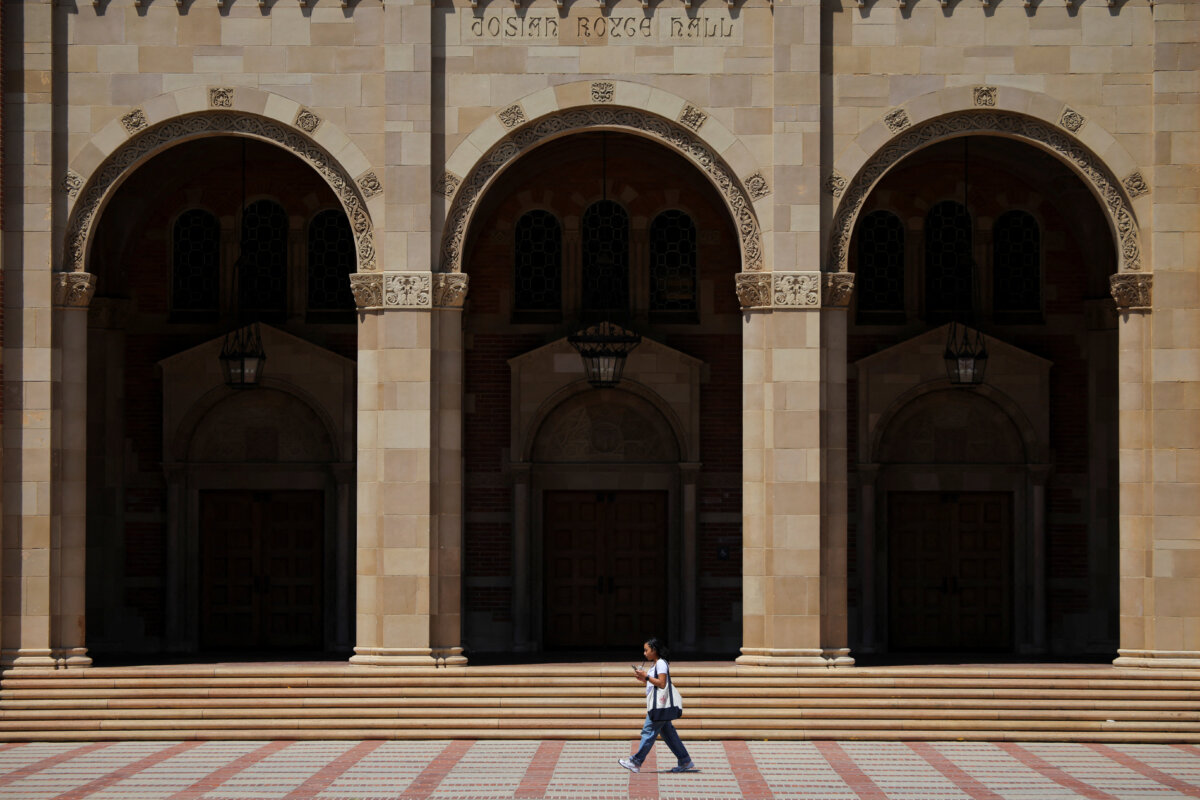
I started at UCLA in the fall of 1977, after graduating from a public high school in North San Diego County, a mile inland from the beach. There was never any doubt where my twin brother and I would go. Berkeley, UCLA, Santa Barbara, and the others formed the best public university system in the world. They had sports, too, and parties and pretty girls, we thought. And there was something else: the cost. In my family, a private institution such as the University of Southern California was out of the question. At UCLA that year, tuition was $500.
I made friends in the dorms who were as poor as I was. My brother and I found part-time jobs. I worked early morning and noontime at the elementary school on campus, monitoring the playground. I “hashed” at a sorority, helping out in the kitchen for 30 minutes at lunch and dinner in exchange for a free meal and one dollar (socializing with the sisters was disallowed). For two summers, I hawked the racing edition of the Los Angeles Herald Examiner at the Del Mar track, the following summer working as a camp counselor in Malibu. My brother sat at the desk in the university archives at the research library, where one day three men grabbed a guy sneaking out with a U.S. president’s letters hidden in his briefcase (I can’t remember which president it was).
Meanwhile, classes went on. A lot of them had hundreds of students, especially in freshman year. We sat in big lecture halls and took notes, the professor on stage as remote from us as a singer at a rock concert. Each Friday, we would break up into discussion sections, 25 of us with a teaching assistant, usually a graduate student in the department. Some of them were attentive and smart; others were too busy with their own work to give us much time. Enrollments didn’t thin out until junior year, when you declared a major, and even then, in popular fields, classes could have 40-plus students.
You might say, “Well, you get what you pay for.” No doubt, across town at USC, classes were smaller and professors more accessible. Parents paying high fees expected it to be so. (In our eyes, “USC” stood for “University of Spoiled Children.”) But I received an excellent undergraduate education at UCLA, including in lecture classes with 300 kids. Teachers were tough, and high grades were hard to get. Once I was told that the average mark in upper-division English classes was B-, a remarkable fact given that about 45 percent of college grades today are in the A to A- range. I remember a Shakespeare class with a stern older professor who told us on day one that class begins precisely at 10 a.m. On Day 2, 10 a.m. came, he shut the door, and the presentation commenced—until four minutes later, the door slowly opened and a girl in shorts slid in and approached an empty seat. “I’m sorry,” he said, “class has already started—you must leave.” She blushed and paused, we lowered our eyes, and she departed without a word.
The tight rules and high standards made us work harder, much harder. The curriculum was rigorous, with lots of serious books and heavy general education requirements. Here’s the paradoxical thing: It wouldn’t have been like that if the cost weren’t so low. If UCLA depended on student tuition to survive, the professors wouldn’t be so quick to hit us with a low grade or to enforce such strict rules. If a kid flunked out, it would mean financial pain for the school. If a kid didn’t like the policies, he could go elsewhere, and the admissions office would notice and wonder what went wrong. Tuition in the three figures prevented all that.
The low cost didn’t only make us work harder. It gave us more freedom, too. It took me five years and two summer schools before I earned my degree. I screwed up in a few early classes and bounced around from field to field before settling on an English major at the end of my third year. Some of those courses in science, languages, and philosophy, I still remember and appreciate. They pushed my graduation back a full year, but with tuition still below $1,000, so what?
Big money killed that kind of meandering on the student’s part and exactitude on the teacher’s part. When a student whose family shells out $60,000 decides to transfer, it’s a financial hit to the school, as I said. Students choose their courses always with post-graduate necessities in mind, especially when they have loans to pay, thus losing the opportunity to study things that have no career utility, such as the History of Jazz and the Italian Cinema courses I took at UCLA in my third year. Big money turns students into customers, teachers into content-providers, presidents into fundraisers, and the college itself into a corporate entity.
My advice to high school students and their parents is this: Choose a good two-year college for a low price, discover the best teachers on campus, get all your general education requirements covered, add a batch of other courses of interest, and don’t worry about taking three years instead of two. Then, transfer to a four-year college, and narrow your focus to a major and a career. When you graduate and apply for jobs, nobody will care that you logged a few early years at a lesser institution.
Views expressed in this article are the opinions of the author and do not necessarily reflect the views of The Epoch Times.
 Friends Read Free
Copy
Facebook
Tweet
Friends Read Free
Copy
Facebook
Tweet