
Book Excerpt
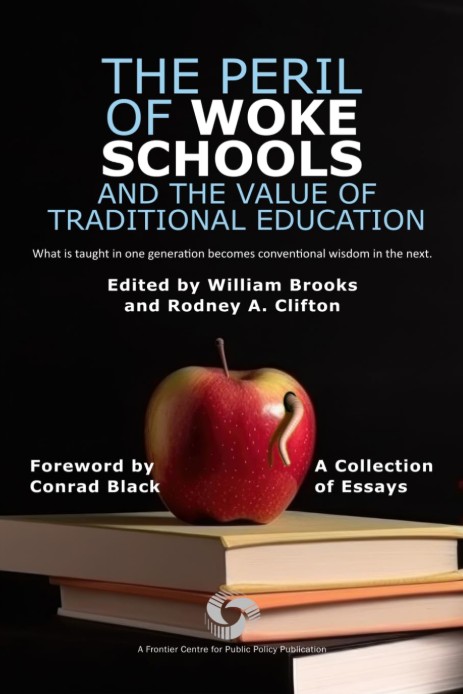
“The Peril of Woke Schools and the Value of Traditional Education,” edited by Frontier Centre for Public Policy Senior Fellows William Brooks and Rodney A. Clifton, is a landmark collection of essays that expose the influence of progressive-woke ideology on North American schools and what this development has cost Canadian children, their families, and society. The following essay is excerpted from the book.
Statistics say that about 14 percent of Canadian 15-year-olds score below Level 2 in reading on OECD’s PISA test, meaning they are not reaching the baseline proficiency expected in many countries.
In fact, almost half of Canadian adults are assessed as having inadequate literacy skills—not utterly illiterate but lacking the reading, writing, comprehension, and numeracy skills needed for many everyday tasks. This means that a significant number of students emerge from 12 or 13 years of mandatory schooling unable to reliably write coherent paragraphs, tackle abstract-thinking tasks, or fully engage with complex texts.
Serious behavioural issues are also being cited by teachers as a major factor in workplace stress and turnover. For example, a 2025 survey of Canadian educators found 53 percent reported experiencing verbal or physical violence in their school during the past year. It’s been estimated that nearly one in five new teachers leave the profession within their first five years, and disruptive classroom behaviour is the most cited reason.
Ironically, this precipitous decline in concrete knowledge, competence, and self-control is accompanied by grandiose self-confidence and a dogmatic intolerance for differing viewpoints. Meanwhile, increasingly more young people are being taught to identify with allegedly oppressed gender minorities, and many seek early medical interventions to transform themselves into the opposite sex.
Each of these problems—the lack of competence, the solipsism and unearned confidence, the collapse of classroom discipline, the elevation of oppression to a virtue, and the hatred of biological limits—may seem like unrelated or distinct phenomena. They are not. These are the rotten fruits of the same tree. Decades ago, it attached itself to the institutions tasked with educating the next generation of citizens. Now it has strangled and overtaken them. If we had to give that tree a name, we could do no worse than to call it “Paulo Freire.”
Freire’s is a name that few people outside education faculties would recognize. But his influence is so pervasive as to make him the third most frequently referenced social scientist of all time, with a half million scholarly citations for his defining work, “Pedagogy of the Oppressed.” That’s more than the most-cited works of either Sigmund Freud or Michel Foucault. It would be nearly impossible to complete a Bachelor of Education degree today without being steeped, knowingly or unknowingly, in his ideas.
I first learned about Freire about two years ago when the conservative government in Alberta attempted to introduce a knowledge-rich history curriculum. Under the planned curriculum, schools would begin introducing students to ancient Mesopotamian, Egyptian, and Indian civilizations starting in Grade 1 before moving to the history of ancient Rome, Imperial China, the Silk Road, and Eurasian trade routes in Grade 2, and so on.
The uproar from teachers’ unions and education faculties was enough to scuttle the plan, probably permanently. They insisted young children are not interested in distant times and places; the past is not “relevant” to them, and they needed to first learn about themselves, their immediate families, and the local firehouse, all of which touch their lives in an immediate way.
According to progressive critics, the proposed world history curriculum was racist or white supremacist. They asserted that teaching a content-rich history program was out-of-date because it could only be achieved using the kind of direct, teacher-led instruction and memorization that ed schools abhor. But most perplexing was the insistence that teaching facts and historical knowledge; children were somehow being stripped of their humanity, creative agency, and their capacity for critical thinking.
This was of course absurd: knowing things is not incompatible with higher-order reasoning and reflective thought; it is a precondition for them. Knowledge, stored in long-term memory, is the stuff we think with. It’s what allows us to analyze and synthesize information, evaluate evidence, solve complex problems, and draw reasonable conclusions.
For example, if you don’t know what a wicket is, you’re not going to be able to “think critically” about whether a bowler should deliver a googly or a doosra. Not only won’t you understand the tactical considerations involved, you won’t have the faintest idea of what that sentence means. But again and again, the most vocal education experts insisted that critical thinking is incompatible with imparting knowledge.
Where did such an obviously fallacious idea come from, and how did it gain so much currency among teachers?
Cue the publication of Paulo Freire’s 1968 magnum opus, “Pedagogy of the Oppressed.” Freire is best known for developing—and denigrating—what he called “the banking concept of education” wherein teachers “deposit” knowledge into the minds of passive pupils, whose task is to receive, memorize, and repeat the information.
“In the banking concept of education,” he writes, “knowledge is a gift bestowed by those who consider themselves knowledgeable upon those whom they consider to know nothing.”
I have yet to meet a teacher who actually projects such total ignorance onto his or her pupils. But when delivering a lesson or introducing new skills, a good teacher will naturally assume that their pupils have not yet acquired the specific knowledge or skill they intend to impart. Otherwise, why bother to teach either? But to Freire, the notion that knowledge is a gift imparted by teachers is “characteristic of the ideology of oppression,” because it justifies the hierarchical distinction between teacher and student.
Under the guise of paternalistic generosity, “the teacher teaches and the students are taught… the teacher talks and the students listen… the teacher disciplines and the students are disciplined.” Students learn to adapt themselves to and conform to the teacher’s designs and, according to Freire, are thereby “indoctrinated… to adapt to the world.” This is tantamount to priming them for oppression.
For Paulo Freire, a liberating pedagogy should erase the distinction between teacher and pupil. Teachers would abandon the idea that they know anything, and stop attempting to have their pupils recite poetry, build historical timelines, or memorize times tables. Being equal to their students, they would have no standing to enforce rules or administer discipline. They would not select a lesson plan or work towards specific outcomes. Instead, responsibility for lessons would be shared, and the content would be made relevant to the lives and experiences of the participants.
Whereas the banking model prescribes the kinds of knowledge that is worth learning, the liberationist model aims at the joint co-construction of meaning. Teachers would learn just as much from their students as the students learn from them:
“Through dialogue, the teacher-of-the-students and the students-of-the-teacher cease to exist and a new term emerges: teacher-student with students-teachers. The teacher is no longer merely the-one-who-teaches, but one who is himself taught in dialogue with the students… Here, no one teaches another… The students—no longer docile listeners—are now critical co-investigators in dialogue with the teacher.”
These ideas are now the received wisdom in education faculties where future teachers are often taught never to stand at the front of a classroom and direct the learning. They must instead wander around the student-centred classroom and facilitate critical conversations, doing their best to connect lessons to the experiences and prior interests of students. In the patronizing parlance of the education faculty, a teacher should be a “guide on the side, not a sage on the stage.”
To be fair, responsibility for this phenomenon doesn’t fall exclusively on Freire. His writings echo the work of earlier education reformers from Jean-Jacques Rousseau to John Dewey to Theodore Brameld, all of whom helped popularize student-led constructivist education at the expense of standards and teacher-led instruction. By the time Freire published “Pedagogy of the Oppressed,” the progressive spirit that possessed him was already starting to overturn conventional education.
It was becoming evident in the decline of Latin and history instruction, the emergence of the open classroom fad, and the disastrous approaches to reading instruction known as “whole language.” Freire took these trends even further, blending the constructivism of education reformers like Dewey with a Marxian ontology and metaphysic that aimed to overthrow reality itself.
Freire was not agnostic about the content of the educational program to be delivered. Like the imagined “banking model” of instruction he despises, Freire assumed for himself special insight into what ends education should achieve. But unlike the banking model of teaching, Freire was not concerned with imparting specific knowledge of subject matter. Instead, his purpose is to have students acquire “conscientização,” or “critical consciousness.”
Critical consciousness is reached when a person becomes aware of the oppressive nature of reality, and his or her status as an oppressed person, and thereafter affects the “permanent transformation of reality.” His model represents the triumph of praxis—transformative action to impose one’s subjective will on the world—over the discovery of truth or the loving contemplation of Being.
This “critical perception of the world” is, without exaggeration, the only value that Freire says teachers should hope to share with students. Anything else would be a form of domination. The acquisition of knowledge is also explicitly rejected because it militates against the acquisition of critical consciousness. As Freire writes:
“The more students work at storing the [knowledge] deposits entrusted to them, the less they develop the critical consciousness which would result from their intervention in the world as transformers of that world. The more completely they accept the passive role imposed on them, the more they tend simply to adapt to the world as it is.”
Having acquired critical consciousness, the next step is to act to re-create reality. This is how a person becomes fully human and self-actualized, in Freire’s anthropology. “For the critic,” he writes, “the important thing is the continuing transformation of reality on behalf of the continuing humanization of men.” In what direction that transformation should occur and to what end, isn’t exactly clear. The eradication of limits and the continual assertion of the will is an end in itself.
Before becoming an influential educational theorist, Freire spent years providing literacy training to the descendants of slaves in his native Brazil. It may be possible to read some of Freire’s prescriptions sympathetically if we narrowly limit their application. Perhaps some of the former slaves he met really did suffer from an excess of passivity and fatalism in the face of unthinkable deprivation. Maybe they did need someone to shake them out of complacency so that they could begin taking steps to rise above their circumstances.
But when he writes about oppression, Freire is not only referring to grinding poverty or invidious discrimination, but to any type of fetter or “limit-situation” that prevents people from enacting their will. In other words, he presents his theories as a universal way of relating to the world and to creation. After the first stage of remaking reality is complete and the immediate oppressors are overthrown, there begins a second interminable phase in which Freire’s pedagogy “ceases to belong to the oppressed and becomes a pedagogy of all people in the process of permanent liberation.”
But permanent liberation from what? It’s not just other people or badly organized social systems that create limited situations. We are all finally constrained by laws of nature: by physics, biology, and by our fallen condition. It is the author of reality that has imposed constraints. Reading between the lines of Freire’s work, it becomes clear that this is the unnamed “Oppressor” from whom we must be liberated.
Classical modes of education aim to understand the laws and order of the cosmos. To quote Eric Voegelin, philosophy is man’s “loving endeavour to apprehend the order of being and attune his soul to it.” Truth, or reality, is understood to be synonymous with the good. It is given to us as a gift, which we may learn to meet with gratitude and love.
To Freire, the philosopher is a chump, and the attempt to understand and conform our souls to the given reality is a fool’s game: a diversion concocted by “the oppressor” to ensure that man does not rise up in revolt.
“Freedom is acquired by conquest, not by gift,” he proclaims. Translated into the classroom, a teacher who attempts to instill virtues in children—qualities of self-control, temperance, docility, and patience in the face of suffering, forgiveness, and so on—is doing the bidding of the oppressor. “Under the sway of magic and myth, the oppressed… see their suffering, the fruit of exploitation, as the will of God,” writes Freire.
An example of what Freire considers credulous docility is relayed in a footnote, where he recounts a story told to him by a Chilean priest. While visiting families living in shanties, the priest asked how they could bear to live as they did. The answer was always the same: “It is the will of God and I must accept it.”
To some, this attitude might be an expression of humility, of grace in the face of suffering, an admirable disinterest in material or worldly gain, or a contented and restful heart. To Freire, it is a servile form of fatalism that must be exorcised if we are to become fully human.
Reading Freire closely, one can’t help hearing another, more ancient voice—one captured in John Milton’s epic poem “Paradise Lost”:
Let us not then pursue
By force impossible, by leave obtain’d
Unacceptable, though in Heav’n, our state
Of splendid vassalage, but rather seek
Our own good from our selves, and from our own
Live to our selves, though in this vast recess,
Free, and to none accountable, preferring
Hard liberty before the easie yoke
Of servile Pomp.
The ideal of human action, as always, lies in the mean. Freire correctly asserts that we are not meant for an existence of pure, passive non-action, lest we be reduced to mere objects. Praxis, or creativity, he suggests, is one means by which man exercises his freedom and his responsibility. But just as it’s impossible to think critically without knowledge, or to write a master’s work of literature without being taught how to write, it is also impossible to create without theoria.
Creation depends on contemplation, discernment, and observation. It requires, first, that we develop the ability to conform our imagination to reality. Just consider what would happen if someone tried to build a suspension bridge without understanding the laws of physics and conforming to those laws. But this is what Freire advises: not acceptance of the limitations and laws underlying creation, but ceaseless tasks to destroy them and thereby be liberated from them.
Our inventive capacities don’t come from rejecting and remaking reality, as Freire suggests, but from imitating it. In the words of J.R.R. Tolkien, we are “man, sub-creator, the refracted light through whom is splintered from a single white to many hues and endlessly combined in living shapes that move from mind to mind… We make still by the law in which were made.”
When we deny the gift of reality and attempt instead to conquer it and remake it according to our will, we deny the very metaphysical ground on which we stand. We should not be surprised that an education establishment committed to this task is leading us into an abyss.
Caylan Ford is the founder of Alberta Classical Academy.
Views expressed in this article are the opinions of the author and do not necessarily reflect the views of The Epoch Times.
 Friends Read Free
Copy
Facebook
Tweet
Friends Read Free
Copy
Facebook
Tweet