
Commentary
The Chinese Communist Party (CCP) is promoting anti-U.S. propaganda related to the Iran conflict through official channels while simultaneously allowing Iranian entities and Chinese citizens to post anti-U.S. content on domestic social media platforms, creating a coordinated information operation that runs parallel to the military conflict.
Artificial intelligence-generated videos and memes mocking U.S. President Donald Trump over the Iran war are spreading across Chinese platforms despite the country’s censorship system. Some of the most widely circulated content focuses on the Minab school strike that killed 168 people, mostly children. The school was directly adjacent to the Seyyed al-Shohada Asif Missile Brigade of the Islamic Revolutionary Guard Corps (IRGC) Navy. The school itself was originally part of the base, but a divider was installed years ago to separate the civilian area from the military installation.
In one widely circulated video, Trump is portrayed as being urged by grotesque creatures to lie when questioned about the attack. Chinese authorities have allowed this content to circulate freely.
Additional videos depict the United States as a power that causes destruction and then imposes control under the guise of security.
Another widely shared clip shows Trump seeking help to reopen the Strait of Hormuz while world leaders ignore him. Chinese state media cartoons have also tied Trump to rising oil prices and mocked his public displays of Christianity.
Beijing’s official response has been coordinated across state channels, with foreign ministry spokespeople, state media outlet Xinhua, and Foreign Minister Wang Yi all repeating the same core messaging: that the strikes violated international law and U.N. Charter principles, that “major countries” should not exploit military superiority, and that attempting regime change produces instability rather than order. China has positioned itself as a neutral arbiter while framing the United States and Israel as aggressors, drawn comparisons to Iraq and the January capture of then-Venezuelan leader Nicolás Maduro, and amplified unverified Iranian casualty claims.
On Chinese platforms, the double standard is structural. The CCP permits Iranian state actors to operate official accounts on Weibo and Douyin with no restrictions on anti-U.S. content, while U.S. platforms are blocked entirely inside China. By 2023, Iran’s mission in China had already amassed more than 1.3 million followers on Douyin and 580,000 on Weibo. Using both platforms, Tehran attacks the United States and Israel, with Chinese state media then amplifying that content.
After Iran claimed to have struck the USS Abraham Lincoln, AI-generated videos depicting the carrier breaking apart trended on Weibo and Douyin, accumulating more than 10 million views within a day. One video used the likeness of a China Central Television news anchor to lend false credibility.
U.S. Central Command denied that the carrier had been struck, calling it part of “Iran’s false messaging machine,” but the content was not removed from Chinese platforms. The Foundation for Defense of Democracies confirmed that Chinese state-aligned accounts were also sharing false claims that Iran had shot down an American F-15 and that Israeli Prime Minister Benjamin Netanyahu had fled Israel.
Douyin and Kuaishou algorithms pushed Iranian military claims into user feeds at scale. Chinese users noted the distortion. One sarcastic Weibo post read, “On Douyin, the USS Lincoln aircraft carrier is about to be sunk by Iran.”
Roughly one in five Weibo posts in the days after Feb. 28 concerned Iran, with hashtags such as “Khamenei Killed”—referring to Iranian leader Ali Khamenei—reaching more than 1 billion views. Carnegie Endowment for International Peace documented how Weibo, WeChat, and Douyin use AI-driven censorship systems that shift “from reactive deletion to proactive suppression.”
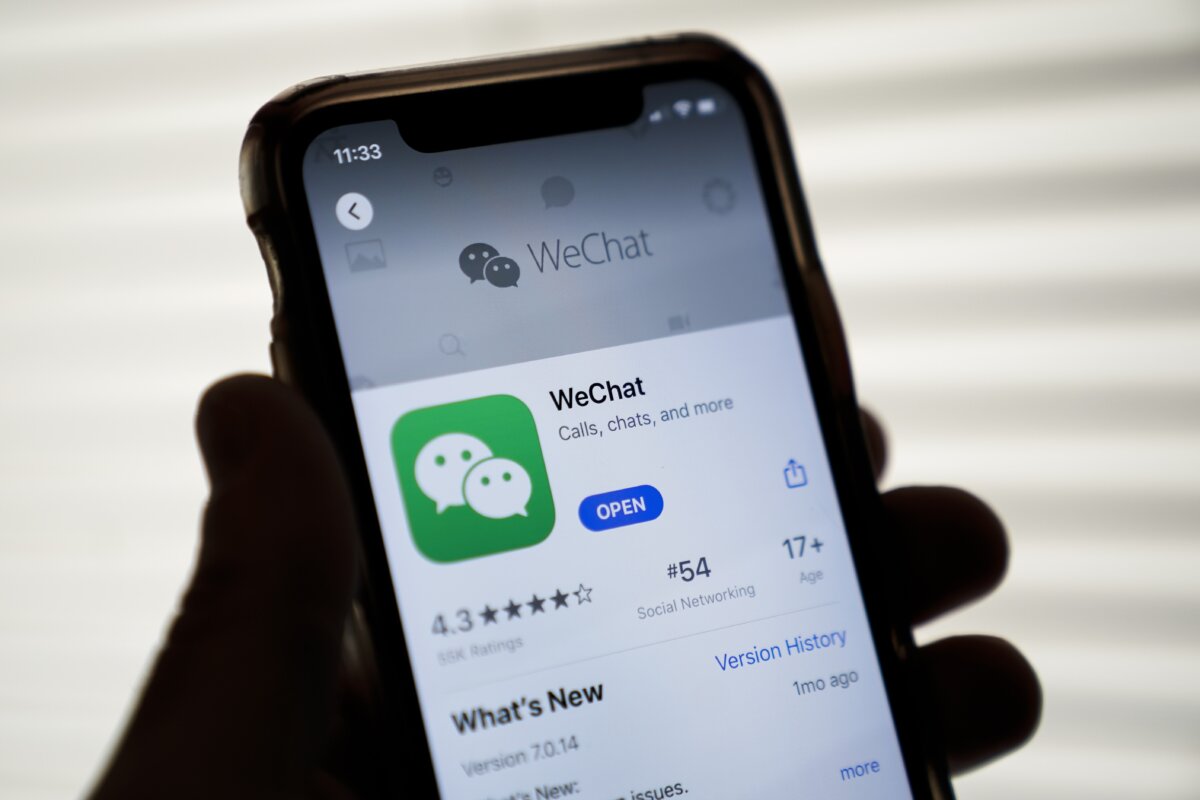
A leaked internal directive to Chinese media outlets during the Russia–Ukraine war instructed editors not to post anything “unfavorable to Russia and pro-Western” and to use only Xinhua, People’s Daily, or China Central Television hashtags. A similar pattern appears to apply to the Iran conflict as well.
On X, the Foundation for Defense of Democracies identified a network of accounts posing as Chinese, Russian, and North Korean users to amplify the appearance of allied support for Iran. As of March 11, eight accounts had reposted each other’s content 286 times and posted identical content 132 times. Account @ChinaENX, created in February, had more than 100,000 followers. A single post from a North Korea-impersonating account received 1.5 million views and 60,000 likes. Transparency data on X indicated that the accounts were being operated from West Asia, not China, suggesting that they are likely linked to Tehran.
The CCP frames every U.S. military action—Iraq, Libya, Venezuela, and now Iran—as part of a pattern it seeks to delegitimize globally. The Iran conflict fits directly into Beijing’s long-running narrative that U.S. power is destabilizing and lawless. This supports the CCP’s broader argument for a multipolar world order with itself as an alternative pole.
On the domestic front, the CCP uses anti-U.S. sentiment to consolidate support. The People’s Liberation Army’s “five lessons” document shows that the Iran war is being used internally to justify military spending and preparedness, reinforcing Chinese leader Xi Jinping’s narrative that China faces an existential threat from Washington.
Although China and Iran may be winning the AI video war online, the United States is winning on the ground. By the end of the first week of the conflict, U.S. forces had sunk or destroyed more than 30 Iranian naval vessels. Iran’s ballistic missile attacks decreased by 90 percent and drone attacks by 83 percent. Khamenei was killed in the opening strikes, along with multiple senior IRGC commanders. His successor, Mojtaba Khamenei, was reportedly wounded, with rumors circulating that he is in a coma. Successive strikes have since killed additional IRGC leaders, as well as their replacements.
The CCP has every reason to want the Iranian regime to survive; its collapse would mean the loss of hundreds of billions of dollars pledged to infrastructure investment, the destruction of the sanctions-busting oil-for-infrastructure barter network, the unraveling of the Belt and Road Initiative’s westward expansion, and the disappearance of Washington’s most reliable strategic distraction in the Middle East.
Despite flooding Chinese platforms with AI-generated carrier strikes that never happened and manufactured evidence of American defeats, Beijing has been unable to alter the battlefield reality, where the United States is winning.
Views expressed in this article are the opinions of the author and do not necessarily reflect the views of The Epoch Times.
 Friends Read Free
Copy
Facebook
Tweet
Friends Read Free
Copy
Facebook
Tweet