
Commentary
Europe’s military relations with China are going full circle, from Cold War-era military technology collaboration during the brief Western entente with China against the former Soviet Union, to now a military target of the Chinese Communist Party (CCP) bent on global domination.
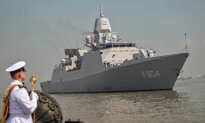
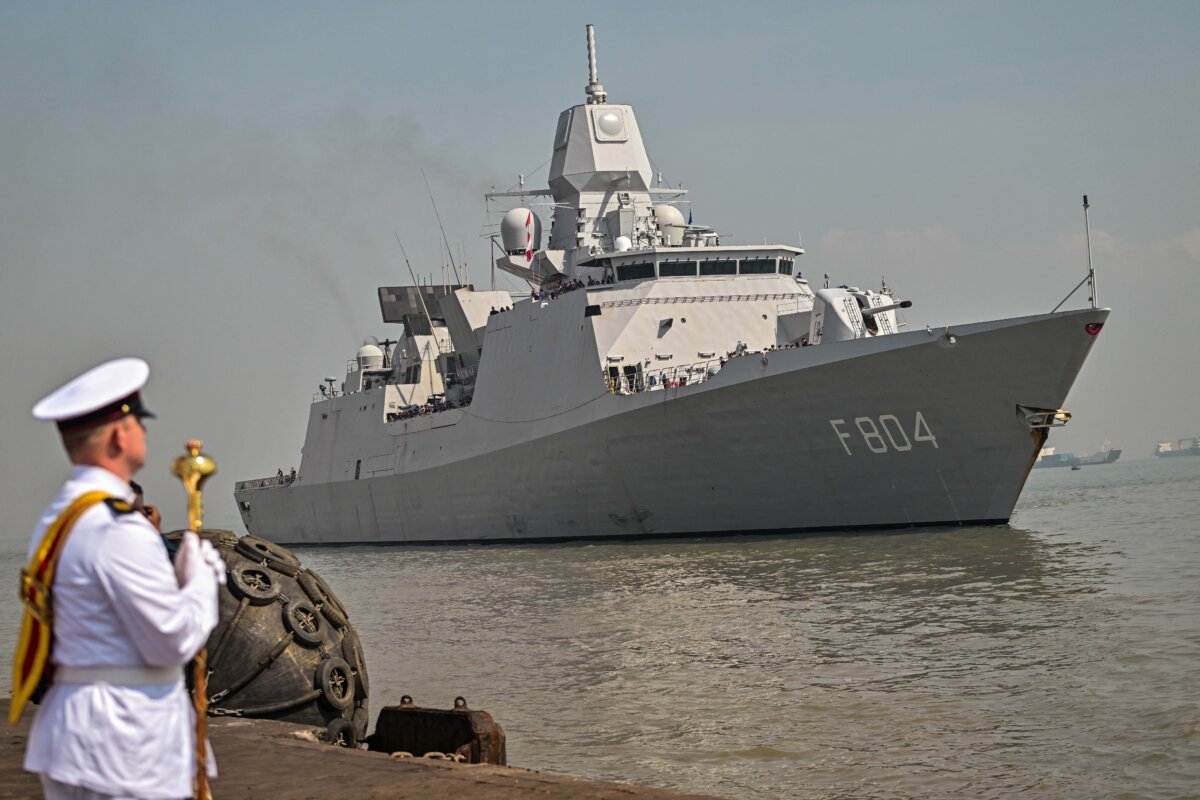
On May 25, the CCP and its People’s Liberation Army (PLA) demonstrated their malevolence toward Europe when PLA Air Force and PLA Navy forces harassed and then shamed the voyage of the Royal Netherlands Navy’s 24-year-old, 6,000-ton frigate HNLMS De Ruyter, as it exercised the freedom to navigate in international waters near the disputed Paracel Islands in the South China Sea.
In January 1974, the PLA defeated South Vietnamese forces to take the Paracel Islands, and since the early 2010s has operated an 8,800-foot runway and naval base on Woody Island, enabling PLA air, naval, and missile forces to threaten the Philippines and Taiwan. Moreover, China is dredging a potential 2-square-mile military base at Antelope Reef south of Woody.
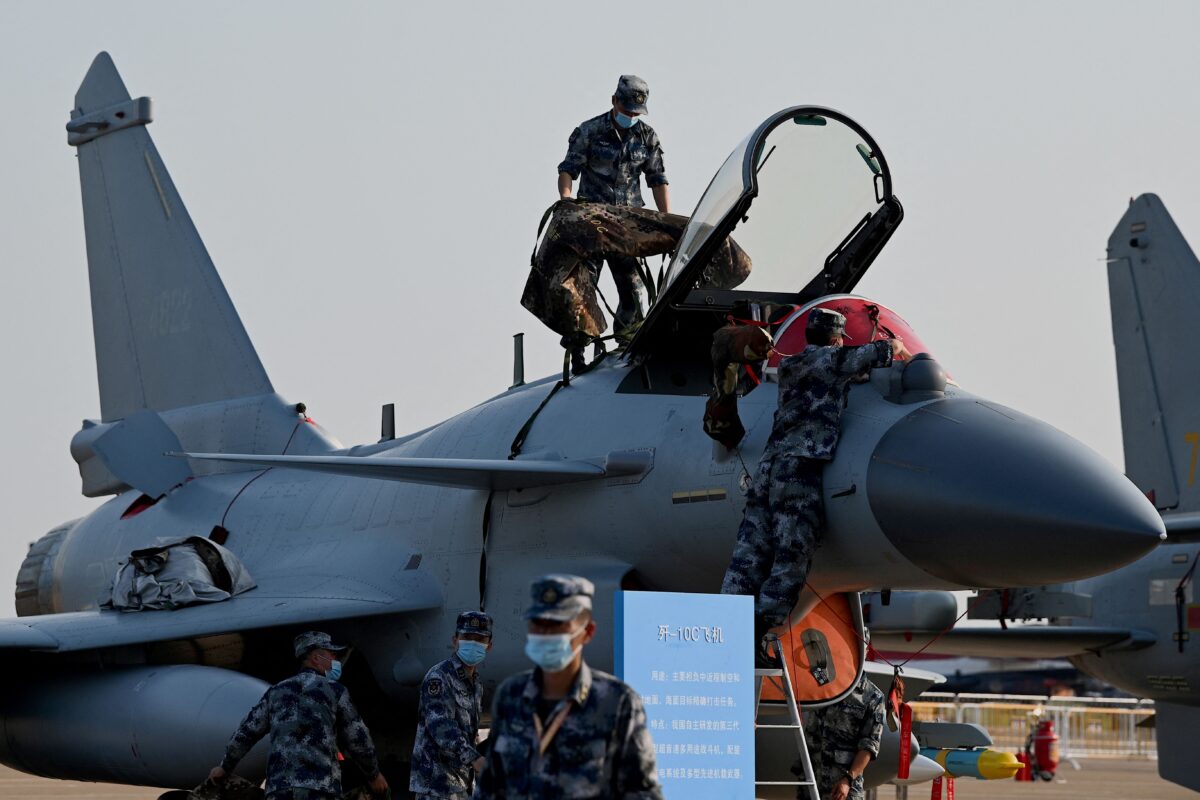
On May 26, third-level Chinese state media Guancha crowed, “Great News! Chinese J-16 fighter jets used live ammunition to drive away a Dutch frigate and helicopter in the South China Sea.”
Chinese state television showed the J-16s, about the same size and performance as the U.S. F-15E, was armed with air-to-air missiles, and the PLA Southern Theater Command (PLA STC) revealed that it conducted war-like “warning electronic jamming” against the De Ruyter.
One Dutch frigate did not pose a threat—it will not be upgraded with Tomahawk land attack cruise missiles until 2027—but the PLA STC cast it as threat because as it was on its way to Hawaii to participate in the large U.S.-led Rim of the Pacific (RIMPAC) exercises, saying, “HNLMS De Ruyter deliberately detoured to China’s Xisha [Paracel] Islands on its way from the Philippines to the Hawaiian Islands to carry out provocative actions, brazenly infringing on China’s sovereignty.”
Causing a miliary-diplomatic tantrum over HNLMS De Ruyter’s voyage helps the CCP to enforce its ridiculous territorial claims to most of the South China Sea and to snarl at Europe’s belated recognition of the Chinese regime’s threats to its security.
As China’s military threat to security in Asia has grown and become undeniable, also threatening Europe’s major Asian commercial partners, the navies of Britain, France, Germany, Italy, and the Netherlands make occasional security cooperation tours to Asia and send ships and aircraft to enforce United Nations embargoes of North Korea, a nuclear missile ally of China.
A Feb. 26 report by Bloomberg estimated that a CCP–PLA war against Taiwan could cause the gross domestic product (GDP) of the 27-member nation European Union to fall by 10.9 percent, which helps explain why the European Union, France, Germany, Poland, the Czech Republic, and Lithuania have all criticized Beijing’s military threat to Taiwan.
And European defense companies are now trying to get back into the lucrative Taiwan military market—in 2025 to 2026, the United States could approve up to $25 billion in military sales—which is why on April 24, Chinese sanctions barred exports to China from seven European companies for selling to Taiwan “dual use,” or civilian items with military uses.
Here is where the Europe–China military tide has turned; Europe’s rush to cash in on commerce with China in the 1980s meant that most European countries halted military sales to Taiwan—the Netherlands conceded as much to China in 1984, after its 1981 sale of two Hai Lung submarines.
And following the example of the United States in the late 1970s to encourage the anti-Soviet stance of then-CCP leader Deng Xiaoping, many European states sought to sell military technology to China.
In the 1970s, China tried to buy Britain’s Harrier vertical take-off combat jets, and, like the French Mirage-2000 fighter jets marketed to China in the mid-1980s, they were judged too expensive by the Chinese.
But the French also briefed engineers from China’s Chengdu Aircraft Corporation on their former Aerospatiale Company’s Hermes small manned spaceplane, which never flew from Europe, but did inform Chengdu’s small Shenlong unmanned spaceplane now performing military missions for the PLA in low Earth orbit.
China was also able to learn much from the French Exocet anti-ship cruise missile (ASCM), which was noted in a now-declassified November 1985 report from the Central Intelligence Agency (CIA).
Warheads used by Iran’s Noor ASCM, a copy of the Chinese C-802, and captured by U.S. forces in January 2024 on their way to Houthi rebels, are copies of the warhead used on Exocet; Iran has used its Noor missile against shipping in the Straits of Hormuz area.
French Aerospatiale Super Frelon heavy helicopters sold in the 1980s were co-produced as the Z-8 for the PLA Navy, and formed the basis for the current family of Change Z-18 helicopters used by the PLA Navy and the PLA Ground Forces.
The former French SEMT Pielstick Company sold naval diesel engines, now co-produced and used in PLA frigates, while Germany’s MTU—at least until 2020—had a co-production agreement for naval diesel engines used on PLA Navy Type-052 destroyers, and MTU diesels were also used on PLA Navy Song-class conventional submarines.
And while Washington stopped its sale of military technology to China following the 1989 Tiananmen Square massacre, the European Council issued a non-binding arms embargo, and a 1998 European Union Code of Conduct was similarly non-binding.
So, in 1998, Britain gave China a major breakthrough in its long quest to build modern turbofan aircraft engines by selling about 90 Rolls-Royce Spey Mk202 engines and the technology to begin co-production, after China had been unsuccessful in copying this turbofan since the 1960s.
Then, in 1999, Britain’s Surrey Satellite Technologies, then a leading-edge developer of micro-satellites, agreed to a 25-year joint venture with China’s Tsinghua University, which then developed China’s first micro-satellites.
It was not until 2021 that the European Union was able to implement a framework of binding regulations to control the sale of dual-use technologies, such as advanced computing technologies, artificial intelligence (AI) technologies, and quantum computing technologies.
However, there is still room for American leadership, such as reviving a body akin to the former Coordinating Committee for Multilateral Export Controls (CoCom), which, from 1947 to 1994, joined the United States and Europe in the largely successful restriction of military and dual-use technology to the Soviet Union.
While European allies have disappointed America by refusing to join the war against China’s strategic proxy Iran, enabling its war against Israel, and its near acquisition of nuclear weapons that would also threaten Europe, the Chinese regime’s harassment of the HNLMS De Ruyter demonstrates the CCP’s growing direct threat to Europe.
Europe’s best defense for its future is to join the American-led resistance to the CCP’s drive for domination, to cooperate with President Donald Trump’s Golden Dome missile defense as soon as possible, and to rapidly increase its own strategic nuclear deterrent.
Views expressed in this article are the opinions of the author and do not necessarily reflect the views of The Epoch Times.
 Friends Read Free
Copy
Facebook
Tweet
Friends Read Free
Copy
Facebook
Tweet