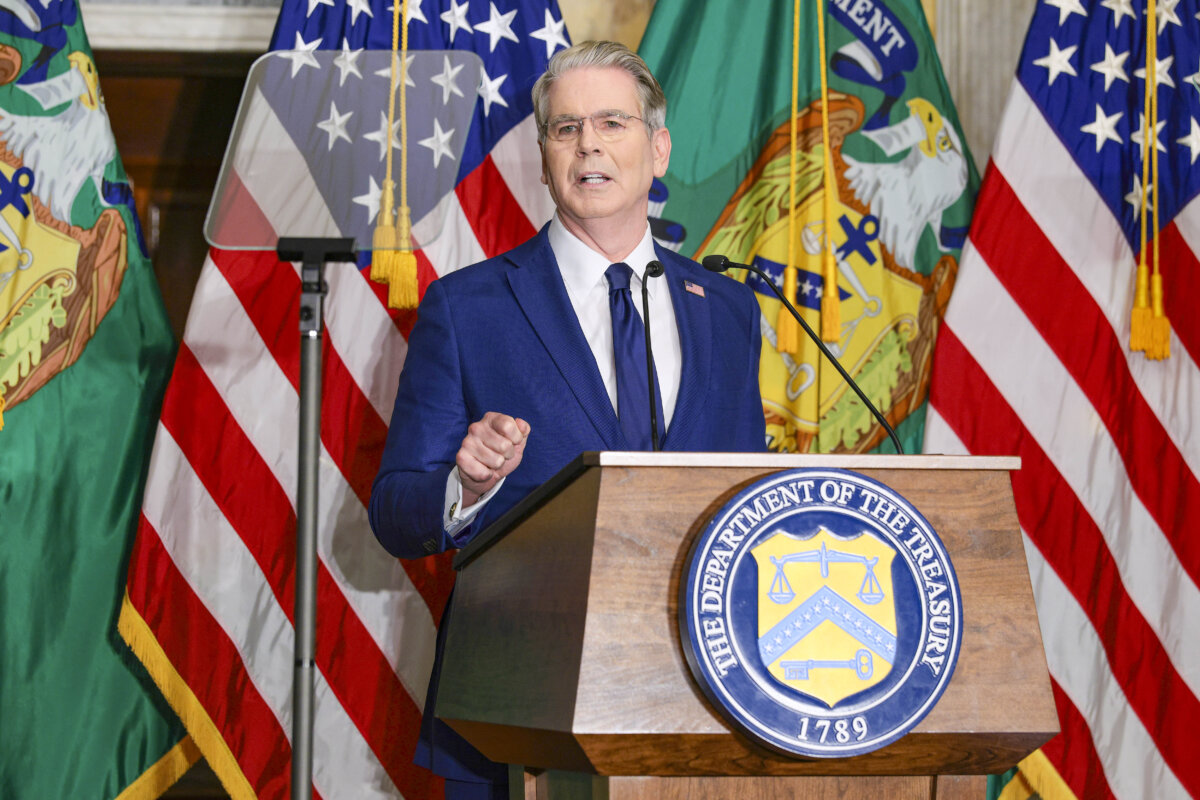


WASHINGTON—U.S. Treasury Secretary Scott Bessent unveiled the contours of the administration’s sweeping campaign to isolate Iran’s economy at an Aug. 24 news conference.
He outlined measures targeting almost 60 firms, individuals, and vessels across the regime’s expansive oil, nuclear, missile, and cyber networks.
Bessent also urged China and other countries not to test U.S. resolve on the latest round of sanctions on Iran.
“In the Second World War, D-Day was the historic beginning of a campaign with our allies to target and drive the enemy from its positions, including those in third countries,” Bessent said in prepared remarks.
“Today, in that same spirit, we are launching an economic onslaught against Iran’s financial connections around the globe.”
As part of Operation Economic Outcast, the Treasury issued five new sectoral determinations, substantially expanding U.S. sanctions authority.
The latest measures allow the United States to sanction any person or entity operating in Iran’s digital assets, technology, gold, aviation, or shipping sectors. These areas, the Treasury says, are being used to evade sanctions, support weapons development, and generate revenue for Tehran.
Additionally, Washington has broadened secondary sanctions exposure, warning that foreign firms that continue conducting Iran‑related business could face exclusion from the U.S. dollar system.
“Those who stand with the United States will reap the rewards of our partnership. Those who tether themselves to the Iranian regime should expect to share the isolation of a withering regime,” Bessent told reporters.
“The clock just started ticking.”
The Treasury has also suspended several general licenses that previously permitted certain remittances and cultural or academic exchanges with Iran, tightening restrictions on financial flows and engagement.
The Treasury’s Office of Foreign Assets Control urges global shipping operations to avoid complying with Iran’s demands in the Strait of Hormuz, citing the risk of expanded sanctions on maritime activity in the Gulf channel.
Bessent did not offer timelines for nations to adapt to sanctions. But he noted that America does not have “infinite patience” and urged China and other countries not to test its resolve.
“Iran now faces a very clear choice, with only two paths before them: complete global isolation and a subsistence economy or a path back to normalcy with an opportunity to rejoin the global economy,” he stated.
Since the U.S.–Israel joint operation began in February, the president has made repeated threats against Iran’s Islamist regime.
China in the Crosshairs
One major economy that could be in the crosshairs of secondary sanctions is China.
The months-long U.S. naval blockade has already affected the Chinese economy, especially in the energy sector. Ninety percent of Iran’s crude oil exports are shipped to Beijing.
Trump and Chinese leader Xi Jinping are scheduled to meet in Washington next month. The possibility that the current administration could impose Iran-related sanctions on China could affect sensitive trade negotiations between the two sides.
Chinese oil purchases have served as a vital economic lifeline for Tehran. China has been bypassing U.S. sanctions by using small independent refineries that import oil via shadow-fleet vessels. Small Chinese banks and non-bank intermediaries reportedly process these transactions to avoid U.S. sanctions.
“Treasury has mapped every node, every facilitator, and every network that Iran has used to smuggle oil and evade sanctions,” Bessent said. “Beginning today, the actions of Treasury and other agencies will tighten the noose and block every potential source of revenue that funds the [Islamic Revolutionary Guard Corps] and the evil Iranian regime.”
Bessent also said that the Treasury Department plans to announce a major sanction against a financial institution by the end of this week.
Economic Costs
For months, the White House has claimed that the Iranian economy has tumbled as it contends with hyperinflation and a currency crisis.
“Iran is completely collapsing!” Trump said in an Aug. 24 Truth Social post.
Iran’s annual inflation rate came in at 88 percent in July.
 Traffic in front of a political billboard at Valiasr Square in central Tehran, Iran, on Aug. 8, 2026. (Atta Kenare/AFP via Getty Images)
Current conditions could be causing internal strife.
Mohsen Rezaei, secretary of Iran’s Supreme National Security Council, warned on social media that if Iran faces efforts to isolate it economically, the country will shut down oil traffic through the Persian Gulf and the Strait of Hormuz. He added that Iran would treat any nation that joins or supports what he called America’s “economic war against the Iranian people” as engaging in an act of war.
Meanwhile, Iranian President Masoud Pezeshkian defended the mid‑June memorandum of understanding between the two countries, calling it the most viable path for resolving what he described as a limbo situation, “neither war nor peace.”
He also acknowledged that nearly six months into the conflict, Iran has struggled to draw investment, underscoring the economic strain created by the ongoing war.
At the same time, the U.S. economy has also borne higher costs because of Middle East strife.
Crude oil prices have been elevated, trading at about $80 per barrel. Motorists have felt the pain at the pump, with the average price per gallon above $4.
This has bled into headline inflation. The 12-month consumer inflation rate has accelerated to above 3 percent, while underlying inflation has remained tamer, running close to the Federal Reserve’s 2 percent target.
Another risk the United States faces is the upward pressure on long-dated government bond yields. The 30-year yield’s surge to its highest level since June 2007 prompted the Treasury Department to announce a doubling of debt buybacks to curb yields at the long end of the yield curve.
Aldgra Fredly contributed to this report.
 Friends Read Free
Copy
Facebook
Tweet
Friends Read Free
Copy
Facebook
Tweet