
This is the second segment of a two-part series examining China’s dual-use maritime fleet, focusing on its development, capabilities, and integration with the People’s Liberation Army. Read Part I here.
Commentary
Under China’s “military-civil fusion” (MCF) strategy, its vast commercial shipping fleet can substantially augment the People’s Liberation Army’s (PLA’s) sealift capabilities, especially for large-scale operations such as a potential Taiwan contingency.
The People’s Armed Forces Maritime Militia (PAFMM)
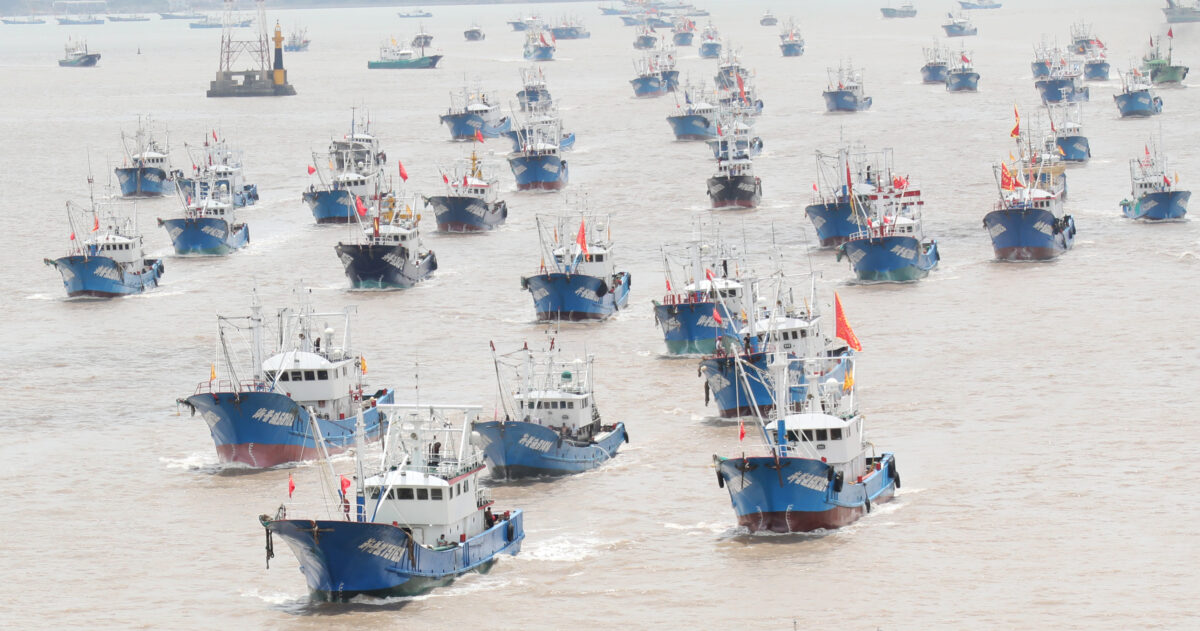
The PAFMM—colloquially known as the “Little Blue Men”—is structurally distinct from the commercial dual-use fleet but represents an equally important component of the Chinese regime’s gray-zone maritime power. The militia operates under provincial and prefectural military district command structures, with professional units receiving direct PLA training, funding, equipment subsidies, and operational tasking while maintaining nominal civilian fishing vessel registration.
The PAFMM has evolved through several developmental phases. Pre-2012 militia activity was largely opportunistic and regionally disorganized. From 2012 to 2016, following the South China Sea island-building campaign, the PLA systematically professionalized militia units, introduced standardized vessels, formalized command structures, and integrated militia operations into coast guard and navy operational planning. Since 2016, the PAFMM has operated with greater sophistication, coordination, and geographic reach.
Professional PAFMM Vessels
Qionglinyu Series and Hainan Lingao-Registered Trawlers: The most capable PAFMM units operate purpose-built or heavily modified steel-hulled trawlers in the 45- to 55-meter range, typically registered to the Hainan Province port of Lingao under the Qionglinyu series registration. These vessels are distinguishable from ordinary commercial fishing boats by several features: steel hull construction with reinforced bow sections optimized for collision scenarios, unusually powerful engines relative to their nominal fishing capacity, extended fuel and provisions storage for prolonged at-sea endurance, satellite communications equipment and shortwave radio suites for real-time reporting to PLA command nodes, and personnel accommodations for militia crew supplements beyond normal fishing crew requirements.
Their operational role encompasses persistent presence operations—maintaining a continuous physical presence at disputed features to establish de facto Chinese control—swarming maneuvers to overwhelm smaller foreign coast guard or naval vessels through sheer numbers, harassment and blocking operations to prevent foreign resupply missions (as repeatedly demonstrated at Second Thomas Shoal against Philippine vessels), and intelligence, surveillance, and reconnaissance (ISR) functions, including optical surveillance, electronic emissions monitoring, and AIS/radar track reporting.
Zhanjiang and Guangdong Militia Trawlers: The Yuemayu-registered fleet operating from Guangdong Province represents a larger, more industrially scaled PAFMM component. Vessels like the Yuemayu 60222 and 60333, and the broader Yuedianyu and Yuemaobinyu series from companies including Desheng Fisheries and Xixiang Fisheries, range from 48 to more than 65 meters and displace 500 to 1,000-plus tons.
Their larger size enables extended South China Sea operations, the carriage of water cannons for non-lethal harassment, and the capacity for logistics and resupply roles that sustain smaller vessels on protracted operations. The corporate owners are state-linked fisheries companies that receive government subsidies explicitly conditioned on PAFMM participation, creating a fully integrated civil-military enterprise structure.
Specialist ISR and ‘Information Boats’
A specialized subset of PAFMM vessels functions primarily as maritime intelligence platforms rather than harassment or presence assets. These “information boats” are crewed in part by trained “information personnel”—militia members with specialized signals intelligence, optical surveillance, or communications training—who collect and relay maritime domain awareness data directly to PLA intelligence channels.
Their value in a pre-conflict or conflict scenario is substantial. Hundreds of militia vessels distributed across the operating area provide a persistent, difficult-to-suppress sensor network capable of tracking foreign naval movements, identifying targeting opportunities, and providing battle damage assessment. They operate below the threshold of overt military action, making suppression politically costly and legally ambiguous under international law. A foreign navy that fires on an apparent fishing trawler that turns out to be transmitting targeting data incurs significant escalatory and reputational risk.
Distant-Water Fleet
China’s distant-water fishing fleet—estimated at more than 57,000 vessels, representing approximately 44 percent of globally visible distant-water fishing activity—extends the PAFMM’s potential ISR reach to every ocean basin. Grid-pattern maneuvers documented near the Galápagos Islands, the Argentine exclusive economic zones, and the Pacific island chains are consistent with systematic hydrographic surveying or cable route mapping rather than with commercial fishing optimization. Many vessels routinely disable AIS transponders (“going dark”), a behavior associated with either illegal fishing operations or deliberate ISR activity.
The distant-water fleet’s logistical backbone—refrigerated cargo vessels (reefers) that serve as motherships for resupply—creates a self-sustaining global presence network that requires no port access and generates no easily trackable port call records.
An Integrated Operational Assessment
Synthesizing across all vessel categories, China’s dual-use maritime fleet would contribute to a Taiwan contingency across five functional domains.
Strategic Surprise and Pre-Positioning: Commercial vessels conducting routine port calls or transiting standard shipping lanes provide a pre-positioned logistics and strike infrastructure that cannot be mobilized against without triggering premature escalation. Arsenal ships like the Zhongda 79 could be within missile range of Taiwan, Japan, or U.S. bases in Guam under entirely commercially plausible cover.
Mass Amphibious Lift: The Bohai and COSCO Roll-on/Roll-off (Ro-Ro) fleets dramatically multiply the PLA’s first-wave and follow-on amphibious capacity. While organic PLAN amphibious ships would lead the assault, commercial Ro-Ro ferries would sustain the operational tempo required to build combat power ashore faster than Taiwan’s defenders could attrit it. The critical metric is not initial assault capacity, but the rate of force buildup—and commercial sealift dramatically accelerates that rate.
ISR and Targeting: The PAFMM “information boat” network, combined with the commercial fleet’s embedded intelligence personnel, provides a near-real-time maritime domain picture that supplements satellite and airborne ISR. In the pre-conflict gray zone and during the opening phase of operations, this network could provide targeting data for the first missile salvos with precision difficult to achieve through overhead assets alone.
Area Denial and Disruption: Militia swarms and China Coast Guard assets operating in coordination create an access-denial problem for allied reinforcement efforts that is distinct from—and complementary to—conventional A2/AD (anti-access/area denial) systems like DF-21D anti-ship ballistic missiles. Physical harassment, disruption to sea lines of communication, and the risk of miscalculation-induced escalation complicate allied force flow even absent direct kinetic engagement.
Logistics Sustainment: Container ships, bulk carriers, and multipurpose vessels provide the backbone of sustainment for a protracted campaign. A cross-strait operation requiring weeks or months of sustained operations would rapidly exhaust PLA Navy organic logistics capacity; commercial auxiliaries bridge the gap between initial assault consumption and established supply lines.
The dual-use fleet has significant limitations and vulnerabilities, especially in high-intensity contested environments:
- Thin-skinned commercial hulls are extremely vulnerable to anti-ship missiles, torpedoes, and even large-caliber naval gunfire, with no damage control infrastructure comparable to warships.
- Crews—even militia-trained ones—lack the combat damage control, firefighting, and emergency seamanship training of military sailors.
- Arsenal ships like the Zhongda 79, once identified and targeted, lack the speed, maneuverability, and defensive systems to survive in a contested battlespace.
- The militia swarm model is effective in gray-zone operations, but becomes a target-rich environment once kinetic rules of engagement are authorized.
- Civilian vessel crews may not comply with mobilization orders under fire, creating command-and-control fragility absent from purpose-built military forces.
Concluding Thoughts
China’s dual-use maritime fleet is one of the most consequential yet underappreciated elements of the PLA’s warfighting potential. It is not a supplementary capability—it is a deliberate strategic architecture designed to overcome the most fundamental quantitative constraint on Chinese power projection: insufficient dedicated military sealift.
Through MCF-mandated construction standards, institutional integration via state enterprises, continuous operational exercises, and the professionalized PAFMM, Beijing has created a mobilizable maritime force that would multiply effective PLA operational capacity by factors that purely naval-centric assessments routinely undercount.
The Zhongda 79 arsenal ship concept, if broadly implemented, adds a distributed strike dimension that challenges fundamental assumptions about what constitutes a combatant vessel under the laws of armed conflict—a deliberate ambiguity that Beijing will exploit to maximum operational and legal advantage.
Read Part I here.
Views expressed in this article are the opinions of the author and do not necessarily reflect the views of The Epoch Times.
 Friends Read Free
Copy
Facebook
Tweet
Friends Read Free
Copy
Facebook
Tweet