
Commentary
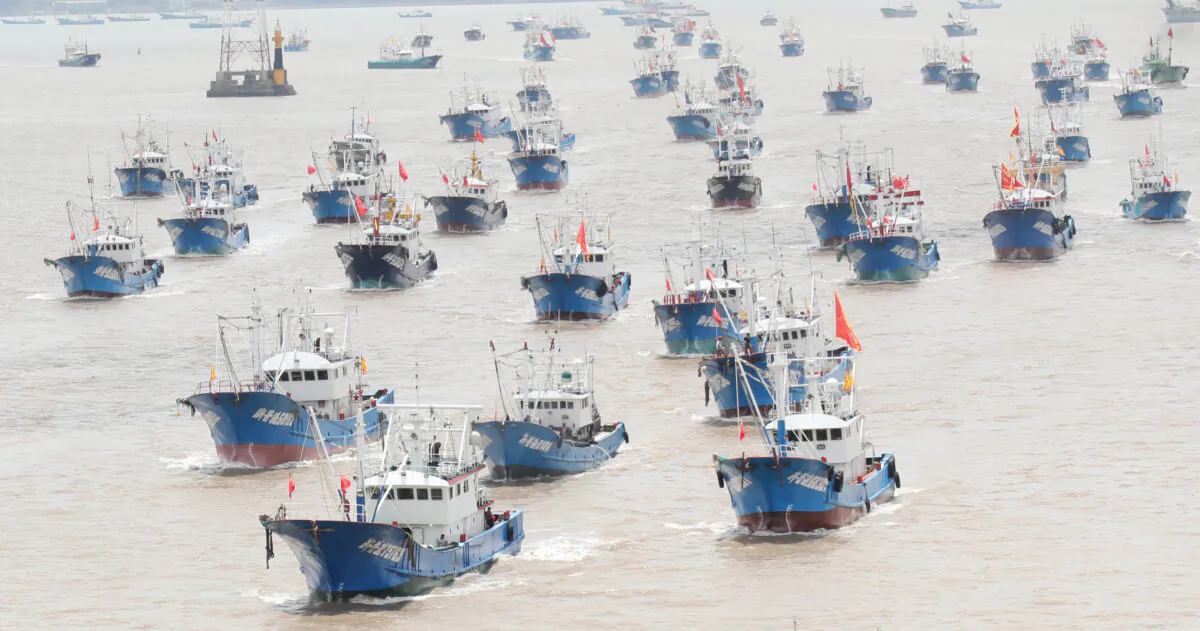
China’s massive distant-water fishing fleet operates as both an economic and paramilitary force, using illegal fishing, gray-zone tactics, and maritime militia operations to expand Beijing’s global influence.
In January, an Argentine Coast Guard ship picked up garbled Mandarin from nearby boats among roughly 200 Chinese fishing vessels operating near the country’s waters, primarily hunting squid. A Reuters review of maritime movements from January 2025 to March 2026 found that the flotilla had grown by nearly 50 percent over the past decade.
Buenos Aires and Washington have raised concerns about Chinese vessels moving in patterns consistent with mapping Argentina’s continental shelf. Juan Battaleme, Argentina’s defense secretary for international affairs under Argentine President Javier Milei until December 2025, told Reuters that Argentine officials notified Beijing when incidents were detected, and Chinese officials responded with “ambiguous” explanations for altered vessel trajectories. Under international law, only Argentina has the right to explore and exploit resources on its continental shelf.
Washington was also concerned that the Chinese Communist Party (CCP) was using its fishing fleet to build a regional presence and test Argentina’s ability to control its South Atlantic waters. U.S. officials also believe that the vessels could be involved in intelligence collection for China.
Argentina’s naval authorities have noted that seabed mapping by a foreign vessel, even outside the exclusive economic zone (EEZ)—the 200-nautical-mile zone in which a coastal state holds exclusive rights over continental-shelf resources—constitutes “at the very least an unfriendly action or potentially hostile act,” particularly when conducted without prior consultation with Argentine authorities.
The Argentina story, reported on May 13, is the latest example in a pattern now documented across six continents. China’s Distant Water Fishing fleet is estimated at up to 16,000 vessels, more than triple the combined fleets of Japan, South Korea, Spain, and Taiwan. It logs more than 110 million hours annually in the waters of 90 nations.
Its violations fall under the legal category of illegal, unreported, and unregulated (IUU) fishing. However, its paramilitary component overlaps with the People’s Armed Forces Maritime Militia (PAFMM), also known as the Chinese Maritime Militia. The PAFMM consists of civilian fishermen who receive military training, equipment, and state stipends to operate in disputed waters supporting Beijing’s strategic objectives.
This gives China a forward presence that is difficult to confront militarily. These groups are treated as interlocking elements of the same gray-zone strategy, alongside the China Coast Guard and the People’s Liberation Army Navy.
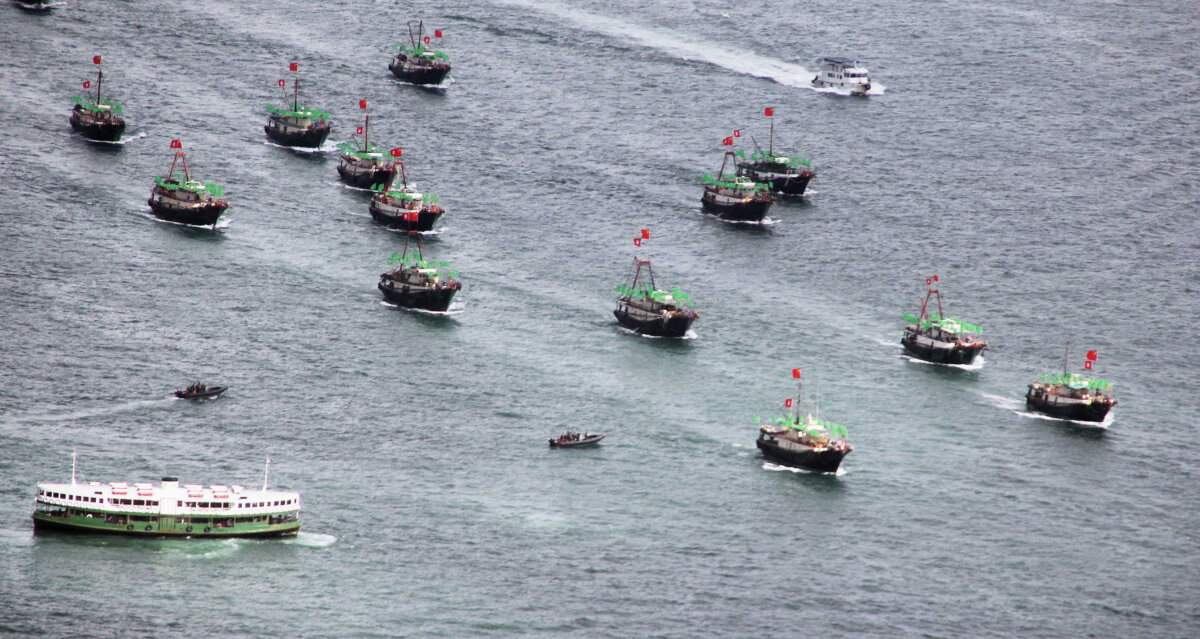
The January congressional report by the House Select Committee on the CCP states that the Chinese regime “deploys and recalls these vessels like pieces on a chessboard, withdrawing them before diplomatic summits to ease tensions, surging them into disputed waters to assert leverage, and extending their presence from the South China Sea to the Antarctic.”
Committee member Rep. Carlos Giménez (R-Fla.) said that Beijing “commands the world’s largest fishing armada like a military force, using it to strip resources from nations, exploit forced labor, destroy marine ecosystems, and dominate global seafood supply chains.”
Former U.S. Coast Guard official Scott Clendenin testified that the Coast Guard declared IUU fishing the top maritime security challenge, surpassing piracy.
The core tactic is consistent worldwide. Vessels mass legally at or just outside a nation’s EEZ boundary, then disable automatic identification system (AIS) transponders before crossing. Between January 2018 and April 2021, Oceana documented 6,227 “gap events” near Argentina’s EEZ boundary, periods when vessels disappeared from electronic tracking for more than 24 hours.
The vessels remained dark for more than 600,000 hours in total. Two-thirds were Chinese-flagged squid jiggers. Oceana’s analysis of AIS transmissions found that China accounts for 44 percent of visible fishing activity worldwide, suggesting that the true share is likely higher due to dark vessel operations.
The largest swarming event occurred over Christmas 2025. IngeniSpace detected 1,700 Chinese fishing vessels converging into coordinated L-shaped formations off Ningbo, China, from Dec. 23, 2025, to Dec. 25, 2025, with the pattern recurring from Jan. 9 to Jan. 12. Vessels held formation for more than 30 hours across a line stretching 200 miles, a behavior unrelated to fishing.
Ray Powell, director of SeaLight at Stanford’s Gordian Knot Center for National Security Innovation, called it unprecedented.
“Chinese fishing fleets routinely operate in large groups, but over a thousand vessels holding parallel lines for hundreds of miles over 30 hours has no clear precedent in publicly available data,” Powell said.
Security analysts assessed that the vessels were directed not to fish but to demonstrate Beijing’s capacity to mobilize civilian fleets for strategic purposes, with many linked to Zhejiang Province, China’s largest concentration of documented maritime militia units.
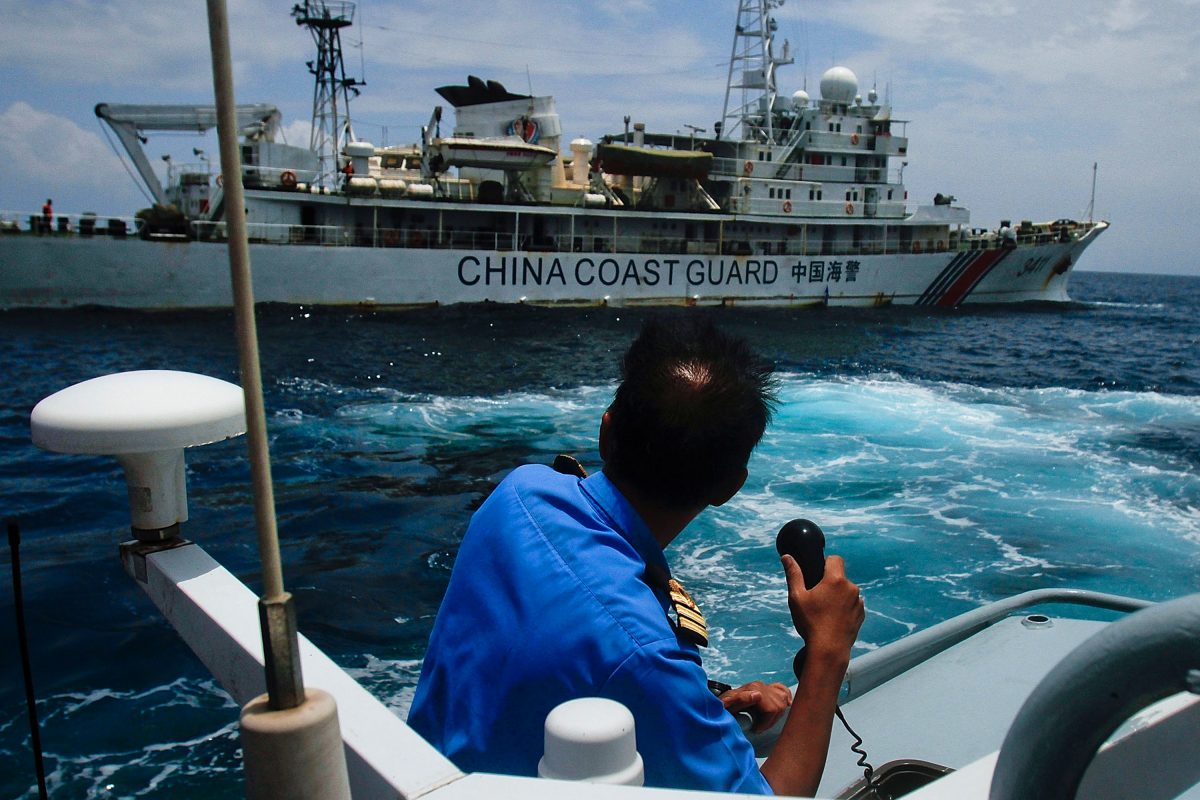
The United States has taken legislative and operational steps to counter the Chinese regime’s illegal maritime activity. However, the fleet’s scale makes it difficult for the United States to respond effectively.
In December 2025, the House Foreign Affairs Committee approved the Stop Illegal Fishing Act, which would authorize U.S. President Donald Trump to impose sanctions on individuals and companies engaged in IUU fishing. A parallel Senate bill, the Protecting Global Fisheries Act, would require the U.S. State Department to deliver an annual report to Congress on China’s global IUU activity. The 2026 National Defense Authorization Act includes a provision banning Chinese seafood from U.S. military commissaries and dining halls.
Operationally, the U.S. Coast Guard has deployed USCGC Stone and USCGC James to conduct joint operations with Argentina, Brazil, and Uruguay under Operation Southern Cross and opened the Illegal Unreported Unregulated Fisheries Center of Expertise in Honolulu to coordinate enforcement. In 2022, the USCGC James took evasive action after a Chinese-flagged vessel attempted to ram the cutter in the Pacific off South America, a reminder that fisheries disputes can escalate into military confrontation.
Japan has also allocated $1.9 million through the U.N. Office on Drugs and Crime to fund surveillance drones, patrol boats, and image analysis systems for Argentina, Ecuador, Peru, and Uruguay.
The enforcement gap, however, remains structural. As one Argentine analyst noted, “maintaining a single patrol boat at sea is a significant burden” when hundreds of unregulated vessels operate at the EEZ boundary.
Views expressed in this article are the opinions of the author and do not necessarily reflect the views of The Epoch Times.
 Friends Read Free
Copy
Facebook
Tweet
Friends Read Free
Copy
Facebook
Tweet