
Commentary
Although the U.S. fleet remains the world’s preeminent naval power, China’s state-backed shipbuilding industry now dwarfs America’s in output and capacity, prompting bipartisan lawmakers and the Trump administration to push aggressive trade and industrial policies to rebuild U.S. maritime strength before the balance shifts further toward the Chinese Communist Party (CCP).
Ahead of U.S. President Donald Trump’s May 14–15 summit with Chinese leader Xi Jinping in Beijing, a bipartisan group of senators urged Trump not to offer concessions on shipbuilding. Sens. Tammy Baldwin (D-Wis.), Mark Kelly (D-Ariz.), Tim Scott (R-S.C.), and Todd Young (R-Ind.) wrote in a letter to Trump that China’s “decades-long effort to decimate American shipbuilding” demanded trade remedies “to their fullest extent.”
They also pushed for passage of the SHIPS for America Act, which would provide tax credits for domestic shipyard investments and authorize $2.5 billion over 10 years for domestic shipbuilding projects.
At issue are U.S. port fees on Chinese-built ships. When Trump and Xi met in South Korea in October 2025, they agreed to pause tit-for-tat maritime fees for one year, suspending an estimated $3.2 billion in annual costs for large Chinese-built vessels entering U.S. ports. The suspension, which covers fees targeting Chinese-owned vessels, operators of Chinese-built ships, and foreign-built vehicle carriers, runs through Nov. 9, 2026.
China reciprocated by suspending countermeasures against U.S.-linked vessels. The fees were originally imposed in April 2025 following a USTR Section 301 investigation that determined China’s targeting of the maritime sector for dominance “burdens or restricts U.S. commerce.” The senators argued that the threat of fees caused orders placed with Chinese shipyards to drop roughly 25 percent before rebounding after the pause.
The Iran war was discussed at the recent summit. China remains the largest buyer of Iranian oil despite pressure from the Trump administration, a point of leverage Beijing held going into the talks.
In 2024, China accounted for 54.67 percent of global shipbuilding output; South Korea followed at 28.02 percent, Japan at 12.57 percent, and the United States at 0.04 percent, placing it 19th worldwide, according to data cited by the Cato Institute.
In the first quarter this year, China’s shipbuilding completion volume reached 15.68 million deadweight tons, up 46 percent year-on-year, per official data. China’s share of the global shipbuilding market grew from approximately 5 percent in 2000 to more than 50 percent by 2023.
A leaked Office of Naval Intelligence slide showed China has 232 times the shipbuilding capacity of the United States, with one of China’s 13 naval shipyards alone matching the capacity of all U.S. naval shipyards combined.
China structures its industry through the CCP’s “military-civil fusion,” under which several shipyards of the China State Shipbuilding Corp. simultaneously produce commercial vessels and warships for the People’s Liberation Army (PLA) Navy in the same facilities. The revenue from commercial orders subsidizes overhead costs for naval construction.
The United States has no equivalent commercial base, meaning U.S. naval shipyards such as Huntington Ingalls and Bath Iron Works carry their full cost burden on government contracts alone, with no commercial volume to offset fixed costs.
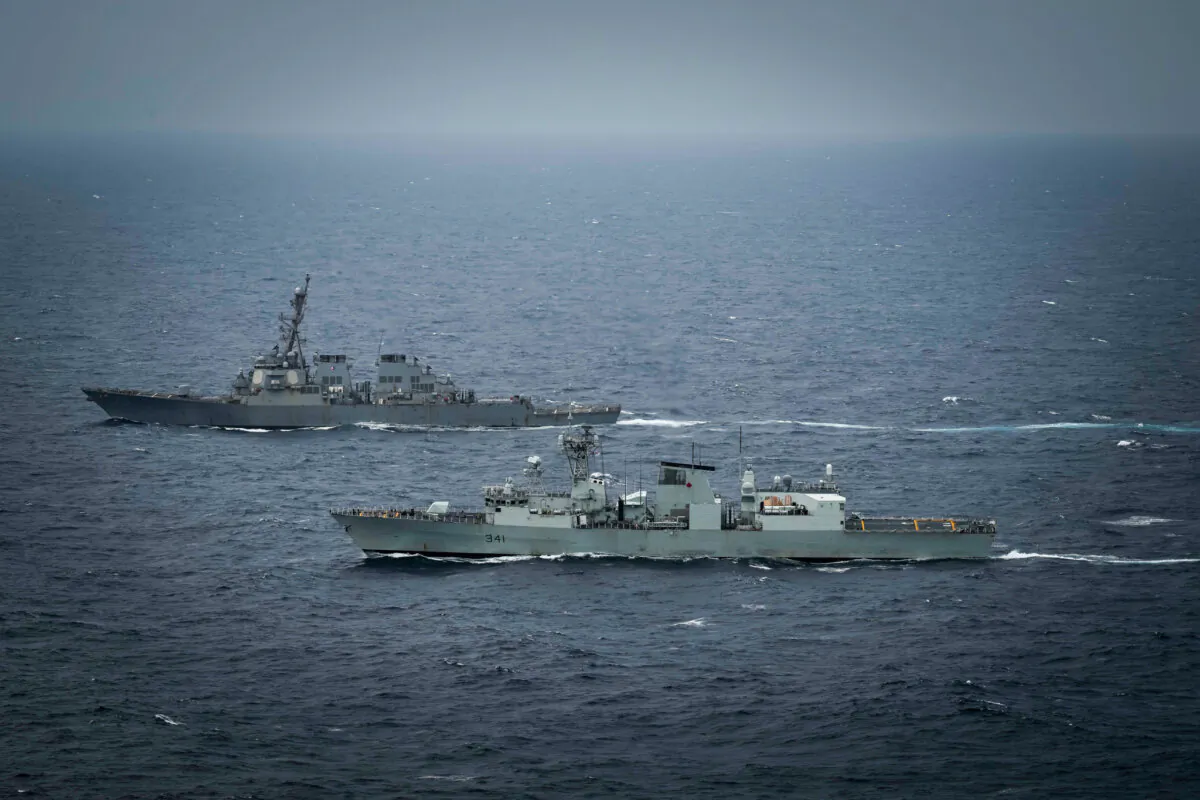
The PLA Navy has more than 370 ships and submarines, including three conventionally powered aircraft carriers. As of October 2025, the U.S. Navy had 293 ships. In 2016, the Navy Force Structure Assessment set a goal of expanding the fleet to 355 ships. It was endorsed and codified into law by Trump when he signed the FY2018 National Defense Authorization Act. The Biden administration, however, never endorsed the 355-ship or subsequent 381-ship goal as a funding priority. As a result, the United States has fallen short in terms of the number of ships built.
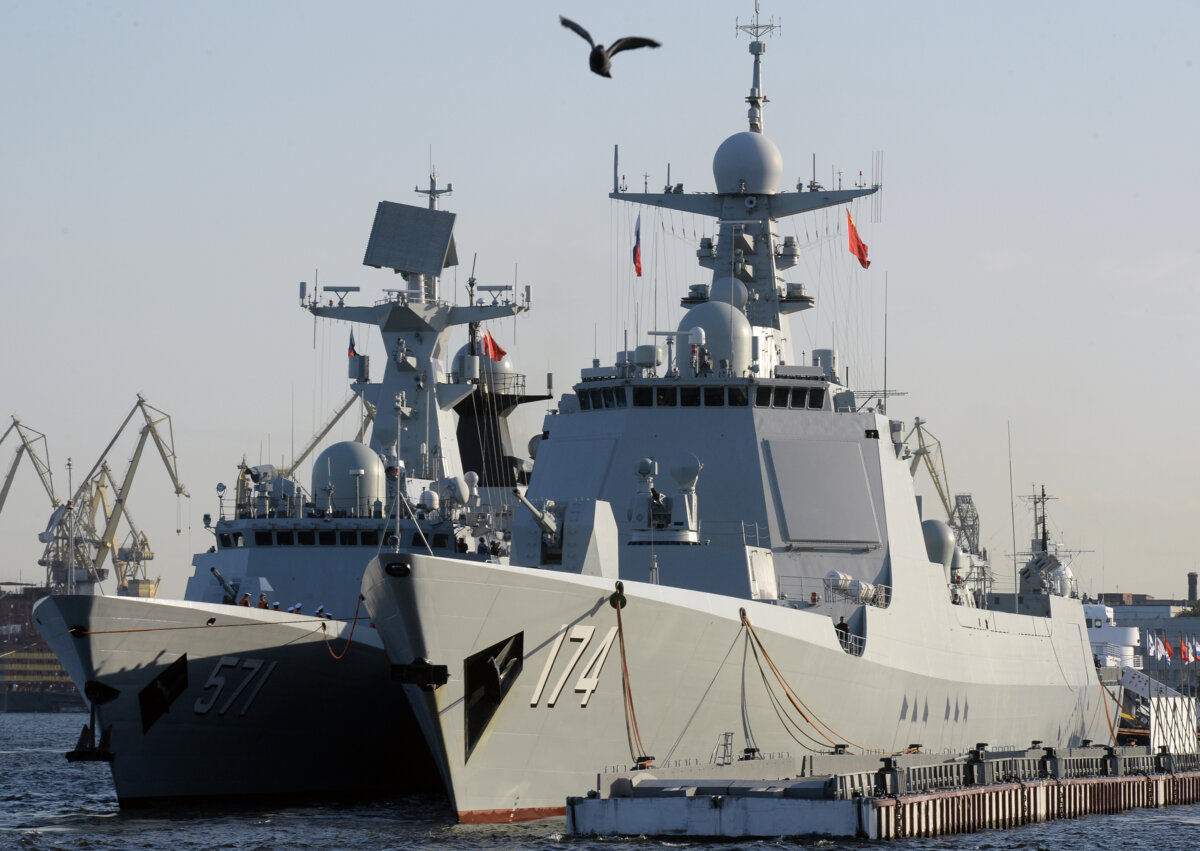
China’s destroyer fleet grew from 20 in 2003 to 50 by early 2026, while the United States maintains 73. The U.S. Navy is retiring its Ticonderoga-class cruisers by 2029, a strategic determination that the class has reached the end of its service life and that its capabilities are addressed by newer destroyers and unmanned platforms. China has no cruisers by its own classification, though the U.S. Navy rates its 14-Type 055 large destroyers as cruiser equivalents.
Hull count alone does not determine naval power. Aircraft carriers and nuclear submarines are the primary measures of blue-water force projection capability. The U.S. Navy is mandated by federal law to maintain a minimum of 11 operational aircraft carriers, all nuclear-powered, 10 Nimitz-class, and one Gerald R. Ford-class.
China has only three carriers, none of which is nuclear-powered. The U.S. nuclear submarine fleet, comprising ballistic missile submarines, guided missile submarines, and fast-attack submarines, substantially exceeds China’s in both numbers and capabilities, and it has decades of operational experience.
Despite its lead in hull count, China remains logistically constrained in sustained open-ocean operations. It has one overseas military base in Djibouti. It has insufficient replenishment vessels for extended deployments, no ability to conduct repairs abroad, and no established logistics infrastructure to sustain a deployed fleet in the Atlantic or Pacific.
Trump initiated a new battleship program, the first since the cancellation of the Montana class in 1943. On May 11, acting Secretary of the Navy Hung Cao confirmed in the Navy’s fiscal year 2027 30-year shipbuilding plan that the Trump-class will be nuclear-powered, designated BBGN, the first planned U.S. nuclear surface combatant since the retirement of nuclear cruisers in the 1990s. Each ship will displace approximately 35,000 tons. They will carry a 128-cell vertical launch system, hypersonic missiles, a railgun, and directed-energy weapons.
The Navy plans to acquire 15 Trump-class BBGNs between fiscal year 2028 and fiscal year 2055, each estimated at $17 billion. The first ship, the USS Defiant, is projected to commission in 2036. The 2026 Navy shipbuilding budget fell to $20.8 billion, down from $37 billion.
On Feb. 13, the White House released the Maritime Action Plan, developed by Secretary of State Marco Rubio in his dual role as national security adviser alongside Office of Management and Budget Director Russell Vought. The plan proposes fees on all foreign-built commercial vessels entering U.S. ports, ranging from 1 cent to 25 cents per kilogram, projected to raise between $66 billion and $1.5 trillion over 10 years.
It calls for establishing 100 Maritime Prosperity Zones, creating a Strategic Commercial Fleet of U.S.-built vessels, and establishing a Maritime Security Trust Fund as a dedicated mandatory funding stream. The United States currently operates eight active shipyards capable of building vessels greater than 400 feet.
Then-Secretary of the Navy John Phelan told the Senate Armed Services Committee in June 2025, “We are still the dominant naval power, but our adversaries are closing the gap at a concerning, accelerating rate.”
Views expressed in this article are the opinions of the author and do not necessarily reflect the views of The Epoch Times.
 Friends Read Free
Copy
Facebook
Tweet
Friends Read Free
Copy
Facebook
Tweet