
Commentary
Something has gone badly awry in relations between men and women. A disquieting anti-male animus has settled over Western culture, proclaimed in our universities, echoed throughout the media, and embedded in public policy.
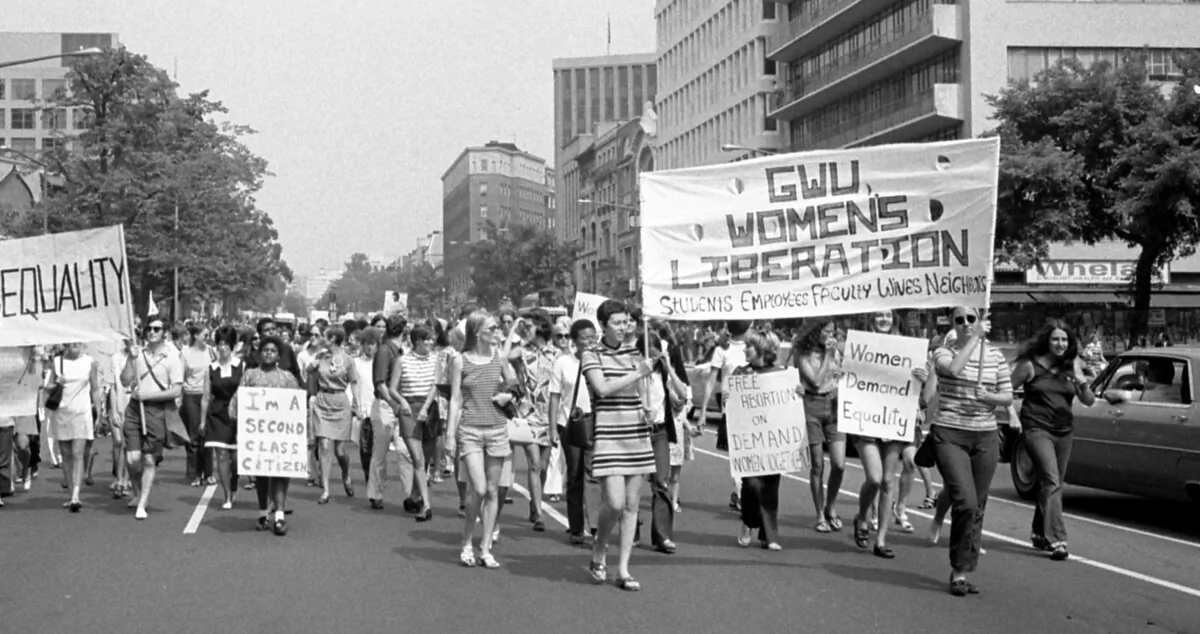
What began as a justifiable demand for women’s equality has hardened into a view of the sexes as antagonistic classes, one innocent and oppressed, the other guilty and oppressive. In promising to liberate women, feminism has diminished their moral agency and estranged them from men.
This is the central paradox at the heart of Janice Fiamengo’s fiery indictment of feminism, “The Goddess That Failed.” She argues that feminism has corroded the moral fabric of Western civilization and severely damaged relations between men and women—relations on which both a flourishing human life and a thriving social world depend.
Not least among feminism’s casualties, she writes, is “women’s capacity to love.” It is an arresting claim. Feminism presents itself as the great emancipatory movement of the modern age, the doctrine that freed women from dependence, silence, and servitude. Fiamengo contends that it has instead fostered resentment, alienated women from men, weakened the family, eroded our core institutions, and rendered relations between the sexes increasingly suspicious and adversarial. A movement promising happiness and freedom has left many women discontented, distrustful, and estranged from the very relationships that give human life meaning.
Her accusation is delivered with the verve of an apostate who knows the faith from the inside. Fiamengo, formerly a professor of English Literature at the University of Ottawa, was once a true believer. She can still recall feminism’s “euphoric exaltation” and its self-flattering conviction of moral purity. She understands the peculiar satisfaction of belonging to a movement that neatly divides the world into the innocent and the guilty, and that then assures its adherents that they stand forever on the side of righteousness.
Fiamengo now regards feminism in all its forms as a corrosive ideology. She acknowledges the wide varieties of feminism but focuses on “feminism’s most popular and taken-for-granted form as it relates to everyday life, dating, marriage, divorce, child-rearing and sexuality.” Tellingly, she concedes that there are “moderate feminists, but there was never a moderate feminism.”
The distinction matters. Feminism ultimately rests on a Manichaean division between the sexes. Women are cast as innocent victims; men as their oppressors and as beneficiaries of an omnipotent, remorseless patriarchy. The infinitely varied relations between men and women, the ones that we all experience in ordinary life, are thereby reduced to a single, all-explanatory struggle for power.
This binary distorts the texture of social life. Men and women typically do not encounter one another as representatives of antagonistic political classes. They meet as mothers and sons, fathers and daughters, husbands and wives, teachers and students, friends and lovers. Their lives are bound together by affection, duty, sacrifice, gratitude, disappointment, fondness, and forgiveness.
To compress this intricate moral world into a contest between patriarchal power and female victimhood is to replace lived reality with ideological abstraction. Feminism teaches women to interpret their lives through the lens of victimhood and grievance, “ignoring the details that don’t fit.” Life’s ordinary disappointments become political wrongs, while the inevitable compromises of love and family life are recast as oppression. In the feminist dispensation, gratitude becomes false consciousness, and resentment against the patriarchy becomes the mark of authenticity. The result is not liberation but a psychologically debilitating estrangement from men, from family, and ultimately from the dispositions of trust and tenderness on which love depends.
Fiamengo traces this outlook’s institutional ascendancy to the universities. Beginning in the 1970s, feminist professors introduced generations of impressionable undergraduates to radical claims about men, women, and power. They presented these claims not as contestable theories open to evidence and argument, but as settled social-science findings. Betty Friedan’s “The Feminine Mystique” offered an influential model, famously comparing the condition of the suburban American housewife to imprisonment in a “comfortable concentration camp.”
The comparison was morally grotesque. More significantly, it helped establish a style of feminist argument in which emotional force displaced proportion and anecdote masqueraded as evidence. For Fiamengo, this was not merely a rhetorical corruption but an epistemological one, with grave consequences for the university: “Female-led institutions become more oriented to social justice than to objective truth: feelings matter more than facts, contexts more than law, and victim identities more than expertise.”
Once these feminist doctrines gained institutional authority, disagreement ceased to be treated as an intellectual challenge and instead became evidence of moral complicity. “Women’s studies demanded that its students accept and adhere to a narrow political dogma.” Advocacy was recast as scholarship, while dissent was treated as a failure of character. Graduates subsequently carried these beliefs into fields such as journalism, law, medicine, education, and government. Ideas incubated in seminar rooms gradually solidified into the broader culture’s unquestioned moral presumptions.
The consequences now surround us. Our society is intensely attentive to the welfare of girls and women, even as boys fall behind in school and drop out of higher education at alarming rates. Men suffer disproportionately from addiction, isolation, homelessness, workplace deaths, and suicide. Yet male suffering struggles to command any sustained public concern. If men constitute the oppressor class, their pain must be either exaggerated, deserved, or negligible.
Fiamengo writes with an anger that is plain. Beneath it, however, lies a sorrow for men taught that their masculinity is inherently suspect; for women encouraged to mistake resentment for strength; for children deprived of stable families; and for a civilization steadily consuming the moral inheritance on which its freedom depends.
The book’s deeper concern is the recovery of a world in which men and women might once again understand themselves not as adversaries but as partners in our shared human enterprise.
Such a recovery must begin by repudiating feminism’s ideological binaries and restoring the language of agency, responsibility, reciprocity, and love. No society can prosper when one half of humanity is taught to fear and despise the other. Nor can it flourish when a doctrine promising liberation leaves both sexes lonelier, angrier, and less capable of love. Men are not a criminal class, and women are not perpetual victims.
“The Goddess That Failed” is an important contribution to a debate our culture has long lacked the honesty to pursue. Readers may resist some of Fiamengo’s conclusions or recoil from the severity with which she states them. They should nevertheless read her book, and heed its warning carefully. What is at stake is not merely the fate of feminism, but whether men and women can recover the trust, affection, and mutual obligation that all of us require.
Without that recovery, no human life can flourish, and no civilization can endure.
Views expressed in this article are the opinions of the author and do not necessarily reflect the views of The Epoch Times.
 Friends Read Free
Copy
Facebook
Tweet
Friends Read Free
Copy
Facebook
Tweet