
Commentary
To most people, the accreditation process is an unknown. That’s unfortunate, because accreditation is one of the shaping forces in higher education.
Here’s how it works. In the United States, in order for a school to qualify as a legitimate educational institution and issue valid degrees to people who pass through it, the school must undergo a review/evaluation by an informed and independent judge. The judging body itself must be certified by the government. New, aspiring institutions request that the accreditor conduct a review for the first time and (they hope) receive from it a green light, while existing institutions remain on a schedule of periodic updates to ensure that what the accreditor originally approved still obtains, with no deterioration of performance.
It’s a critical test, one a college or university absolutely must pass. A poor evaluation forces the institution to get its act together and make improvements or close its doors. During the evaluation process, administrators are anxious and tentative. Reviewers visit campus, observe meetings and events, examine documents, interview different parties, and craft a final report. They are out to affirm that the school’s mission statement follows education norms and ideals and then determine whether campus practices adhere to that statement. Are the teachers qualified as they should be? Does the curriculum ensure that a degree from the institution verifies that the graduate has received a proper general education and specialized instruction in a major? Are admissions policies fair and fiscal conditions sound?
The questions demonstrate the power of the accreditor. Schools have to open their books and their classrooms to outsiders whose discretion they can’t challenge. I remember many years ago when my university was undergoing a regular check-up and the administration ordered all professors to pull their old graduate school transcripts to prove that we had really earned our doctorates. We laughed and complied, although it was no joke at some other institutions at about that time, where high officials were found to have lied on their résumés.
Throughout the process, a set of guidelines is upheld; the whole thing is supposed to work on academic principles alone. No commercial or political yardsticks are to be applied, for instance, criticism of a public university for not producing enough graduates to meet the needs of employers in the home state.
It is surprising, then, that we find at one of the major accrediting agencies, the Southern Association of Colleges and Schools (SACS), a position statement dated December 2023 on diversity, equity, and inclusion (DEI) that makes this demand of the institutions that it reviews: “Equally important is the opportunity to recruit a diverse faculty and staff that reflects the larger society.”
A simple expectation but a far-reaching one. The position statement goes on to praise institutions that have created DEI offices and have made special efforts to support “students from traditionally underrepresented groups.” Schools that haven’t done so get the message: Beef up your DEI labors or risk a lower score.
A few years before, another regional accreditor, the Middle States Commission on Higher Education, announced a “diversity, equity, and inclusion project as a call to action.” The call urged schools to alter any policy that appeared to have a “disparate impact on an increasingly diverse population.” The leadership of the Commission acknowledged the force of its encouragement explicitly, proudly noting “the use of accreditation activities to leverage and support critical institutional shifts.”
Needless to say, the insertion of DEI criteria into accreditation politicizes the process—and does so in a leftward, identitarian direction. It adds a duty of social engineering to the mission of higher education. In the SACS statement cited above, the measure of success is not the education that takes place in a school’s classrooms and libraries. It is, instead, the proportionate representation of faculty and staff relative to society as a whole. Does the percentage of professors who are African American match the percentage of African Americans in the local city or state? This is what the accreditor pledges to examine. In doing so, it has raised the DEI factor to critical status.
In the past, schools that resisted the identitarian vision had nowhere else to go. They were bound to the regional accreditor. In 2022, however, the Florida legislature passed a law requiring public institutions to switch accreditors in every cycle, thereby breaking the hold of one accreditor on the state. Now a new initiative has gone further. University systems in Florida, Georgia, South Carolina, North Carolina, Tennessee, and Texas have come together to create their own accrediting body, one without political designs. It’s called the Commission for Public Higher Education, a rival to the others, although it must go to the Trump Department of Education for authorization before it may do its work.
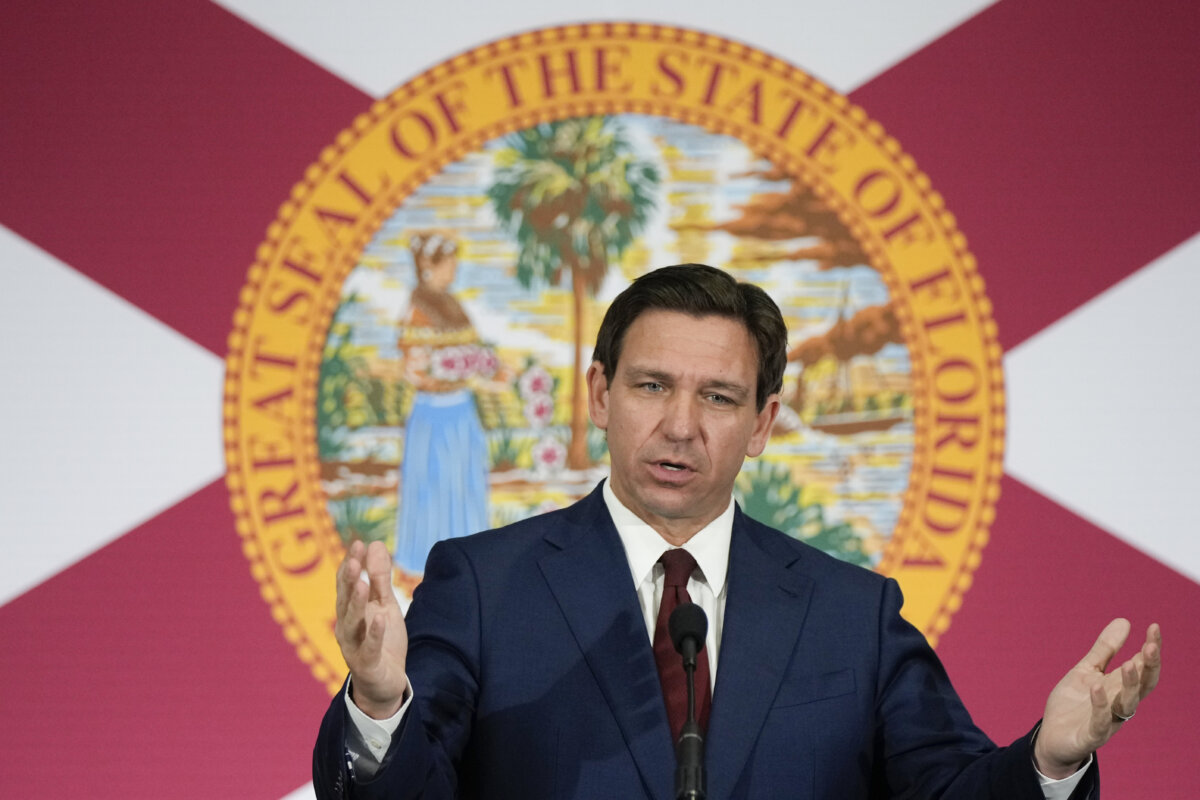
Florida Gov. Ron DeSantis says the new body will avoid “ideological fads” and stick to “student achievement” and “pursuing truth.” He and leaders in other states hope for expedited approval from Washington, and they expect that other state systems will join them once the commission demonstrates its validity. No DEI demands will be part of it.
This is the best way of conservative reform of higher education—not to alter existing units that have been captured by identity politics but to design and implement alternative pathways. If those paths prove more efficient, effective, and, most of all, educational, they will prevail.
Views expressed in this article are the opinions of the author and do not necessarily reflect the views of The Epoch Times.
 Friends Read Free
Copy
Facebook
Tweet
Friends Read Free
Copy
Facebook
Tweet