
Commentary
One of the most important components of ranking California cities is waiting for some of them to provide their annual comprehensive financial reports (ACFRs).
I broke up the state into nine regions, closely following the Caltrans districts. There are 78 cities in the Central California region, and I provided the 2019 rankings more than a year ago. The city of San Joaquin has now provided its ACFRs for 2020, 2021 and 2022. So, the rankings for the fiscal year ending June 30, 2020, are shown in the graph below.
I want to thank the city of San Joaquin for responding to my requests. Also, the city of Amador City provided financial records from which I had to prepare the unrestricted net position.
By obtaining the ACFRs and reviewing the Basic Financial Statements, take the unrestricted net position (UNP) from the statement of net position (balance sheet) and divide it by the city’s population to calculate the per capita. Using this simple temperature gauge, let’s see how the cities in the region compare.
While most of the cities stayed in place for the year 2020, moving six places or less, 11 moved seven places or more and deserved a closer look. And remember, the COVID-19 lockdown occurred in the final four months of that fiscal year, which contributed to the areas combined unrestricted net deficit increasing by $444 million.
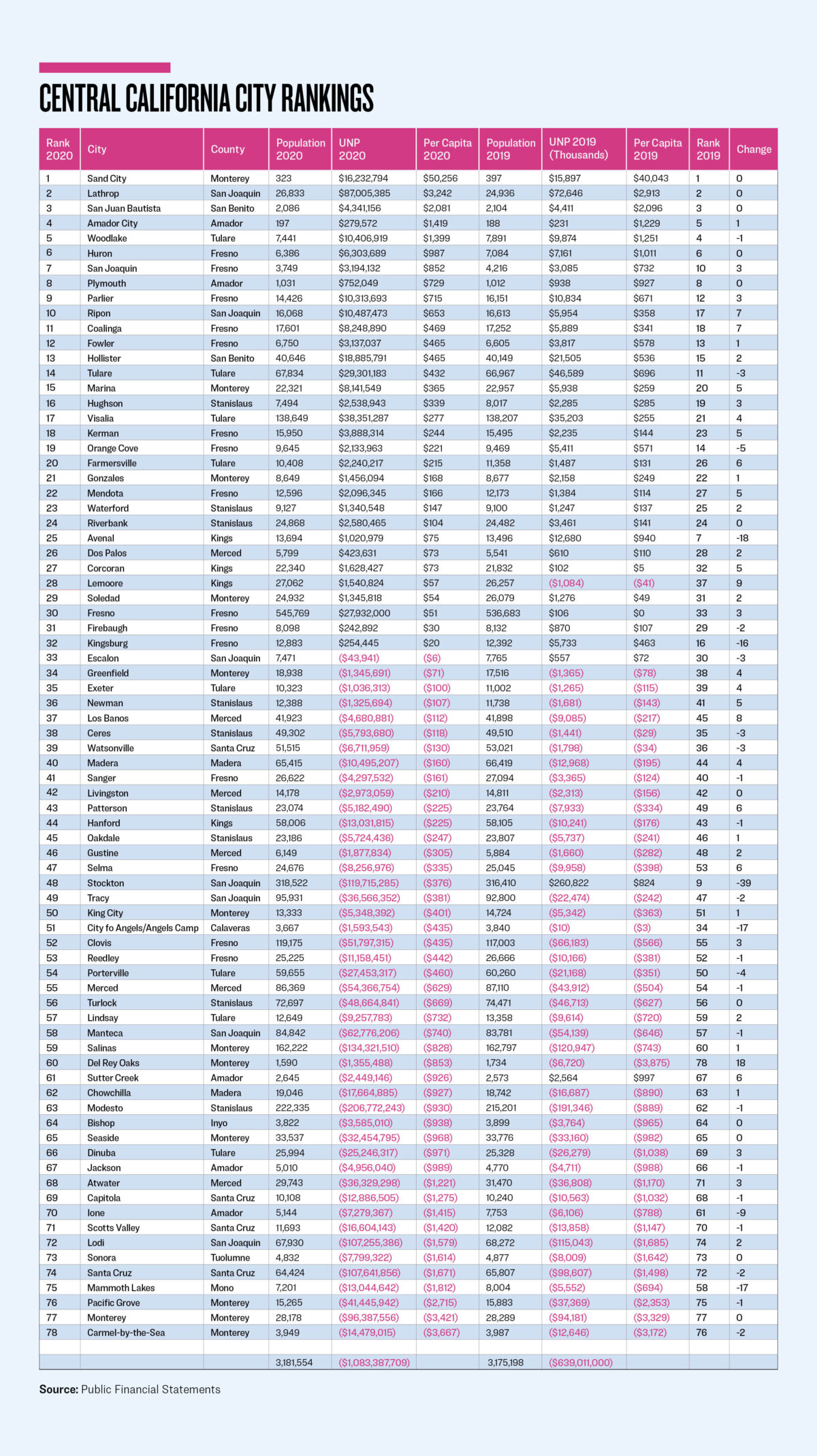
The biggest upward mover was Del Rey Oaks, jumping from last place in 2019, it moved up 18 positions. It had revenues in excess of expenditures of $14.6 million, with Community Development grants of $9.6 million and a release of obligation due to the Fort Ord Reuse Authority of $4.4 million being the two major contributors. This was related to the South Boundary Roadway project dissolution originally initiated by the U.S. Army and dominates the footnote disclosures in the ACFR.
It moved $14.4 million into restricted assets and reduced its net investment in capital assets by $5.2 million, which explains, sort of, the improvement in its unrestricted net position by $5.4 million. I say somewhat, as reducing the $4.5 million FORA liability should have increased the net investment in capital assets. This category on the statement of net assets needs a supporting schedule in the footnotes to assist the readers of the true results of these financial activities.
The city of Lemoore had then-Vice President Mike Pence pay a visit during the fiscal year. It had expenditures in excess of revenues of $2 million. It transferred $6 million out of restricted assets. And it allocated $1.4 million to net investment in capital assets. Combined, its unrestricted net position improved by $2.6 million and moved the city up nine places.
Los Banos, where my family enjoys eating at an historic Mexican restaurant when we drive up or down the state, had revenues in excess of expenditures of $11 million. It transferred $7.3 million into restricted assets—explaining the bulk of the $4.4 million improvement in its unrestricted net deficit, moving it up eight places.
Ripon had revenues in excess of expenditures of $4.5 million. It transferred $6.4 million into restricted assets. It increased its unrestricted net position for the beginning of the year by $6.4 million. The net investment in capital assets is not provided and there appears to be no fixed assets—the joys of using the “modified cash basis.” There was no explanation for the prior-year adjustment in the footnotes accompanying the ACFR, and page three of the disclosures did not reconcile to the statement of position ending amount for the unrestricted net position. Consequently, it is difficult to determine how it increased by $4.5 million, moving it up seven places.
Coalinga had revenues in excess of expenditures of $5.5 million, allocated $3.4 million into net investment in capital assets, explaining the bulk of its $2.4 million improvement to its unrestricted net position. It moved up seven positions.
Now let’s review the cities that dropped nine or more places, starting with Ione, which had to deal with the threat of a prison closing by the state government, about broke even for the year. It moved $1.1 million into restricted assets, explaining the increase in its unrestricted net deficit of $1.2 million. With a small population, this transfer dropped it nine places.
Kingsburg participated in a dog rescue story during this year. It also had revenues in excess of expenditures of $3.7 million, transferred $6.8 million into restricted assets, and acquired a $2.3 million increase in its net investment in capital assets. The combination resulted in a net decrease in its unrestricted net position of $5.4 million and dropping it 16 places.
Angels Camp, known for Mark Twain’s jumping frog of Calaveras County, also known as the City of Angels, had revenues in excess of expenditures of $959,097. It decided to restrict $2,033,271 and allocate $508,968 to net investment in capital assets. Combined, it increased its unrestricted net deficit by $1,583,142 and dropped it 17 places.
Avenal had expenditures in excess of revenues of $3,709,586. It transferred $348,678 into restricted assets. And it reduced its net investment in capital assets by $1,398,899, thanks mainly to depreciation expense of $1,447,026. Combined, the unrestricted net position dropped by $2,659,365. It dropped 18 places.
Mammoth Lakes dropped 17 places, but for an odd reason. Its annual comprehensive financial report for the year ending June 30, 2019, showed an unrestricted net deficit of $5,552,050 on its statement of net position. But the footnote preceding the basic financial statements shows the unrestricted net deficit at $13,458,093. The 2020 statement of net position shows the higher deficit amount. Therefore, the previous year’s ACFR was in error. For this fiscal year, the revenues were in excess of expenditures by $3,993,912, of which $921,978 went towards the net investment in capital assets and $2,704,526 was transferred to restricted assets. The net result, $367,408, should have reduced the unrestricted net position. However, it grew by $413,451. Consequently, the finance director of my favorite ski resort has some explaining to do concerning both years. If you visit next fall to do some leaf peeping, please visit City Hall and get the answers.
Stockton, a city that has filed for Chapter 9 bankruptcy, had revenues in excess of expenditures of $33 million. It transferred $35 million into restricted assets. But it made a classic mistake. It increased its net investment in capital assets by $378 million, with no reflection of a similar increase to its capital assets. This common error reduced the unrestricted net position by $380 million and caused this city to drop 39 places. It doesn’t look good for the 2021 ACFR, as this dramatic drop in the rankings continued.
With that, watching what your city councils are or aren’t doing and whether more scrutiny needs to be paid to the financial reporting may be warranted. Does your city have a finance committee with qualified volunteers? Does it have an audit committee? It would seem that having more eyes to demand prompter reporting and better accuracy is something that should be considered by every city council.
Views expressed in this article are the opinions of the author and do not necessarily reflect the views of The Epoch Times.
 Friends Read Free
Copy
Facebook
Tweet
Friends Read Free
Copy
Facebook
Tweet