Commentary
When the Roman Empire in the West fell in the fifth century, swamped by waves of Germanic barbarians, the eastern part of the empire, by far the richest and most urbanized, survived. Sometimes called the Byzantine Empire (after Byzantium, the original Greek name for the capital city Constantinople), it managed to maintain its existence until the middle of the 1400s.
It was a highly civilized realm and one that took its Christianity very seriously, but in its 1,100-year history it seldom had a moment’s peace. It was assailed by waves of invaders—Bulgars, Khazars, Lombards, Avars, Slavs, Pechnegs, Vikings, Persians, Arabs, Turks of every variety—and plagued by endless palace coups. This meant that the military played a large part in politics, and the problem of disaffected generals and soldiers was always present.
As the seventh century began, the Byzantine Empire had a very successful ruler. Emperor Maurice had won numerous victories against his realm’s enemies. He had expanded his territory in the east against the very powerful Persians and relieved his country of having to pay an onerous annual tribute to them. He had pushed back the Avars in the Balkans and the Lombards in Italy, but these victories came with a high financial price. His attempts to economize at the expense of soldiers’ wages led to a revolt, and a disgruntled general named Phocas seized the capital with the support of the army and the Constantinople mob, murdering the incumbent Maurice and his six sons.
This was the first successful violent coup in almost 300 years, and with no inherent legitimacy, Phocas had to maintain his rule by appointing relatives to high positions and with terror and violence. The borders collapsed under barbarian pressure from the north and Persian pressure in the east; rebel generals began marching on the capital, and rioting broke out in the empire’s cities. Phocas responded with more terror, including the murder of Maurice’s wife and daughters.
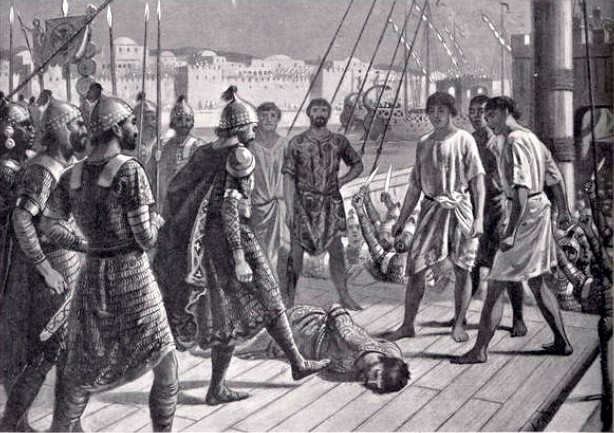
In 610, a fleet led by Heraclius, the son of the governor of the African provinces, landed near Constantinople. The local military and civil service went over to him and declared him the new emperor; Phocas’s bodyguard deserted him, and Heraclius entered the capital in triumph. When Phocas was dragged before him, Heraclius sneered, “Is this how you have ruled, wretch?” Phocas replied, “And will you rule better?” Heraclius personally killed his predecessor on the spot and had his head paraded through the capital.
The Romans and their Byzantine successors had an interesting policy toward dead losers of the game of politics; it was called damnatio memoriae, the erasure of all visible signs of their existence. Phocas’s statue in the Hippodrome was knocked over and publicly burned. The very name of Phocas was scratched from monuments, his portrait busts were smashed, and literary works that praised him were consigned to the flames. It was as if he had never been.
Though the reign of Phocas was brief, in some ways it was highly consequential. He was the first emperor for centuries to wear a beard and for some reason, he seems to have been a fashion leader in facial hair: Every Byzantine emperor thereafter, right to the end of the empire in 1453, was bewhiskered. More importantly, in his search for support from the Pope, he transferred the title of “Universal Bishop” from the Patriarch of Constantinople to the Bishop of Rome. The decree that the Pope was “the head of all churches” would be an important weapon for the papacy in the centuries to come.
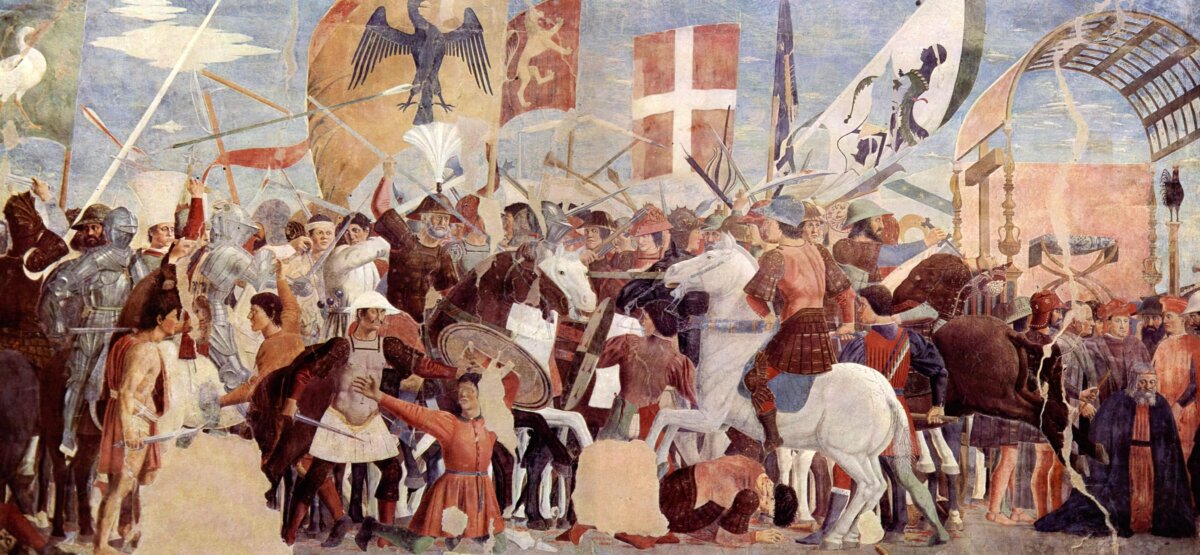
Heraclius, the successor of Phocas, had a much longer reign (he died in 647) but it was no less troubled. Theological quarrels between various factions in the Christian church led to dissatisfaction with imperial rule in Egypt and the Levant. The resurgent Persians threw his armies back all the way to the walls of Constantinople. They overran the Middle East, captured Jerusalem, and bore away the True Cross, which was reputed to be one on which Christ had died, the Church’s most sacred relic.
After years of struggle, Heraclius was able to defeat the Persians and recover the True Cross, but these decades of war left both empires bankrupt and exhausted—easy prey for the sudden outburst of Islamic armies in the 630s.
Views expressed in this article are the opinions of the author and do not necessarily reflect the views of The Epoch Times.