Commentary
The government-sponsored student loan industry is a system structured to fail its borrowers and enrich university administrations at taxpayer expense. It should be profoundly reformed.
When the Biden administration announced its student loan debt forgiveness program in 2022, I wrote that canceling student debt was fundamentally wrong—morally, economically, and constitutionally. The Biden administration’s proposal was to pay for the program through deficit reduction, nothing more than a substitution of one debt with another, even if the deficit were reduced (it wasn’t). Canceled student loan debt adds to the national debt, a balance that has ballooned from $8.5 trillion in 2007 to more than $37 trillion in 2026.
The courts eventually struck down the Biden administration’s debt forgiveness scheme. But the debate over debt forgiveness obscured a more important conversation. The problem was never primarily about whether to cancel student loan debt. The problem is a system that has accumulated $1.84 trillion in outstanding debt in the first place, nearly all of it (92 percent) held by the federal government, and much of it unrepayable … ever. This system has trapped millions of Americans in a form of debt servitude and drained their economic productivity.
Approximately 42.8 million Americans carry federal student loan debt, with a record-high average balance of a little less than $40,000. Student loans represent the second-largest category of consumer debt in the country after mortgages. Roughly 24 percent of borrowers are currently behind in payments, with active repayment delinquency rates running nearly 2 1/2 times their pre-COVID-19 pandemic levels.
Current federal interest rates—up to 9 percent—are not usurious on their face. But applied to large balances across long repayment horizons, the compounding math is punishing. Annual debt service often consumes 20 percent to 25 percent of the take-home pay of the median American worker before housing, food, transportation, or health care. The arithmetic of student loan repayment is, for many borrowers, incompatible with the arithmetic of living.
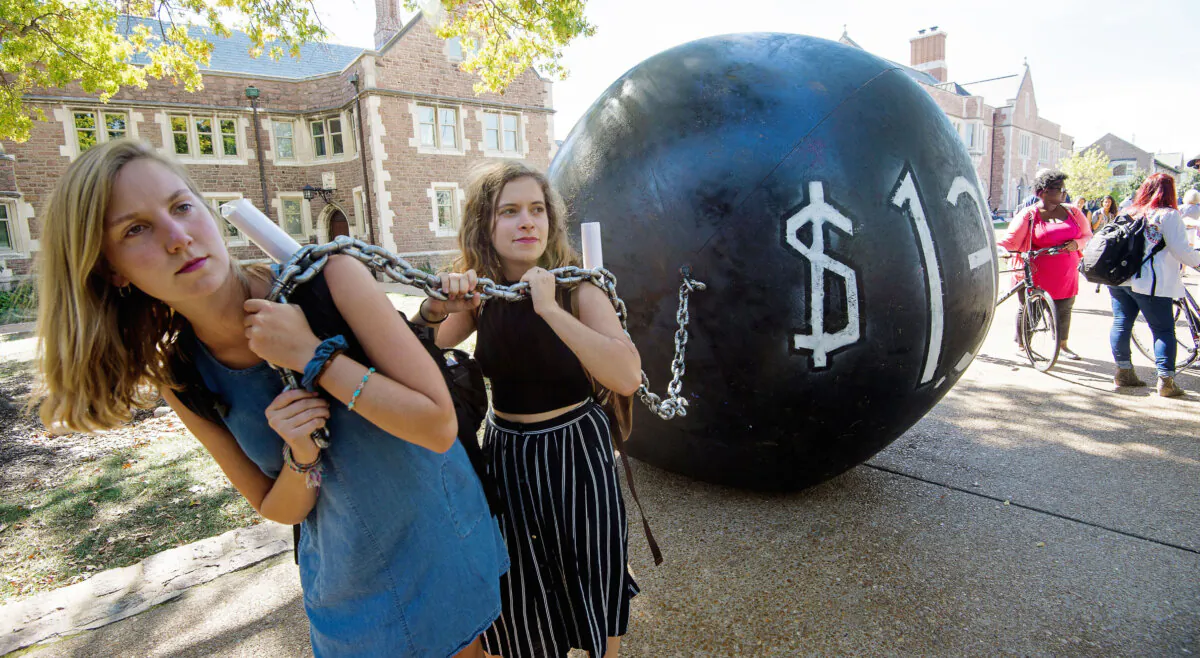
The debt becomes a financial anchor around an individual’s neck that he will carry all his life, cutting off opportunities to buy homes and invest for retirement, as well as sullying credit records. Unlike mortgages on homes, paying down student loan balances doesn’t leverage an initial equity investment into gains for the future. It only fills a hole dug in the past.
Debt forgiveness is the wrong answer—not only because it is unfair to those who repaid their loans through years of hard work and unfair to the millions of taxpayers who would bear the cost through the hidden tax of government debt and inflation, but also because it addresses none of the structural conditions that produced the crisis.
The higher education industry has enriched itself at students’ and taxpayers’ expense. When the federal government guarantees loans and disburses them without underwriting standards—without asking whether the degree being acquired has any labor market value, without assessing the borrower’s ability to repay—it removes the market’s most important signal. Universities can raise prices indefinitely because someone will always pay.
Since 1980, college tuition has increased by more than 1,200 percent. General consumer price inflation over the same period is approximately 300 percent. In this century alone, the average cost of a four-year college has risen by 157.5 percent; even after adjusting for inflation, tuition remains 37.5 percent more expensive in real terms than it was at the millennium.
Administrative spending at colleges grew by 61 percent between 1993 and 2013, vastly outpacing instructional spending. Universities have built palatial campuses, proliferated administrative bureaucracies, and funded a vast ideological infrastructure—all financed by students who borrowed from the government. University coffers filled while students got the bill, but no skills. This was not a natural market phenomenon. It was a consequence of flawed policy.
The system is indifferent to the fact that not all degrees are created equal. STEM graduates, physicians, attorneys, and certain finance professionals generally earn enough to service their debt and build wealth over time. But large numbers of students borrow heavily for degrees with weak or negative economic return—and in many cases, those students had neither the aptitude nor the information to understand what they were buying.
Education degrees make the point well. A bachelor’s degree carries a median debt of $46,820 among new graduates. Entry-level teacher salaries in most states run $35,000 to $45,000. An education graduate has the highest debt-to-income ratio of any undergraduate major, with median debt representing 154 percent of first-year income.
Meanwhile, test data have consistently shown education majors scoring well below average compared with STEM, pre-med, business, and finance students. The system is loading its most financially vulnerable participants—and those with the least capacity to evaluate the transaction—with the most unserviceable debt, for degrees with the weakest return. If this pattern appeared in the consumer finance industry, it would be called predatory lending. In higher education, it is referred to as “uplifting” or “financial inclusion.”
The macroeconomic and social externalities compound harm. Most student loan borrowers have delayed or forgone homeownership, marriage, children, and retirement savings because of their debt burden. Americans aged 35 to 49 now carry $681.5 billion in total student debt—evidence that for millions of people, these loans are not a brief early-career inconvenience but a multi-decade constraint on human flourishing. A generation of over-leveraged workers with suppressed consumption capacity is a macroeconomic drag, not just a personal hardship.
The taxpayer pays twice, first in direct taxes and then through the hidden tax of inflation. When borrowers default or are forgiven, that liability flows directly to the national balance sheet. Every dollar of uncollectible student debt makes a small contribution to the deficit-debt-inflation doom loop that will lead to an eventual credit crisis for the United States and a debasement of its currency.
The good news is that corrective market forces are already in motion. Artificial intelligence (AI) is not a hypothetical future threat to the economic model of higher education; it is a present-tense disruption. AI tools are performing tasks that once required expensive professional degrees: legal research, financial analysis, medical diagnostics, software development. The marginal value of a four-year degree in fields in which AI can replicate entry-level cognitive labor is declining, and it will continue to decline. The market is beginning to impose the discipline that federal loan policy never did.
A better model has existed for generations in more sensible corners of the economy: technical training, apprenticeships, and vocational education. A licensed master plumber or experienced electrician can earn well into six figures. Both careers require training—paid apprenticeships, not debt-financed classrooms—with no tuition, no student loans, no administrative overhead, and no ideological indoctrination. A 22-year-old completing an electrician’s apprenticeship is earning a living debt-free, while a peer financing a bachelor’s degree in communications is three years into accruing interest.
The policy prescriptions are not complicated. Require more rigorous underwriting, cap loan amounts relative to expected earnings, and make universities share in the downside risk when their graduates default. End the federal government’s role as an indiscriminate creditor to any enrollee at any institution offering any credential. Invest in vocational and technical training pipelines. Reform accreditation to recognize alternatives. Allow the markets to price the value of skills based on supply and demand, and let that price signal guide what the next generation of workers chooses to learn.
Views expressed in this article are the opinions of the author and do not necessarily reflect the views of The Epoch Times.
 Friends Read Free
Copy
Facebook
Tweet
Friends Read Free
Copy
Facebook
Tweet