
Commentary
“Oh, what a tangled web we weave, when first we practice to deceive!”—Sir Walter Scott, “Marmion.”
The Romans had a saying: “falsus in uno, falsus in omnibus”—“untruthful in one thing, untruthful in everything.” English common law subscribed to the same idea. If a witness lies about one detail, the courts can reject their entire testimony.
The legal courts are not the only venue in which we can see judgment in action however.
The “Odyssey” is filled with disguises and deceptions. Gods appear as humans, kings appear as beggars, servants prove nobler than aristocrats, while those that flout the gods with impunity (like the suitors) are ultimately doomed. Homer repeatedly forces his audience to confront a fundamental problem: things are not necessarily what they appear to be.
How does a wise man proceed? He learns to adapt to it.
The epic’s tale of judgment deferred does not mean justice denied. Justice requires patience, suffering, and discernment. But it will come because the gods are ultimately just.
Odysseus is the example par excellence of a man we should not dismiss as if he were a court witness. He is a notorious trickster and liar.
Most people are aware of Plato’s objections to Homer in “The Republic.” For Plato, the capacity of poetry to deal in appearances was dangerous. He attacked the imitative nature of poetry, which he thought presented its images at a distance from truth, and worst of all, formed the passions without any real knowledge. Not just Odysseus but Homer is a liar. It’s a clear position.
“The Republic” is not Plato’s only word on Homer though. In the “Lesser Hippias,” Socrates and the sophist Hippias debate whether Homer intended Achilles or the wily Odysseus to be the better man. The argument surprisingly shifts to whether it is better to do wrong voluntarily or involuntarily. Socrates argues that the person like Odysseus who does wrong or lies voluntarily (knowing the truth and choosing to subvert it) is “better” than the one who does it involuntarily (through ignorance or weakness). Hippias is shocked that Socrates thinks a deliberate liar is superior.
For Plato, what is most important is not the act of deceiving but the ability to discern the truth.
We must look past Odysseus’s deceit to see that point.
One of Homer’s great instruments for doing this is what Aristotle calls anagnorisis—recognition scenes—whereby a character moves from a state of ignorance to knowledge.
Recognition scenes are more than clever dramatic devices in the “Odyssey.” They enact one of the poem’s central claims about wisdom: we must exercise discernment to see persons and things as they truly are.
The structure of Odysseus’s homecoming reinforces this idea. When we first encounter Odysseus in Book 5, Calypso (Gr. kalyptein, “to conceal” or “cover”) has hidden him from the world. Odysseus must emerge from hiding before he can begin his return. His nostos is therefore also, in a suggestive sense, an apokalypsis, a revelation. The king who has been hidden from the world gradually comes back into view.
But the revelation cannot and does not happen all at once. It is a painful odyssey.
When Odysseus reaches Ithaca, Athena disguises him as an old beggar. It seems an odd plot device, but it is consistent with the ways of wisdom. Returning incognito allows Odysseus to undertake a reconnaissance mission of character tests.
Revelation is not uniform. It happens on both sides.
The first major recognition scene I will discuss is with Telemachus. After a brief period of deception, Athena restores Odysseus’s appearance in front of his son. His legendary father is standing before him. The astonished young man initially assumes that the stranger cannot be Odysseus and must be a god. He does not believe his own eyes. Odysseus has to tell him the extraordinary truth before he believes it. Telemachus’s acceptance of that revelation also reveals something new about him: his maturity. Confirmed in the truth, the orphan becomes a son. He can now act alongside his father to restore the household he will inherit.
The recognition by Argos, Odysseus’s neglected and blind old dog, is very different. No divine transformation is necessary. Lying abandoned on a dung heap, Argos hears his master’s voice, perks up his ears, wags his tail, and dies. It is one of Homer’s most moving scenes precisely because it is so uncomplicated. His master has come home. The faithful creature dies happy.
With Eurycleia, recognition comes unexpectedly. Washing the stranger’s feet, the old nurse discovers the scar Odysseus received as a young man while boar hunting. The story of how it occurred is a painful memory inscribed on his flesh. Clothing can be changed; status can be hidden; appearances can deceive. But that memorial of pain is part of his identity. The scarred young man has returned as a legendary war hero.
Yet Homer saves the most difficult recognition scene for Penelope.
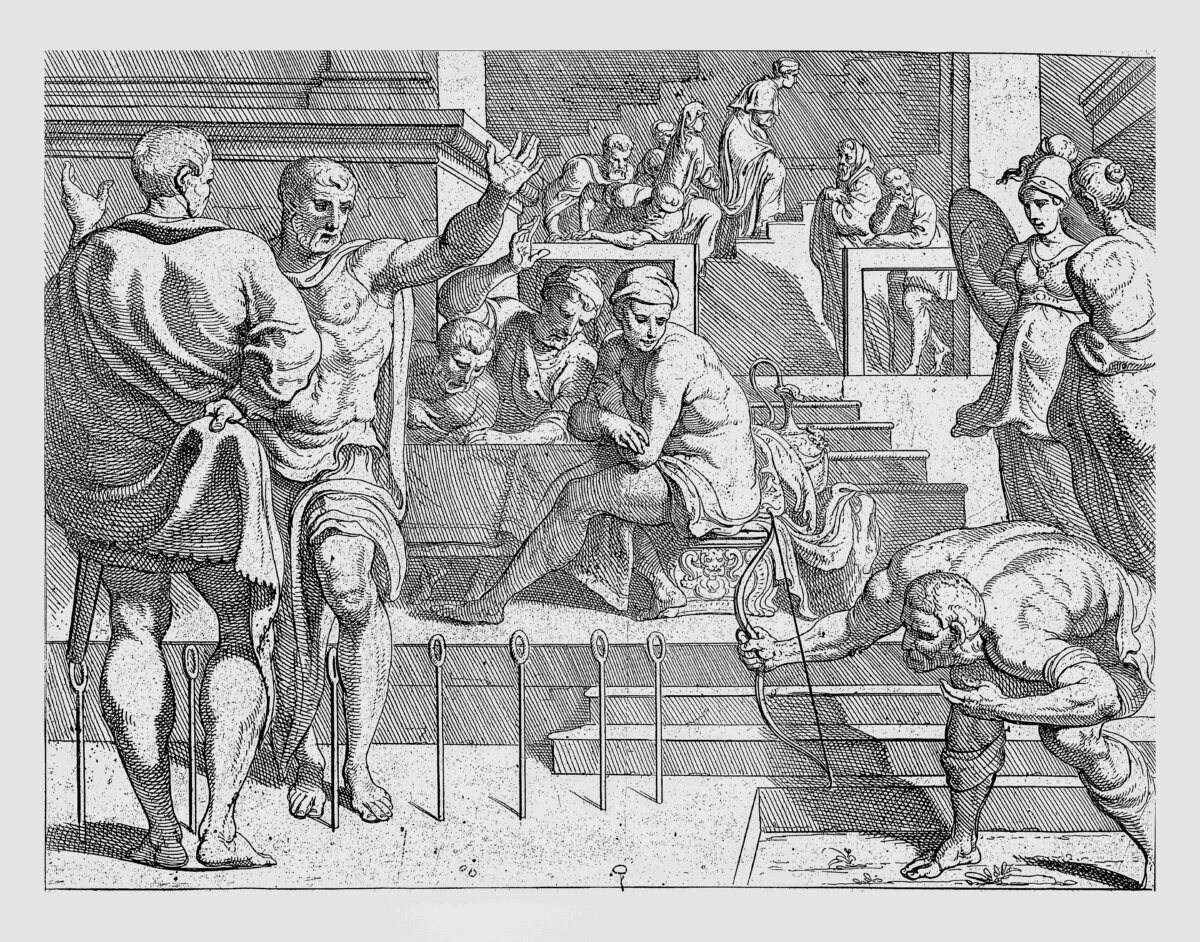
Penelope has spent 20 years surrounded by false claims, deceptive appearances, and men seeking to manipulate her. She has deceived them in return. She will not accept a man simply because he looks like Odysseus or shoots an arrow through the axe heads. She will not accept a dream given by the gods. Her hesitation is sometimes mistaken for coldness or excessive suspicion. On the contrary, it reveals her wisdom.
Her test concerns their marriage bed. It too has a history, and it is one that only she and Odysseus know.
Odysseus had constructed the bed upon the living trunk of an olive tree rooted within their house. When Penelope orders that the bed be moved, Odysseus protests: it cannot be moved without destroying it. Their shared memories are fixed to it. Their marriage, like the bed, is rooted, living, and immovable. It is not a symbol of pain but of blessing. It gave rise to their son and heir, Telemachus.
Penelope’s caution does not show her skepticism toward the truth but her fidelity to it. She refuses counterfeit displays of recognition because she desires the real thing.
Finally comes Laertes, Odysseus’s aged father. He reveals his scar, but it is not enough. Odysseus has to reveal more. He appeals to the memory of the orchard his father gave him as a boy. He recalls the trees individually—13 pear trees, 10 apple trees, 40 fig trees, and rows of vines. Revelation again depends upon shared memory. Odysseus is restored not merely as a king but as a son.
These recognitions form an ascending pattern that allow Odysseus to recover his full identity. Telemachus recognizes the father he needs to be a man. Argos recognizes the master he adores. Eurycleia recognizes the body she once nursed as an infant through its scar. Penelope recognizes her husband through the secret of their marriage. Laertes recognizes his son through a remembered cultural inheritance.
Truth arrives gradually.
And this gradual unveiling prepares for the poem’s final act. Once Odysseus is revealed, the time for judgment is ripe. The beggar whom the suitors inhospitably mocked is the king whose household honor they have violated. They had mistaken judgment deferred for justice denied. The gods, with Odysseus as their chosen instrument of justice, will set them straight.
Odysseus’s return is therefore apocalyptic in the fullest sense. Judgment follows revelation.
The question running through the “Odyssey” is not simply whether Odysseus will come home, but whether his household will be faithful enough to welcome him. The fact that they are reveals that the man of wisdom has a household marked by the same.
Odysseus’s journey home is thus also a journey from appearance to reality, from concealment to revelation, and ultimately from ignorance to judgment.
For more discussion of “The Odyssey,” go to my YouTube channel. If you would like a free copy of my “Visual Guide to Homer’s Odyssey,” click here.
Views expressed in this article are the opinions of the author and do not necessarily reflect the views of The Epoch Times.
 Friends Read Free
Copy
Facebook
Tweet
Friends Read Free
Copy
Facebook
Tweet