
Commentary
Yes, there is a nuclear arms race. But the United States is not in it and has not been since the end of the Cold War and the collapse of the Soviet Union. To the contrary, the United States has significantly reduced both its reliance on nuclear weapons and its inventory of nuclear forces by more than 90 percent.
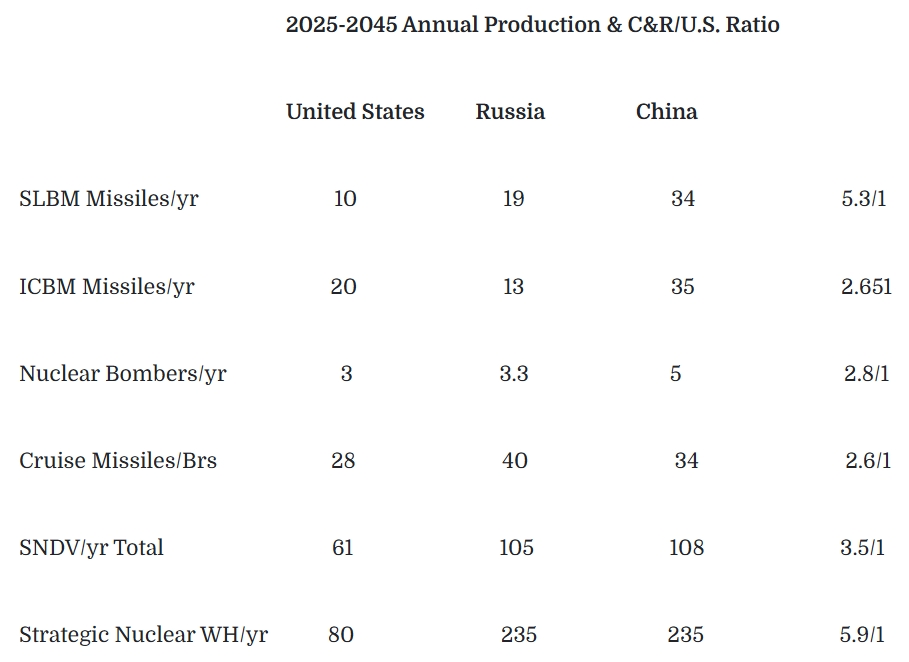
Two major countries engaged in an accelerating nuclear arms race are Russia and China. Trouble remains as, while thankfully, the United States has now taken critical steps to modernize its strategic nuclear forces, replacing its aging forces on a one-for-one basis—the United States remains from 2.5 to six times worse off than its peers in the nuclear weapons production business because the United States is racing only to stay in place.
Russia has not only modernized its strategic nuclear forces (more than 90 percent completed), it has also significantly increased the number of nuclear warheads it can deliver, replacing, for example the single warhead Topol intercontinental ballistic missiles (ICBMs) with multiwarhead Yars ICBMs, creating a warhead count potentially far in excess of New Start Treaty limits.
Russia currently has 168 Yars ICBMs (24 silo, 144 mobile), each carrying four to six reentry vehicles (RVs); 36 Yars-S, each carrying three heavy RVs; and 46 SS-18 ICBMs, each carrying 10 RVs, being replaced by the Sarmat each carrying up to 15–20 light (90–150 kiloton, referring to explosive power and not weight) RVs. The SS-19s are largely retired except for 18 that are carrying the Avangard hypersonic vehicle. Current total ICBM warheads are between 1,916 and 2,190 if fully uploaded.
Russia has five Delta-IV ship submersible ballistic nuclear submarines (SSBNs), each carrying 16 Layner submarine-launched ballistic missiles (SLBMs) and each capable of carrying eight to 12 RVs. Russia also has eight Borei SSBNs with two more under construction and two to four more planned after that. Each Borei caries 16 Bulava SLBMs, each SLBM carries six RVs for a total of 1,312–1,632 warheads. Votinsk, the production plant, can produce Yars and Bulava missiles at a rate of about 40 per year.
Russia’s bomber force is rapidly decaying—the roughly 52 Tu-95 Bears were to be modernized with new engines and avionics, but that program is moving slowly due to sanctions, and the same is true for the 13 Tu-160 Blackjack bombers to be modernized to the Tu-160 M2 standard. Russia planned on building fifty additional Tu-160M2s, but that program is also delayed, as is Russia’s new stealth bomber, the PAK-DA. Total current bomber weapon numbers are 964 bringing total Russian strategic nuclear force totals to 4,192–4,786 warheads.
China’s rapid nuclear buildup has been characterized as “breathtaking” by U.S. officials. Although China continues to claim a minimum deterrent posture retaliatory only in nature, its forces as deployed enable it to execute any policy/strategy the regime wishes.
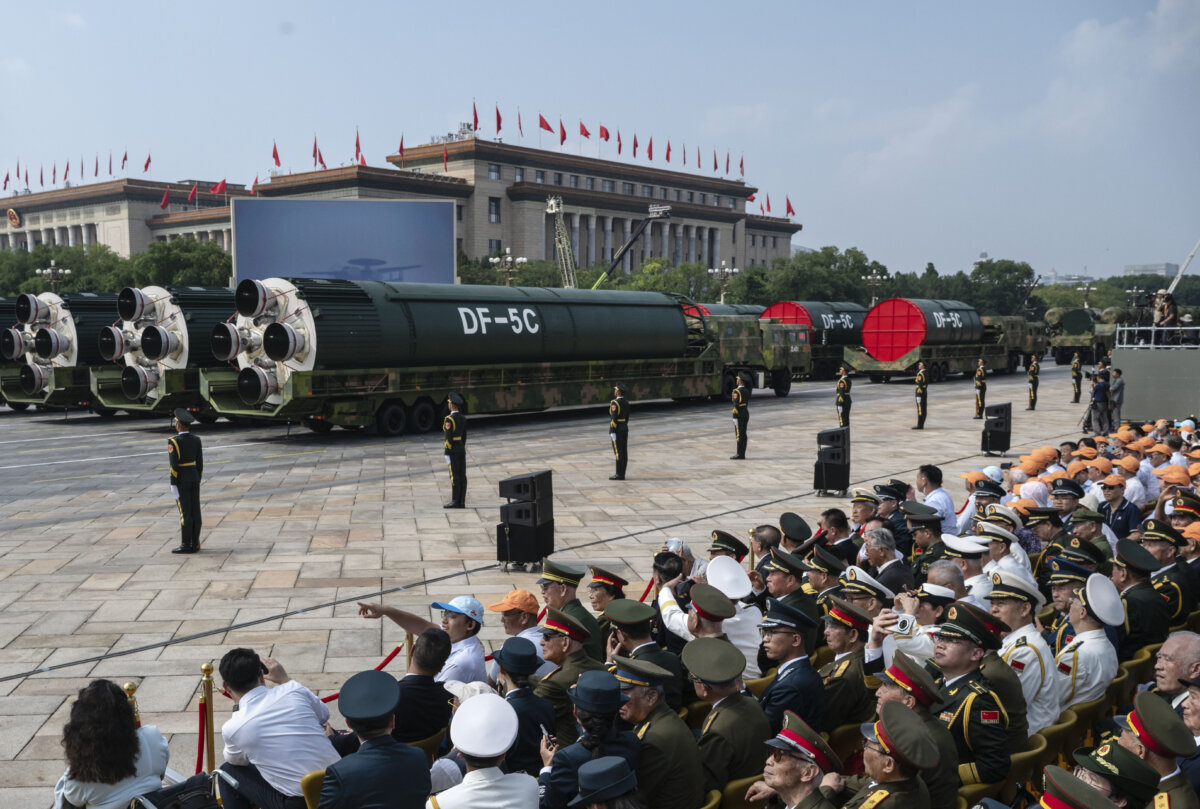
China has 96 DF-31 mobile ICBMs each with one to three RVs; 84 DF-41 ICBMs with two to 10 RVs; 40 DF-5 B/C liquid fuel silo based ICBMs with 10 RVs (DF-5C); and 320–360 silo-based DF-31/41 in three ICBM fields. China recently showcased the new DF-61 ICBM, close in size to the DF-41 and more technologically advanced. A recent DIA report stated that China would have 700 ICBMs by 2035, some 75 percent more than the United States.
China’s sea leg of their nuclear triad consists of six Type 094 Jin class SSBNs, each with 12 JL-3 SLBMs with one to three RVs for a total of between 72 and 216 SLBM warheads. Another six to eight Type 096 SSBNs are expected to be deployed by 2035, each carrying 16–20 JL-3 or new class SLBMs. Total current SLBM warhead count is 216, but the new 096 SSBN would add another 288–480 warheads.
China’s air leg of the triad consists of 90–100 H-6K bombers carrying six or seven CJ-20 cruise missiles (2000 km range) as well as 20–30 H-6N carrying one new JL-1 nuclear missile revealed in the recent military parade. China can produce 15–20 H-6 bombers/year, but H-6 production will likely be replaced by production of the H-20 stealth bomber. China’s stealth bomber is expected first flight in 2025–2026 and will have a range of 8,500 kilometers and be capable of carrying 10–16 weapons. Current total bomber weapon count is 630 warheads.
China’s current total strategic nuclear weapons count is 4,846 if fully uploaded. This is in stark contrast to the U.S. Intelligence Community statement that China only has about 600 strategic nuclear weapons. However simple math shows that if you take the current Russian and Chinese missile numbers stated by the Federation of American Scientists and the Intelligence Community and multiply by the estimated warhead carriage capability you produce far higher warhead numbers than 600.
The strategic nuclear modernization and buildup programs of China and Russia are largely completed, with Russia completing deployment of at least 46 Sarmat ICBMs with 15–20 RVs as well as the Arcturus SSBN with a 2035 IOC, and eventually the PAK-DA bomber.
China’s strategic nuclear force is forecast to continue to grow to 700 ICBMs by 2035 as well as the addition of the Type 096 SSBN, additional H-6 bombers, and a new H-20 stealth bomber.
In contrast, the United States is only modernizing its triad, not increasing its force size or capabilities, replacing aging systems on a one-for-one basis with no increase in deployed nuclear warheads—in no way can these modernization actions be viewed as “arms racing.”
The Sentinel ICBM with one warhead will replace the existing 450 MM III ICBM which are 55 years old and armed with one warhead, starting in the 2030s and completed by the 2040s. The Columbia SSBN, with 16 D-5 SLBMs (currently armed with about four RVs) will replace the OHIO SSBN with 20 D-5 SLBMs on a one-for-one basis starting in 2030–2032 and completed by 2042. D-5 SLBMs from Ohio D-5 SSBNs will go into the Columbia SSBNs. The U.S. sea leg of the triad could have 1,536 warheads if fully uploaded with eight RVs per SLBM.
The B-21 dual role conventional/nuclear bomber will enter the force in 2027 at a rate of seven to 10 per year for a total of 100 bombers. They can carry B-61 bombs or eight nuclear AGM-181 Long Range Stand-Off (LRSO) cruise missiles. They will replace the 45 B-1 conventional bomber and the 20 B-2 bombers. The 76-strong B-52 force will be modernized into the B-52J configuration with new engines and avionics and fly until about 2070, when it will be 100 years old. The B-52J will be capable of carrying up to 20 long range strike options or cruise missiles.
In summary, while China, Russia, and North Korea have been “arms racing” since the end of the Cold War, the United States has been an observer on the sidelines. The current long-delayed U.S. strategic force modernization program is replacing systems aging out on a one-for-one basis without increasing capability while Russia, China, and North Korea have not only modernized their force, they have also significantly increased their capabilities.
The United States is facing a two-peer deterrence problem—a Russia with as many as 4,786 strategic nuclear warheads and a China with potentially upward of 4,846 strategic nuclear weapons, for a combined force of 9,632 strategic nuclear warheads.
The United States will have 3,010 strategic nuclear weapons and approximately 200 theater weapons if we upload all our missiles. As stated by the U.S. Strategic Posture Commission as well as a growing number of U.S. officials, the United States will have to increase its nuclear forces—but how and how fast?
From RealClearWire
Views expressed in this article are the opinions of the author and do not necessarily reflect the views of The Epoch Times.
 Friends Read Free
Copy
Facebook
Tweet
Friends Read Free
Copy
Facebook
Tweet