

Commentary
“Adam Smith was a radical and revolutionary in his time—just as those of us who preach laissez-faire are in our time.” —Milton Friedman
Two hundred and fifty years ago on this date—March 9, 1776—a quiet and absent-minded Scottish professor released an intellectual bombshell that would become an instant bestseller. Adam Smith’s “An Inquiry into the Nature and Causes of the Wealth of Nations” appeared in two imposing volumes. It was a Declaration of Economic Independence.
Within a generation, it had reshaped the intellectual foundations of political economy. Today he is considered the father of modern economics.
But to his contemporaries, he was something more unsettling: a radical.
What was his message? He advanced the radical idea of laissez-faire economics, arguing that governments should allow individuals the freedom to decide where to live, what occupations to pursue, what prices to set, and with whom to trade, with minimum government intervention.
Was he right? Or do his critics (Marxists, Keynesians, and socialists) have the better argument, that free-market capitalism is inherently unstable, unequal, and unjust?
Smith’s central claim was disarmingly simple yet profoundly subversive. Prosperity, he argued, does not flow primarily from royal decrees, bureaucratic planning, or the accumulation of gold and silver. It emerges from the decentralized decisions of millions of individuals pursuing their own improvement within a framework of justice and robust competition.
In a world dominated by monarchy, guild privilege, trade restrictions, and state-sponsored monopolies, this was revolutionary doctrine.
Smith dared to suggest that an individual “pursuing his own interest” would “frequently promote that of society,” guided as if by an “invisible hand.” The phrase appears only once in “The Wealth of Nations,” yet it has come to symbolize the broader insight of his system: that order can emerge spontaneously from liberty. Markets coordinate human activity not through central design but through prices, competition, and voluntary exchange.
To many critics, then and now, this vision seemed naive or dangerous. Without detailed supervision, would not society descend into chaos? Had not past episodes of commercial upheaval required the firm hand of authority to restore order? In the 18th century, governments routinely intervened “in a thousand and one ways,” regulating trade, production, wages, and colonial commerce. Economic life was a matter of statecraft.
Smith performed an intellectual somersault. He argued that greater liberty, not greater control, was the more reliable engine of stability and wealth—provided that it was constrained by the rule of law.
“Every man, as long as he does not violate the laws of justice, is left perfectly free to pursue his own interest his own way,” he wrote. Freedom was not anarchy; it was disciplined by competition and legal equality.
Smith’s moral language is striking to modern ears.
He wrote that to prevent a people from making “all that they can of every part of their own produce [is] a manifest violation of the most sacred rights of mankind.” Economic liberty, in his view, was not merely efficient; it was just. Ayn Rand couldn’t have said it better.
Yet Smith was no Pollyanna. His “system of natural liberty” did not promise perfection. It would not end business frauds and deceptions, ruthless competition, materialism, and crony capitalism. After all, he warned, “People of the same trade seldom meet together, even for merriment and diversion, but the conversation ends in a conspiracy against the public, or in some contrivance to raise prices.” But in the end, under robust competition and the rule of law, the passions would be moderated under a constrained commercial society. Indeed, he said, it is the fear of losing customers “which restrains [man’s] frauds and corrects his negligence.”
His prediction was bold. Under the Smith model, nations would achieve “universal opulence which extends itself to the lowest ranks of the people.” This was no promise of riches for the elite alone. Smith foresaw rising wages, expanding opportunity, and material improvement for ordinary workers.
“Little else is required to carry a state to the highest degree of opulence from the lowest barbarism, but peace, easy taxes, and a tolerable administration of justice,” he wrote.
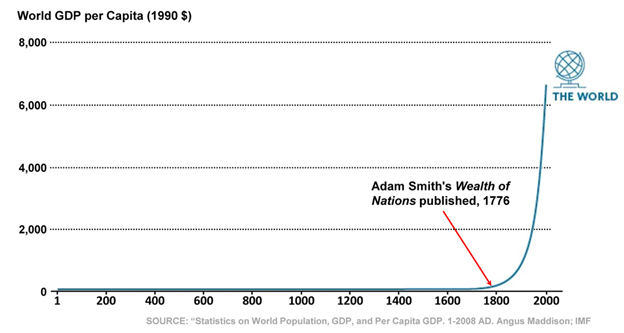
The historical record that followed is extraordinary. Within decades of the book’s publication, the Industrial Revolution transformed Britain and then much of the Western world. Over the next two centuries, global income per capita multiplied many times over. Life expectancy soared. Infant mortality collapsed. What had been the near-universal human condition—subsistence existence—began to recede.
Was this mere coincidence? Or did Smith identify the mechanism that would unlock sustained growth?
In the late 20th century, scholars sought to test this question empirically. In the mid-1980s, economists associated with the Fraser Institute, led by Michael Walker, began constructing an empirical index to measure the degree to which nations approximated Smith’s model. With input from economists, including Milton and Rose Friedman, they identified key components of economic freedom: limited government, secure property rights, sound money, freedom to trade internationally, and light regulation of credit, labor, and business. The first Economic Freedom of the World report appeared in 1996 and has been updated annually since. (The Heritage Foundation publishes a similar index.)
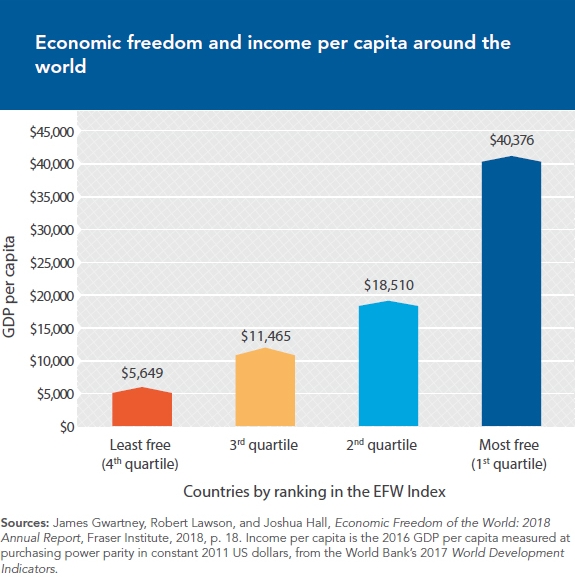
The findings are striking. Countries scoring higher on measures of economic freedom consistently exhibit higher per capita incomes (see chart above), longer life expectancies, lower extreme poverty rates, and stronger environmental performance. Although correlation does not prove causation, the pattern is robust across decades and continents. Following the fall of the Berlin Wall in 1989 and the collapse of the Soviet bloc, many nations liberalized trade, privatized state industries, stabilized currencies, and strengthened property rights. Global poverty declined at the fastest pace in recorded history.
Capitalism, whatever its flaws, proved vastly more effective at delivering abundance than central planning. The Soviet model—once hailed as the future—was largely abandoned. Markets generated the quantity, quality, and diversity of goods that planned economies chronically failed to provide.
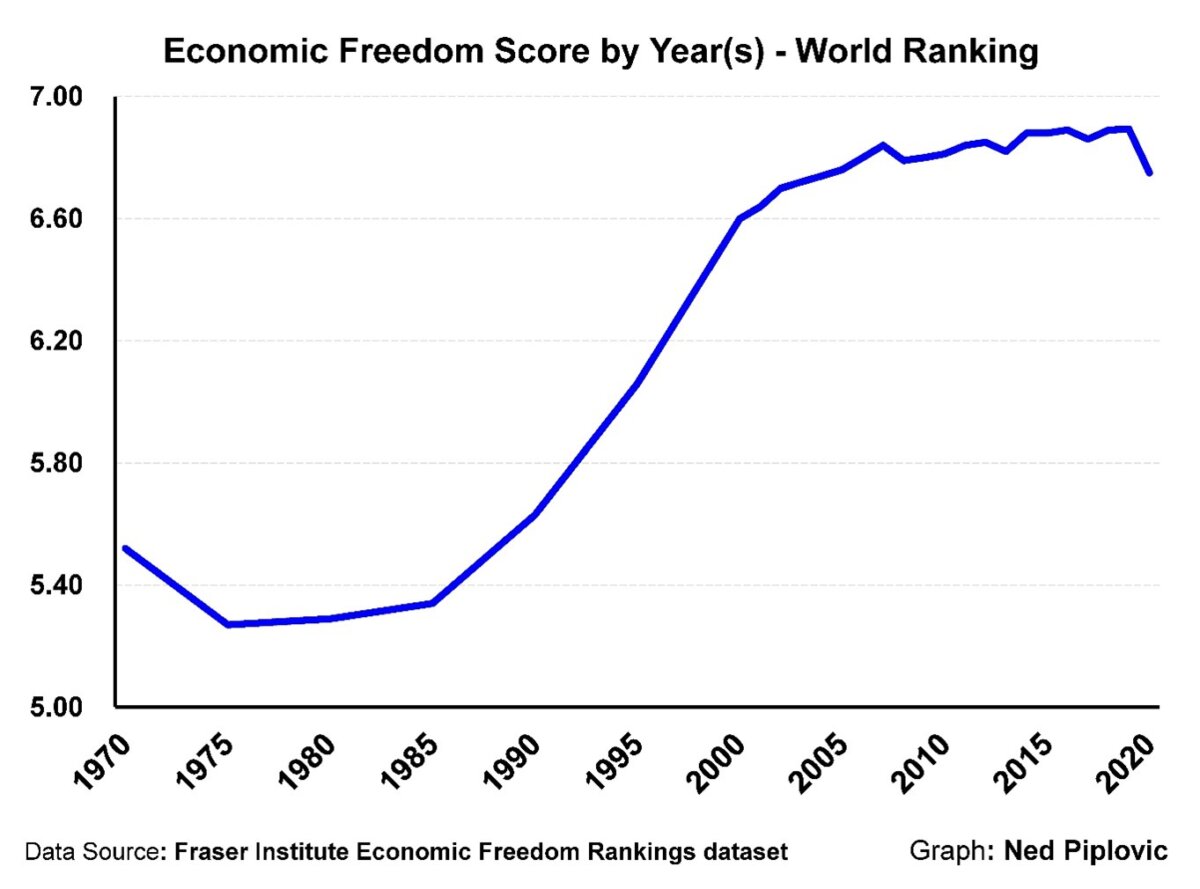
Yet the trajectory has not been uniformly upward. In the 21st century, measures of economic freedom have stagnated or declined in several advanced democracies. Expanding regulatory states, mounting public debt, trade restrictions, and renewed enthusiasm for industrial policy reflect a partial return to top-down governance. Critics of market liberalism argue that inequality, financial crises, and environmental degradation demand a more assertive state.
The debate is hardly settled. Smith himself was no ideologue. He recognized the need for public goods, infrastructure, education, and certain regulations. He warned against collusion among businessmen and acknowledged that markets could be distorted by power and privilege. What he opposed was not government per se but government that substitutes centralized direction for voluntary exchange.
Two hundred and fifty years on, the core question he posed remains urgent: Are societies more likely to flourish when individuals are trusted with economic freedom under the rule of law, or when authorities attempt to engineer outcomes from above?
Smith’s own answer was characteristically measured yet hopeful. He wrote that the “uniform, constant, and uninterrupted effort of every man to better his condition” is powerful enough to propel improvement “in spite both of the extravagance of government, and of the greatest errors of administration.”
Long live Adam Smith!
Views expressed in this article are the opinions of the author and do not necessarily reflect the views of The Epoch Times.
 Friends Read Free
Copy
Facebook
Tweet
Friends Read Free
Copy
Facebook
Tweet