Commentary
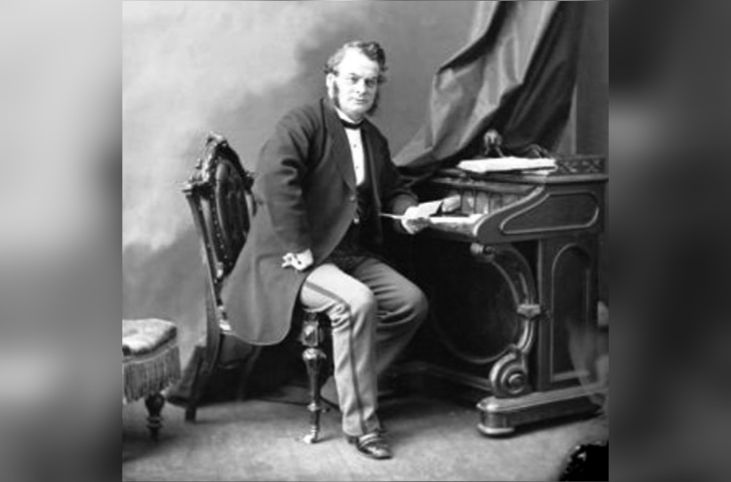
Canada’s beautiful national motto, “A Mari Usque ad Mare,” from Psalm 72:8, “He shall have dominion also from sea to sea” (Authorized Version) was adopted in 1921. But it was first identified in 1866 by Leonard “Lennie” Tilley, chief delegate from New Brunswick to the Confederation conferences, when he proposed the name of “Dominion” for the united provinces. An evangelical Anglican and a strict temperance man, Tilley was a descendant of Loyalists from New York (two Tilleys landed with the “Mayflower” Puritans in 1620), in the founding generation of the Province of New Brunswick in 1784, when it was separated from Nova Scotia.
The story goes that Tilley was at his morning prayers in the back garden of his cousin, Samuel Tilley Grove, when the “dominion” psalm caught his eye. It shows how good daily habits can pay off! The name “Dominion of Canada” was adopted, not Union, Federation, Kingdom, or Republic, and “from sea to sea,” taken later from the Latin Vulgate. After Confederation, Tilley served twice as Canada’s finance minister in two governments led by Sir John A. Macdonald, and two separate terms as lieutenant governor of New Brunswick (1873–78 and 1885–93), the only person to serve as viceroy of the same province twice.
Tilley had made a tidy fortune operating drug stores in St. John before entering politics. He married his first wife, Julia Ann Hanford, in 1843 and they had eight children. He had a career showered with honours, including Knight Grand Cross of the Order of St. Michael and St. George, and Companion of the Bath.
But early in his career Tilley made a huge gaffe. Serving as provincial secretary in Attorney-General Charles Fisher’s Liberal government, he sponsored a temperance bill to completely “prevent the importation, manufacture, or selling of liquor.” Owing to his connections and influence, it narrowly passed.
But Tilley forgot that in a parliamentary system, a law must enjoy public acceptance. Since New Brunswick was a province that had no objection to drinking, the people hated Tilley’s law. That’s because most of the 18th-century Loyalist founders had brought more with them than a preference for the Crown, entitlement to its favour, and a sense of bitter grievance with the Yankees. They were also great consumers of booze.
To the first Loyalists, “the use of liquor was considered necessary to happiness, if not to actual existence,” explained James Hannay in “The Life and Times of Sir Leonard Tilley” (1897). Without it “life would not be worth living.” In 1838 there were at least 200 taverns in Portland and St. John, and 120,000 New Brunswickers consumed 312,298 gallons of rum, gin, and whiskey, plus 64,579 gallons of brandy. Cheap Jamaica Rum was most popular, “an infallible cure for nearly every ill that flesh is heir to,” and “nothing could be done at that time without its use,” wrote Hannay.
Born in 1818 in Gagetown, Samuel Leonard Tilley was apprenticed at a drugstore in St. John at age 13 and worked his way up to management. He became a certified pharmacist at 20 and partnered with cousin Thomas Peters with a sign that proclaimed: “Cheap Drug Store!” He took up debating and joined the Portland Total Abstinence Society and the Sons of Temperance. He supported protective tariffs and, reluctantly at first, was nominated and elected for St. John County in 1855.
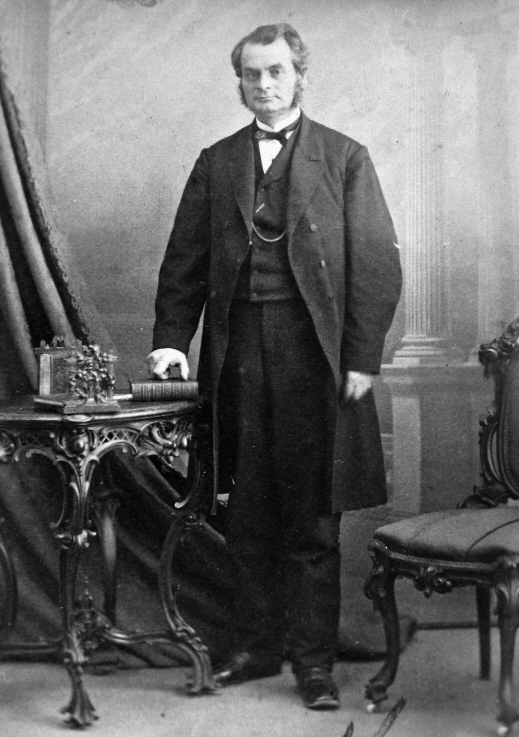
Tilley’s anti-drink bill provoked public chaos. The lieutenant governor, the Hon. John Manners-Sutton, a great cricketer and a man who enjoyed a drink, took the bold step of unilaterally dissolving the elected assembly, forcing a new election over booze. The Liberals called him “tyrant” for his clear violation of Responsible Government, and attacked the “Rummies.” Conservatives denounced the “Smashers” and cried “Support the Governor!” The Liberals were defeated in 1856 and Tilley himself lost his seat.
That taught Tilley a lesson. A year later he ran again, but without pushing prohibition too hard, and was re-elected.
Railways were the great obsession and economic necessity from 1858 to Confederation. Tilley helped found the Rail-Way League (New-Brunswick Colonial Association) and battled skeptics who mocked one proposal to build rail branches all over New Brunswick as “the Lobster Act” because they “seemed to extend … like the claws of a lobster.” They built them anyway.
Railways and Confederation went hand in hand. But yet again, Tilley and his allies suffered a setback in the 1865 election—“the most overwhelming defeat that ever overtook any political party” in provincial history. Tilley lost his seat again. Out of 41 elected members, only six supported Confederation!
Really, New Brunswickers were of two minds. But in 1866 there appeared a deus ex machina in the Fenian invasion scare. The violent brotherhood of Irish veterans of the U.S. Civil War reminded New Brunswickers where their loyalties lay. As Hannay put it: “The Fenians appeared to have been under the impression, as many residents of the United States are to this day, [that Maritimers] were anxious to come under the protection of the stars and stripes.” It was an “absurd idea” and there “never was a greater delusion.”
Defending Confederation, Tilley’s speech was the “best he ever delivered in the House.” At the next election New Brunswickers swung again, electing a pro-Union government with Tilley at its head. His first wife having died, likely of cancer, in 1862, he married Alice Starr Chipman, the daughter of close friend Zachariah Chipman, a prominent shipowner, in 1867. They had two children.
Tilley served as Canada’s finance minister in 1873. Then, when the Conservatives were defeated, he accepted the post of lieutenant governor, a deserving fulfillment of his career and his family’s heritage.
When Macdonald was re-elected in 1878, Tilley returned to the finance portfolio—a move that would be regarded as dubious today, given that the viceregal office should ideally be non-partisan. He retired in 1885 owing to poor health, and resumed the ceremonial role of lieutenant governor. In 1893 he retired to Linden Grange, the Tilleys’ summer house at St. Andrews, and died in 1896.
Biographer Hannay wrote: “The attitude of the people and Congress of the United States towards Canada has generally been one of hostility. [They] believed that by showing hostility to us with respect to the tariff and other matters, and limiting the area of our commercial relations, they could put such pressure upon Canada as would compel our people to unite with them. This scheme has failed because it was based on a misconception of the spirit of our people.”
“Lennie” Tilley, who gleaned a “dominion from sea to sea” from the scriptures, was in the forefront of the fight.
Views expressed in this article are the opinions of the author and do not necessarily reflect the views of The Epoch Times.