
Commentary
Decades have gone by since our cities, towns, and houses were lit by humane colors and technologies. It’s true that I would like to go back to lanterns fueled by whale oil. I wasn’t around for streetlamps, but I long for them. I admit it.
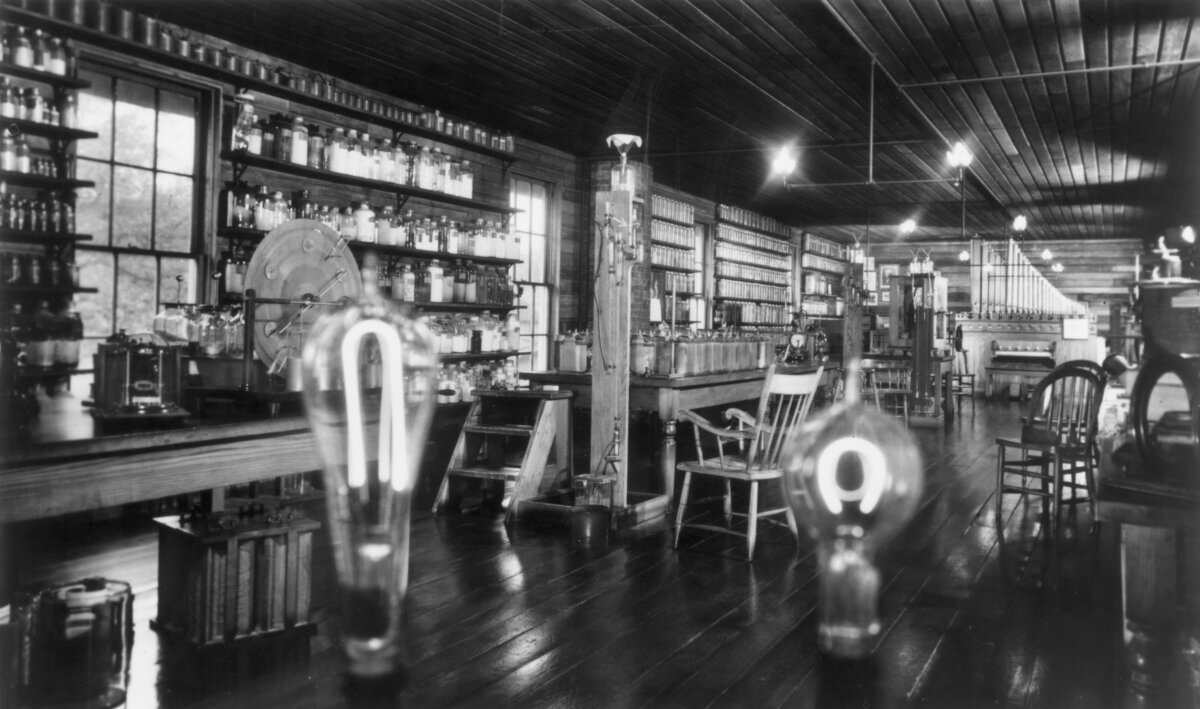
If we cannot do that, at the very least we can return to historic Edison bulbs. The 21st-century replacements just aren’t doing it.
It truly breaks my heart to drive by historic apartment units with bright white fluorescents and LED bulbs out front, in the hallways, and blinding people from the windows. This is a tragic and wholly preventable error. There is an impression that one bulb is as good as another. This is wrong.
The propaganda against incandescent bulbs started decades ago. “The science” issued a fatwa against them on grounds that they emit as much heat as light and are therefore supposedly inefficient. I recall the switch during my own lifetime when suddenly the crazy fluorescents were turning up everywhere, not just in schools and offices but also in our homes.
Does anyone remember the swirling tubular things designed to fit into traditional fixtures?
What began as a push for energy savings morphed into outright bans, driven by federal mandates under the Energy Independence and Security Act of 2007, which set escalating efficiency standards that standard incandescent bulbs simply couldn’t meet.
Phaseouts rolled out gradually: 100-watt bulbs first in 2012, then 75-watt, 60-watt, and finally most general-service incandescents by 2023 under updated Department of Energy rules. The factories shuttered, production lines for traditional bulbs were dismantled, and the familiar pear-shaped incandescents vanished from store shelves.
Even now, they are extremely hard to find for everyday use. You pretty much have to special order exempted products or hunt for “specialty” versions—such as appliance lamps, rough-service bulbs, three-way, colored, candelabra under 60 watts, or shatter-resistant types—that skirt the general-service lamp restrictions.
These exceptions allow some incandescents to persist legally, but they rarely fit standard household fixtures without adaptation. As a result, most people are stuck with LEDs or remnants of the old stock.
Whatever you can do to achieve lighting with incandescents is worth doing. There are myriad reasons. Fluorescents give off the feeling of light but not really light itself. It is a powder that glows but does not comfort in any way. Worse, they flicker at imperceptible rates (often because of magnetic ballasts), which can trigger eye strain, fatigue, headaches, and even migraines in some people.
Studies link prolonged exposure to disrupted circadian rhythms, as the high blue-light content suppresses melatonin production, making it harder to wind down at night. LEDs, although more stable and efficient, often emit spikes in blue wavelengths that mimic daylight too harshly indoors, contributing to digital eye strain, sleep issues, and a general sense of unease. Neither truly replicates the gentle, full-spectrum warmth of fire.
Once I noticed this, I could not shake my annoyance. A few years back, I was invited to a house party, and fluorescents were everywhere. The hostess was busy in the kitchen, and other guests weren’t paying much attention. I was going nuts and knew that I could not possibly stand another minute. It so happened that I had eight or so incandescent bulbs in my car. I went outside and picked them up.
Surreptitiously, I replaced all the bulbs in the living area of the house. The leftover bulbs I put in my old package and hid them until later, when I could take them back to my car before finding a nice dumpster for them.
No one noticed that I was doing this, and why would they? It’s not a normal thing to do. Within 15 or so minutes, the whole character of the room was fundamentally changed. It went from cold and clinical to warm and welcoming, with only a change in the bulbs.
The guests didn’t notice it either. But the change still affects the mood and demeanor of the room. Profoundly. We could all relax as if sitting by the fire.
That’s the key to understanding why incandescent bulbs are so appealing. They tap into a primal desire to sit by the fire together. That’s still in us, perhaps not in our conscious brain but at a level that is deeper. It brings us a sense of comfort and safety. The alternatives just don’t measure up.
Incandescent light follows the radiation curve: as the filament heats, it emits a continuous spectrum rich in red and amber wavelengths, shifting warmer when dimmed—just like a campfire or candle. This spectrum renders colors vividly, flatters skin tones, and promotes relaxation by avoiding blue-light overload.
Modern LEDs can approximate this with “warm white” options, but many lack the nuanced depth; their light feels flatter, more artificial.
To be sure, much of this is about the color temperature of bulbs. Online, the proper color is listed as amber or warm (about 2700K or lower, dipping to 2000K–2200K when dimmed). There are plenty of LED bulbs made in that color now that mimic incandescent glow without the supposed inefficiency. Some even use filament designs for that vintage look.
Avoid stark 5000K+ “daylight” LEDs indoors; reserve those for task areas. Smart bulbs with app control can adjust color, but I remain uninterested in any technology labeled “smart.” They presume we are dumb and are all about feeding data to some machine out there in the cloud.
President Donald Trump has long railed against bad lighting and the effective ban on incandescent bulbs himself. It has been a staple of his speeches for years, from complaining that efficient bulbs make him “look orange” to vowing rollbacks of energy standards. In his first term, he eased some restrictions; more recently, executive actions and bills such as the Liberating Incandescent Technology Act have aimed to repeal the 45 lumens-per-watt backstop.
Yet despite the rhetoric, serious moves remain stalled—committees review, but factories long ago retooled for LEDs. The infrastructure for mass incandescent production is gone; even if regulations loosen, reviving it fully seems unlikely.
Still, nothing is done. That means it is up to you. Most bulbs in your house and outdoors can be changed. It’s a more wonderful shift than wallpaper or furniture, because the proper lighting can and will change the entire character of domestic life. It is not to be underestimated.
If you don’t want to live in what looks and feels like a room for surgery, you should make the change.
Start small: swap hallway and living-room fixtures first. Hunt specialty incandescents where legal. Experiment with dimmers to recreate that fireside intimacy. The payoff is immediate: warmer moods, better evenings, and a quiet rebellion against sterile modernity.
Lighting isn’t just so you can see around you. It’s atmosphere, emotion, and home. Light should serve people and humane ideals. It’s time we reclaim it.
Views expressed in this article are the opinions of the author and do not necessarily reflect the views of The Epoch Times.
 Friends Read Free
Copy
Facebook
Tweet
Friends Read Free
Copy
Facebook
Tweet