
Commentary
A revolution is underway in America’s defense industrial base. It isn’t just about integrating new technologies or making more weapons faster, and smarter, and cheaper, although that lies at the core of any successful manufacturing enterprise. It’s also about rediscovering the lessons learned during World War II and combining those proven techniques with the new approaches and technologies of today, to shore up U.S. defense and provide deterrence for the next century.
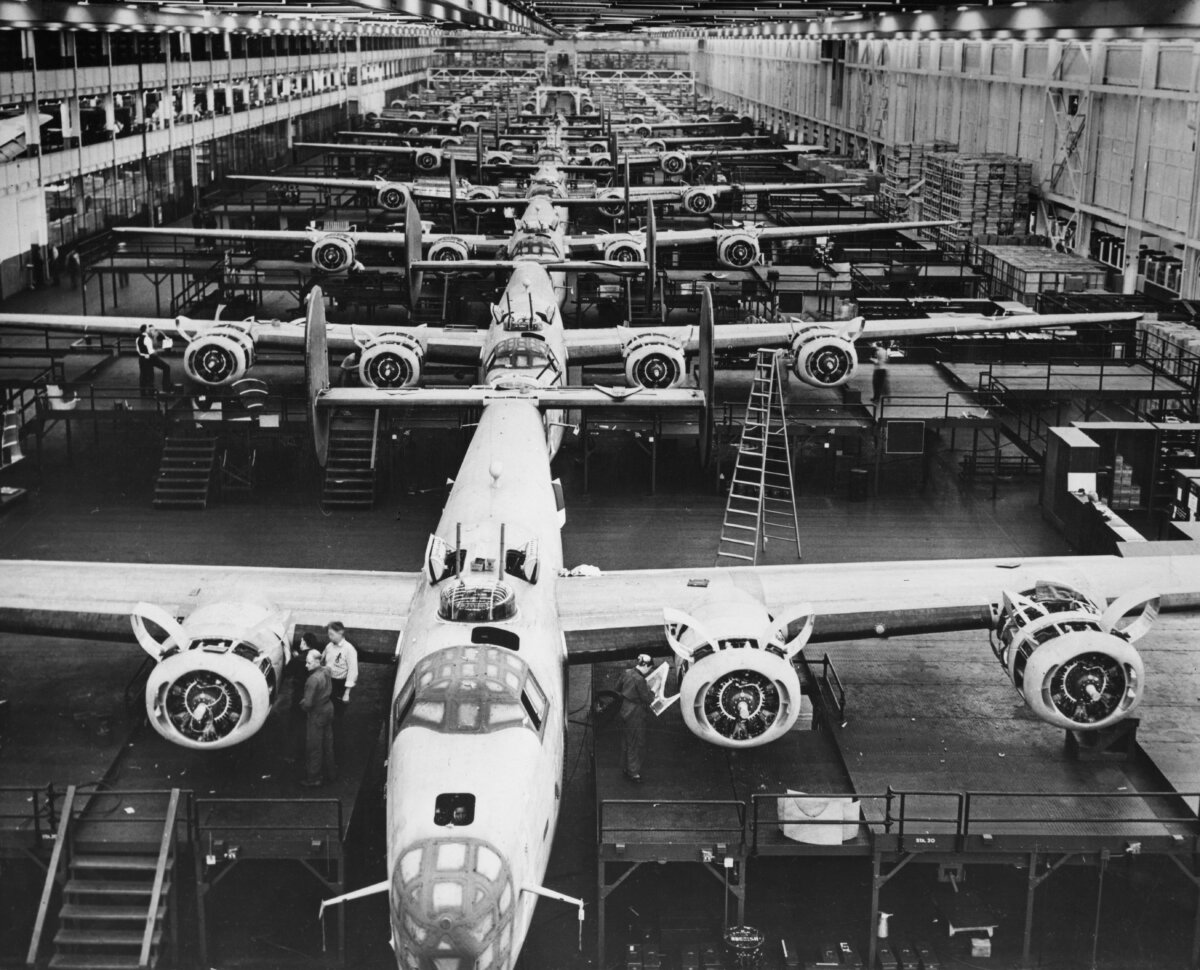
The United States prevailed during World War II through our industrial might and our adaptability in continuously meeting and mastering every new challenge over four years of global conflict. That adaptability gave America the decisive edge on the battlefield. At the time of Pearl Harbor, the U.S. Navy had a grand total of eight aircraft carriers and around 2,200 aircraft. By 1944 the country was building eight aircraft carriers a month and a new warplane every five minutes.
Until now, the key formula for combining innovation with productivity has been fostering competition between key prime contractors to produce the best at the lowest cost. During the Cold War this was a powerful incentive for getting big companies to step up with their “best shot” for a major contract, as when Chrysler and General Motors competed for the M1 battle tank in 1970, and General Dynamics went up against Boeing and Rockwell for the B-1 bomber contract that same year.
With the end of the Cold War, however, the opportunities for competition and the number of possible competitors declined and costs for programs skyrocketed. During WWII, a P-51 Mustang fighter cost an average of $613,000 in 2025 dollars while today a F-35A fighter costs $83,000,000. With numbers like that, it’s hard to imagine producing a new F-35 every five minutes but, with the advent of new engineering, production, and design techniques along with increased use of attritable systems—that are affordable enough to be lost in battle and replaced—a new set of opportunities are presenting themselves.
Rather than relying on a handful of firms competing for a small number of highly lucrative contracts, many firms today are turning to collaboration to come up with more innovative solutions to today’s threat landscape. Just as WWII brought together America’s automobile companies, both large and small, to share resources and IP voluntarily through the Automotive Council for War Production; just as a company like Bell Labs created a modular work environment for sharing ideas and insights; and Steve Jobs deliberately designed his Apple facilities to maximize random interactions between different departments. Encouraging cooperation among defense companies, both large and small, can offer similar qualitative leaps in innovation, and major quantitative leaps in scalability.
One powerful way to do this is through an industrial campus approach. Through industrial campuses, an ecosystem of innovative companies and existing producers can create the production miracle the U.S. needs. Tenants benefit from a less expensive source of capital for factories and R&D while gaining access to a growing network of nearby shared services, logistics, resources, and manufacturing-related capabilities.
By bringing together the companies and tools that make for a horizontally integrated enterprise, they can ultimately achieve the kind of scalability we usually associate with the vertical integration of large system integrators like today’s Lockheed Martin and Northrop Grumman.
The end result of this current effort is the kind of modularity and flexible supply chain management that Henry Kaiser was able to achieve in the 1940s, first in building his Liberty ships and then with his Casablanca class escort carriers for the Navy. It’s also what Andrew Jackson Higgins did with building his landing craft that Gen. Dwight D. Eisenhower credited with winning WWII.
Any new technology needs a physical place to scale from R&D to prototype; it also needs to engage with other pieces of the overall manufacturing ecosystem, in order to scale efficiently to full rate production. A horizontally integrated industrial campus can do both, at scale, quickly.
Most importantly, industrial campuses offer a resilient, flexible, and responsive network of industrial hubs that can move from observing and analyzing a real battlefield problem to designing, testing, producing, and deploying a scalable solution at the speed of innovation. Indeed, the most important lesson we can learn from WWII, and now from the war in Ukraine, is that the weapons deployed at the start of a war are rarely the ones that bring decisive victory. Those instead come together to deal with specific threats and scenarios in the evolving battle space, such as the Sherman tank and Casablanca class aircraft carrier in WWII and the fleets of drones currently combing the skies over Ukraine.
The same will be true for winning the manufacturing race for hypersonics and the Golden Dome, and confronting America’s biggest threat, namely China. Just as turning to cooperation versus competition can make us rethink how to revive our defense industrial base, so the industrial campus can turn cooperation into a powerful tool for manufacturing victory, one system at a time.
From RealClearWire
Views expressed in this article are the opinions of the author and do not necessarily reflect the views of The Epoch Times.
 Friends Read Free
Copy
Facebook
Tweet
Friends Read Free
Copy
Facebook
Tweet