
Commentary
As May ended, delegates from 47 countries gathered in Singapore for the 22nd annual Shangri-La Dialogue. Named for the hotel where it is held and sponsored by London’s prestigious International Institute for Strategic Studies, attendees included prime ministers, defense ministers, and policymakers. Indo-Pacific security was its primary focus.
This year’s gathering was conspicuous not only for those who attended but also for those who did not: China had previously announced that, for the first time in five years, its defense minister, currently Adm. Dong Jun, would not be present. Whether this was because he was, as rumored but officially denied, under investigation for unspecified transgressions or because Chinese leader Xi Jinping had decided to indicate his dissatisfaction with the organization, China would be represented by a delegation from the country’s National Defense University.
It was clear that this snub was not due to a lack of interest. Premier Li Qiang had visited Indonesia en route to Malaysia for the first-ever meeting of the 10-member Association of Southeast Asian Nations (ASEAN) and the six-member Gulf Cooperation Council to coordinate trade policies. A few days earlier, Chinese Foreign Minister Wang Yi had hosted the foreign ministers of 11 Pacific Island states, promising donations to help combat climate change and offering to facilitate negotiations for bilateral trade deals under which the participants could export more to China.
On the first day of the Shangri-La Dialogue, French President Emmanuel Macron began the proceedings with a polished keynote address, chiding Beijing for the disconnect between its opposition to NATO expanding to Asia and its acceptance of North Korean participation in Russia’s war against Ukraine.
France, he reminded delegates, is both a European state and an Indo-Pacific state by virtue of its overseas territories in the area. The time for the Non-Aligned Movement, begun at the Bandung Conference in the mid-1950s, has passed, he said. It is time for a U.S.–Indo-Pacific coalition for peace and prosperity in the region, with China being welcome to join.
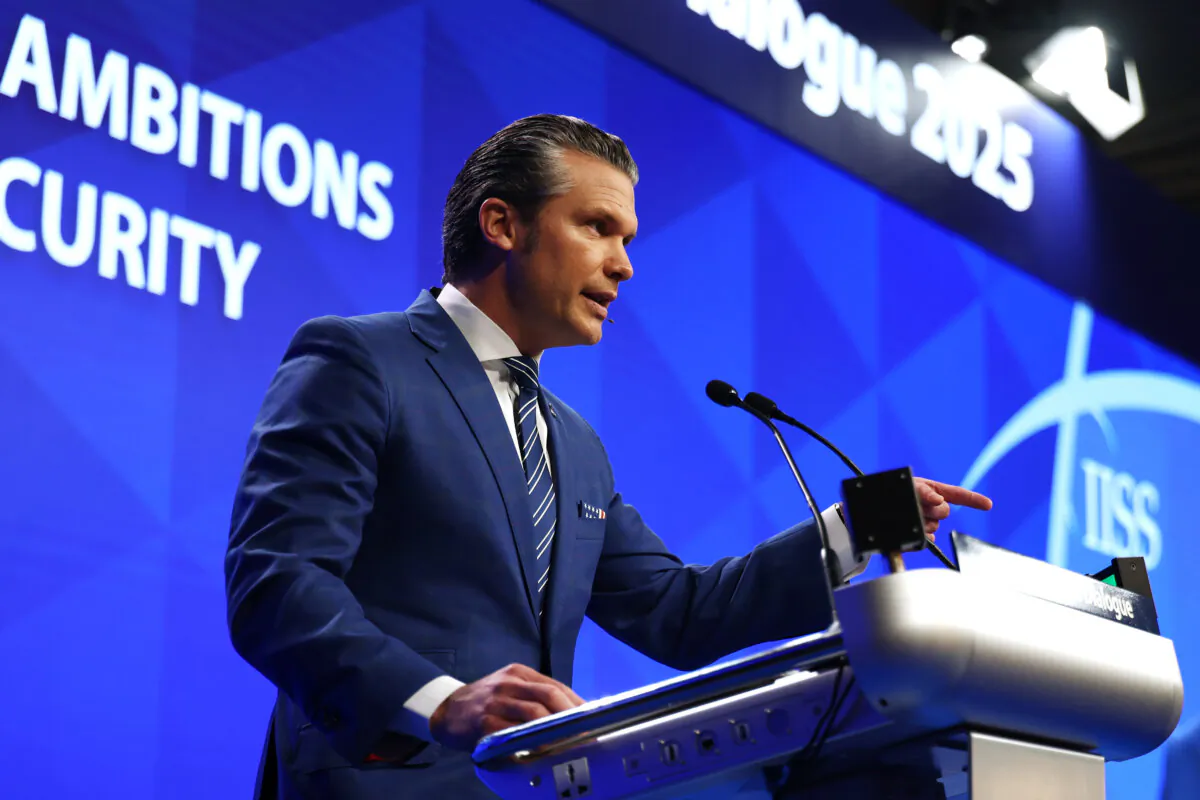
The next day, all eyes were on the address by U.S. Defense Secretary Pete Hegseth. He did not disappoint, saying unequivocally that there is “no reason to sugarcoat” the fact that “the threat China poses is real and … could be imminent.” The United States has been an Indo-Pacific state since early in its existence and will continue to be an active player, he said.
“We are here … and somebody else isn’t,” he said.
U.S. President Donald Trump, Hegseth continued, seeks peace, which means peace through strength. The warrior ethos is back: Defense is to be color-blind, gender-neutral, and merit-based. There will be a 13 percent increase in U.S. defense spending for new submarines, hypersonic weapons, the Golden Dome to defend against incoming missiles, deployment of the sixth-generation F-47 fighter jet, and more investment in U.S. shipyards. A strong military is the best deterrent against aggression. Any attempt to take Taiwan by force would “result in devastating consequences for the Indo-Pacific and the world,” the defense secretary said.
Putting the United States first, Hegseth stressed, does not mean the United States alone. U.S. allies and partners are expected to contribute: This may be tough love but it is love nonetheless. Progress has been made, Hegseth noted, citing sundry military cooperation agreements with states in the area.
Member of the National Defense University delegation Zhang Qi immediately riposted that the multilateral alliances and frameworks in this region, such as the Quad (the United States, Japan, Australia, and India) and AUKUS (the United States, the UK, and Australia), did not include ASEAN countries. Hence, did the United States truly support ASEAN’s centrality? Zhang conveniently ignored the military exercises that the United States, Australia, and Japan have performed with several ASEAN countries; the transfer of defense-related equipment; and cooperation in other fields, such as professional training programs.
The Chinese Foreign Ministry issued “stern” comments against Hegseth’s “negative” remarks on the South China Sea, according to Chinese state media outlet Global Times.
“There has never been a problem with freedom of navigation or overflight in the South China Sea,” the ministry stated.
This was belied by the conference address from Philippine Defense Secretary Gilberto Teodoro, who charged that the Chinese regime has been inconsistent in word and deed in its conduct in the South China Sea.
A special address by Prime Minister Dato’ Seri Anwar Ibrahim of Malaysia was heavy on uncontested truisms such as respect for sovereignty, the importance of consensus, and the need for continued dialogue. Less characterized by content than by bon mots—such as “habits of the heart” could lead to “habits of cooperation,” “trade is not a soft power indulgence,” and “strategic fatigue [must not] dull our moral clarity”—he advocated “active nonalignment” and the importance of a code of conduct for settling disputes.
Unmentioned was the fact that the code of conduct has been under negotiation since 2002, when a more loosely constructed Declaration on the Conduct of Parties in the South China Sea was signed. China seeks a flexible, nonbinding code, while ASEAN wants a legally binding code, but there has been no resolution. With all ASEAN countries dependent on trade with China to varying degrees, it is difficult for the group to reach a consensus on most matters.
Notably, ASEAN did not issue any official statement on the 2016 ruling of the Permanent Court of Arbitration that rejected Beijing’s expansive nine-dash line claim on the South China Sea. With Beijing insistent on its position and disagreement within ASEAN, even on matters of international law, it is highly unlikely that a satisfactory code of conduct can be agreed upon. Beijing continues to consolidate its claims in the area. Not surprisingly, the Malaysian prime minister ducked a question from a Philippine delegate on China’s opposition to Malaysia developing the Luconia Shoals, which are incontestably within Malaysia’s exclusive economic zone but inside the nine-dash line.
Given this situation, it is unlikely that ASEAN, with the possible exception of the Philippines and Vietnam, will heed Hegseth’s call to work with the United States to deter Chinese aggression or participate in the kind of coalitions advocated by Macron. How the U.S. government will respond remains to be seen.
Views expressed in this article are the opinions of the author and do not necessarily reflect the views of The Epoch Times.
 Friends Read Free
Copy
Facebook
Tweet
Friends Read Free
Copy
Facebook
Tweet