
Commentary
With Chinese leader Xi Jinping directing the Chinese military to be ready to invade Taiwan by 2027, a potential invasion of Taiwan is on the minds of many world leaders.
And with China’s 1.4 billion people greatly eclipsing Taiwan’s 23 million—and the Chinese regime’s 2 million active-duty military personnel and $290 billion annual defense budget dwarfing Taiwan’s 169,000 active-duty troops and $19 billion annual defense budget—many presume that China would steamroll Taiwan.
Yet the analysis laid out in the Stimson Center’s 36-page August report titled “Rethinking the Threat: Why China is Unlikely to Invade Taiwan” makes a strong case that such an invasion is unlikely. At a high level, the four major factors analyzed in the report are the risks of escalation, the negative domestic political repercussions, the economic fallout, and the operational challenges. Any one of these meta-factors is enough to give Xi pause, but for now, we will focus on why the invasion would be an operational nightmare.
“A military campaign to conquer Taiwan would be the largest, most complex military operation in history,” the Stimson Center report reads. “Modern military capabilities would make such an operation more complex than the 1944 D-Day landings.”
First, the Taiwan Strait’s formidable 100-mile-wide waters thwart easy crossings, and Taiwan’s jagged coastline repels landings. Regarding water barriers, the Russia–Ukraine war confirms what all of recorded history has shown us: that even relatively narrow barriers, such as rivers, pose major obstacles to offensive operations. A 100-mile strait poses even more of an obstacle.
However, even with all of Taiwan’s natural defensive advantages, China still has a huge advantage in population, military industrial capacity, airpower, and naval power. And it seems likely that Taiwan’s navy and air force, at best, will only be able to play a limited role in its defense.
A 2016 Rand study concluded that even Taiwanese jet fighters protected by bunkers against a missile attack would be of little value if China were to destroy their runways, and that Taiwan would be better off investing in mobile, easily concealable air defense. These mobile air defense units should not be used in a futile attempt to shoot down the overwhelming number of Chinese missiles, but instead should be reserved as a threat to Chinese manned aircraft.
A January 2023 Center for Strategic and International Studies paper documenting multiple simulations of a Chinese invasion states that the sheer volume of Chinese missiles makes Taiwan’s air and naval forces almost irrelevant.
“However, the same is not true of Taiwan’s ground forces, which become critical to the outcome of the operation,” the paper states.
But I would argue that, given how hard submarines are to deal with for any navy, a successful deployment of Taiwan’s three diesel-electric attack submarines would be far from irrelevant and a real thorn in China’s side. If the United States were to add its own submarines to the mix, the invasion’s chances of success would plummet, but the U.S. willingness to get into a full-blown war with China is not certain, so it will not be assumed in this analysis.
However, even if Taiwan’s air force and navy will not be able to play a significant role, the Taiwan Strait, its highly defensible territory, its democracy-loving people, and its ability to mass-produce drones make Taiwan a very hard nut to crack.
In crossing the Taiwan Strait, invasion boats, ships, and landing craft would have to run a gauntlet of anti-ship missiles, air-borne drones, surface drones, underwater drones, sea mines, submarines, and any number of other weapons tactics designed to turn the Taiwan Strait into a “boiling moat” filled with metaphorical, hungry, jaw-snapping crocodiles.
But getting across the strait would be only the beginning of China’s challenges. The hundreds of thousands of Taiwanese soldiers that will be defending Taiwanese territory at any given time will be defending territory that is a defensive commander’s dream and an invader’s nightmare.
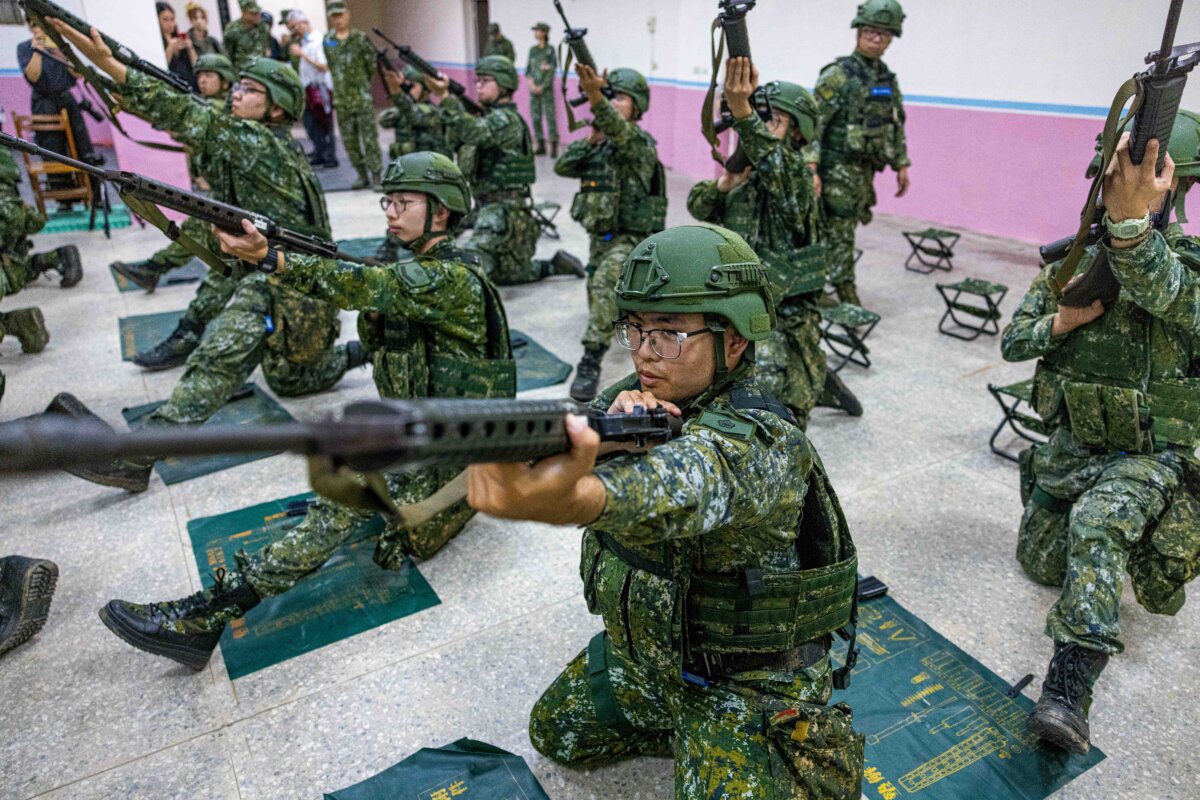
Taiwan’s mountainous terrain, covering more than 70 percent of the island, and its extensive bunker and tunnel networks create formidable obstacles for a rapid Chinese invasion. Rugged peaks, dense forests, and urban chokepoints will enable Taiwan’s 169,000 active-duty forces and 760,000 trained reservists to delay or even push back People’s Liberation Army units.
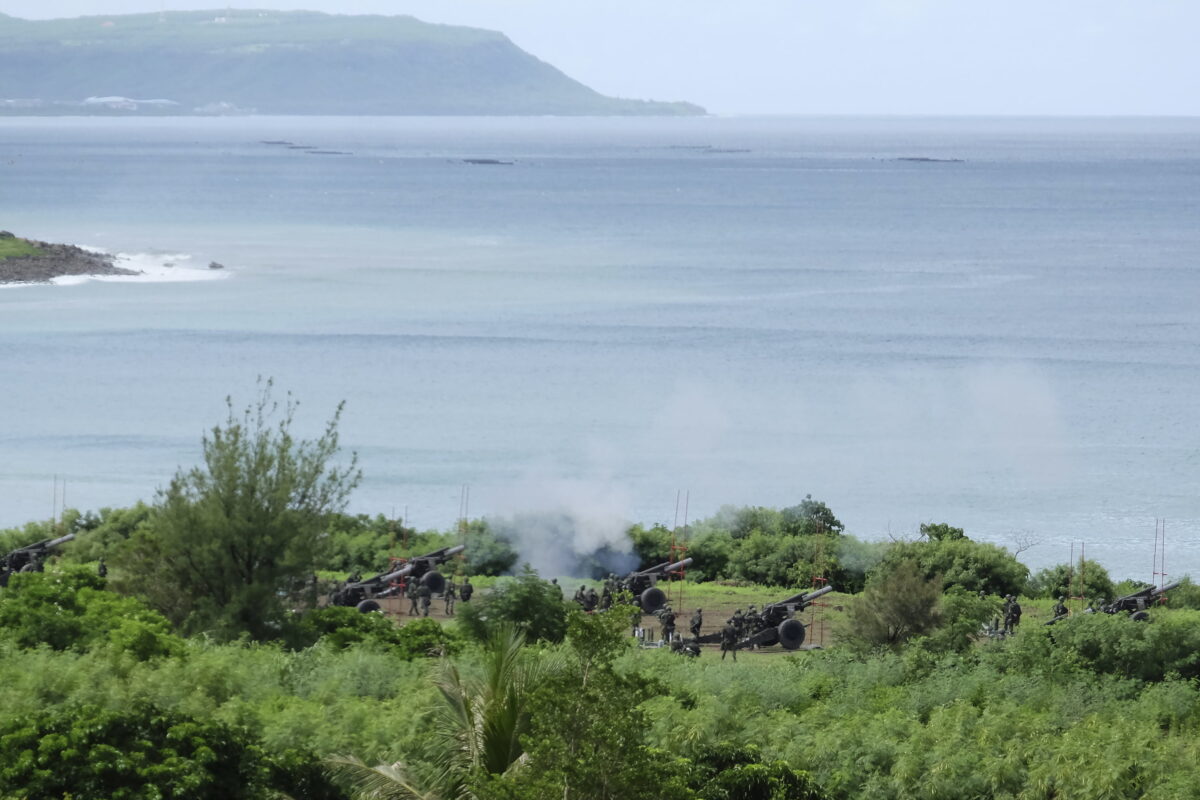
Even maintaining beachheads will be an ongoing struggle for China. Another, perhaps insurmountable, struggle would be keeping enough boats and ships alive to ferry the millions of tons of supplies and equipment necessary to support the hundreds of thousands or even millions of troops involved.
Recent experiences in the Ukraine–Russia war, combined with the fact that Taiwan’s natural defenses are vastly superior to any on the Ukrainian battlefield, suggest that China could suffer hundreds of thousands of casualties, perhaps even many hundreds of thousands, in trying to overcome a determined defense by a mobilized Taiwanese people.
Taiwan also maintains a total reserve force of approximately 1.66 million, although not all would be activated at once. An estimated 760,000 reservists have recent active-duty experience and could be mobilized quickly, while the remaining 900,000 or so would be called up in stages as needed.
These forces, already stationed on the island, can be supplied far more easily than an invading Chinese force dependent on vulnerable maritime logistics. And while the full reserve mobilization would take time, Taiwan’s standing forces—supported by hardened infrastructure and local terrain—would bear the brunt of the initial defense.
Along with existing troops and reserves, many more thousands of Taiwanese are expected to volunteer for military service if the Chinese regime were to invade. And Taiwan has adopted a “whole-of-society defense-resilience” policy that, along with a surge in civilians taking tactical weapons training courses on their dime, prepares Taiwan to deal with wartime realities such as loss of power, communications blackouts, transportation disruptions, and large-scale cyberattacks, as well as providing another armed layer of resistance.
This mobilization process will not immediately yield crack troops, but, as the Ukraine–Russia war has demonstrated, even lightly trained forces manning heavily fortified defensive positions, supported by a determined civilian population, can mount a formidable defense. And Taiwan will be able to provide significant artillery and drone support to its troops, and even tanks, as the situation dictates.
This all adds up to Taiwan being able to leverage some of the most formidable natural defenses in the world, which, in combination with networks of tunnels and bunkers, could turn an invasion by the Chinese regime into a nightmare. Nevertheless, given China’s size and defense industrial capacity, there is little doubt that if Chinese Communist Party officials were willing to pay a considerable price, the regime could eventually take Taiwan.
But in the end, the Chinese regime could end up with very little to reward its efforts, as much of Taiwan would be devastated. There is a very good chance that Taiwanese patriots, facing imminent defeat, would conduct scorched-earth operations to destroy Taiwan’s many multibillion-dollar fabrication facilities that provide the vast majority of the world’s advanced semiconductors. In other words, when you count up the political costs, both at home and in the world, the economic costs of sanctions, massive casualties, and the prospect that much of what is most valuable in Taiwan to China could be destroyed, such an invasion seems very unlikely.
Views expressed in this article are the opinions of the author and do not necessarily reflect the views of The Epoch Times.
 Friends Read Free
Copy
Facebook
Tweet
Friends Read Free
Copy
Facebook
Tweet